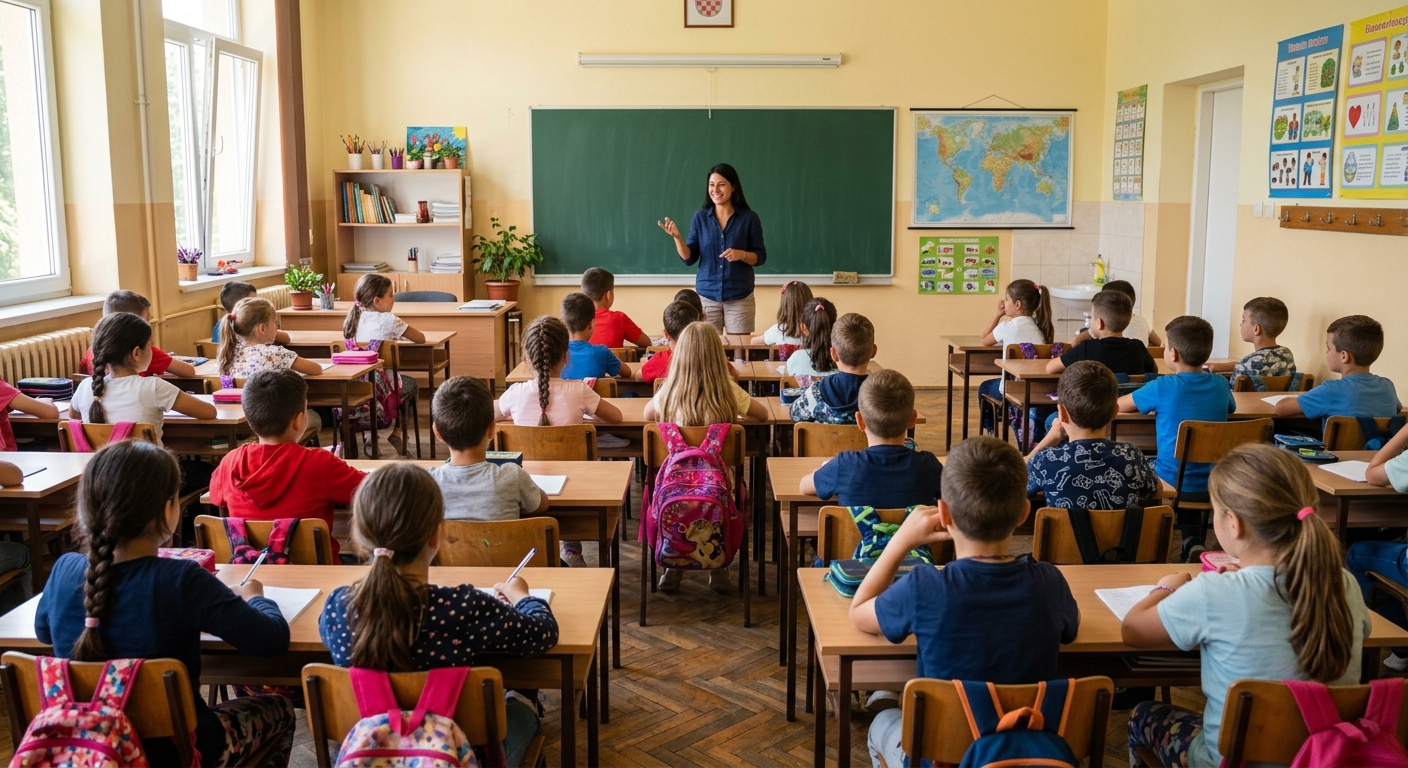
Artificial intelligence is already changing how children in Bosnia and Herzegovina learn, but schools are struggling to keep pace with the technology. AI in education in Bosnia is becoming increasingly important as students use artificial intelligence to find information, complete assignments and understand difficult subjects. At the same time, the country’s education system is facing a separate demographic challenge, with almost 8,000 fewer students over the past three school years and 45 primary schools closing. Children can now use AI to explain lessons, summarize texts, translate material and generate ideas within seconds.
In some cases, they can even use the technology to complete assignments with very little effort of their own. This means artificial intelligence is already part of everyday student life, even though many schools continue to rely on traditional teaching methods. The gap between technology and education is therefore becoming increasingly visible. Schools are now being forced to consider how learning should change in response. The central question is no longer simply whether students should use AI. Instead, schools need to teach children how to use it responsibly and effectively.
Artificial intelligence can provide quick answers, but students still need to understand how those answers are produced and whether they are reliable. Critical thinking, information checking and problem solving could therefore become more important parts of education. The goal should be to make AI a learning tool rather than a shortcut around learning. This challenge is particularly important when it comes to homework and assessment. A student can produce a polished essay or detailed answer using AI without fully understanding the subject. That makes some traditional assignments less reliable as a way of measuring knowledge. If students can outsource writing, research and problem solving to artificial intelligence, teachers may need to rethink how they evaluate academic progress.
More emphasis could be placed on discussions, practical work, presentations and demonstrating understanding. The issue is already receiving international attention. UNESCO has called for a human centered approach to generative AI in education, including clear policies, teacher training, privacy protections and age appropriate use. The organization has emphasized that education systems need to adapt as artificial intelligence becomes more widely available. For AI in education in Bosnia, these international discussions provide a framework for considering how schools can respond to the technology. Teachers are facing one of the most difficult parts of this transition. They are expected to prepare students for a future in which AI will be common in universities, workplaces and everyday life.
Yet many schools still face limited technological resources and insufficient opportunities for teacher training. Simply banning artificial intelligence is unlikely to solve the problem because students can continue using it outside school. Teaching children how to identify unreliable information, protect personal data and use AI responsibly may prove more effective. Bosnia and Herzegovina’s demographic decline adds another layer to the challenge. Fewer children entering schools are already forcing communities to reconsider school networks, staffing and available resources. At the same time, the students who remain are growing up in a technological environment very different from the one in which the current education system was designed. Schools therefore face two major transformations at once. They must adapt to both a changing population and rapidly developing technology.
Artificial intelligence is ultimately only one part of a much broader transformation in education. Schools are also responding to demographic decline, changing labor markets and new expectations among younger generations. The question is no longer whether AI will enter classrooms because students are already using it. The bigger question is whether education systems can adapt quickly enough to ensure that technology supports learning instead of replacing it. The future of AI in education in Bosnia will depend on finding that balance. Schools do not need to compete with artificial intelligence, but they need to teach skills that technology cannot easily replace. Curiosity, judgment, creativity, communication, responsibility and independent thinking will remain essential. As AI becomes increasingly common in children’s lives, helping students develop those abilities could become one of the most important tasks facing Bosnia and Herzegovina’s education system.