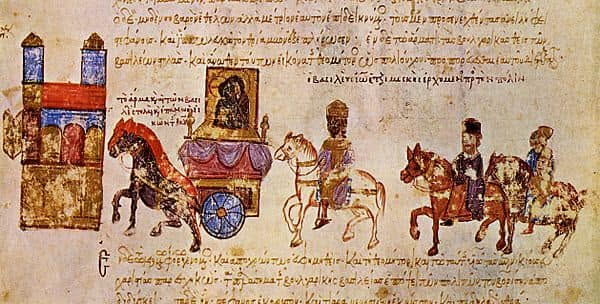
Samuel’s Empire placed Ohrid and Prespa at the center of a powerful medieval state that challenged the Byzantine Empire across much of the Balkans. Around the turn of the 11th century, the two regions became important political, military and religious centers under Samuel’s rule. His state expanded across large parts of the Balkans and became one of the major powers competing with Byzantium. Samuel emerged as the most powerful of the four sons of the local ruler Nikola and eventually became the dominant figure in the state that developed during the political upheavals of the late 10th century. Prespa served as an early center of his rule before the political and administrative center moved to Ohrid. The relocation gave Ohrid an even greater role in the state. The city developed into an important center of administration, religion and culture.
Samuel’s territory eventually extended far beyond Ohrid and Prespa. His military campaigns brought large areas of the Balkans under his authority, including territories in present day Albania, Greece, Serbia and Bulgaria. This expansion brought him into direct conflict with the Byzantine Empire. Emperor Basil II would become Samuel’s most important opponent during a prolonged period of warfare. Ohrid became particularly important during Samuel’s reign. Its fortress was expanded and strengthened, while religious and administrative construction transformed the city. Archaeological research shows that the fortress contains layers from several historical periods. Many of its medieval remains are associated with Samuel’s reign and the period that followed.
The religious importance of Ohrid also grew during this period. Its ecclesiastical institutions became an important center for Slavic Christian culture and education. The city was already connected to a strong literary tradition associated with figures such as Clement of Ohrid and Naum. That tradition helped establish Ohrid as one of the important cultural centers of the medieval Balkans. The conflict with Byzantium eventually turned against Samuel. In 1014, Byzantine forces led by Basil II defeated Samuel’s army at the Battle of Kleidion. Samuel died shortly afterward, while his successors attempted to preserve the state. Byzantine pressure continued, however, and by 1018 the state had collapsed and the territories around Ohrid and Prespa came under Byzantine rule.
The historical interpretation of Samuel’s state remains debated among historians, particularly regarding how it should be classified in modern political and ethnic narratives. The importance of Ohrid and Prespa during the period, however, is central to understanding the region’s medieval history. Their political, religious and cultural institutions continued to influence the area long after Samuel’s state disappeared.
More than a thousand years later, Samuel’s legacy remains visible across Ohrid and Prespa. The fortress above Ohrid, medieval churches and surviving cultural traditions preserve evidence of a period when the region stood at the center of a major Balkan power. The story of Samuel’s Empire also reflects the broader struggle between emerging medieval states and Byzantium that shaped the political history of southeastern Europe.