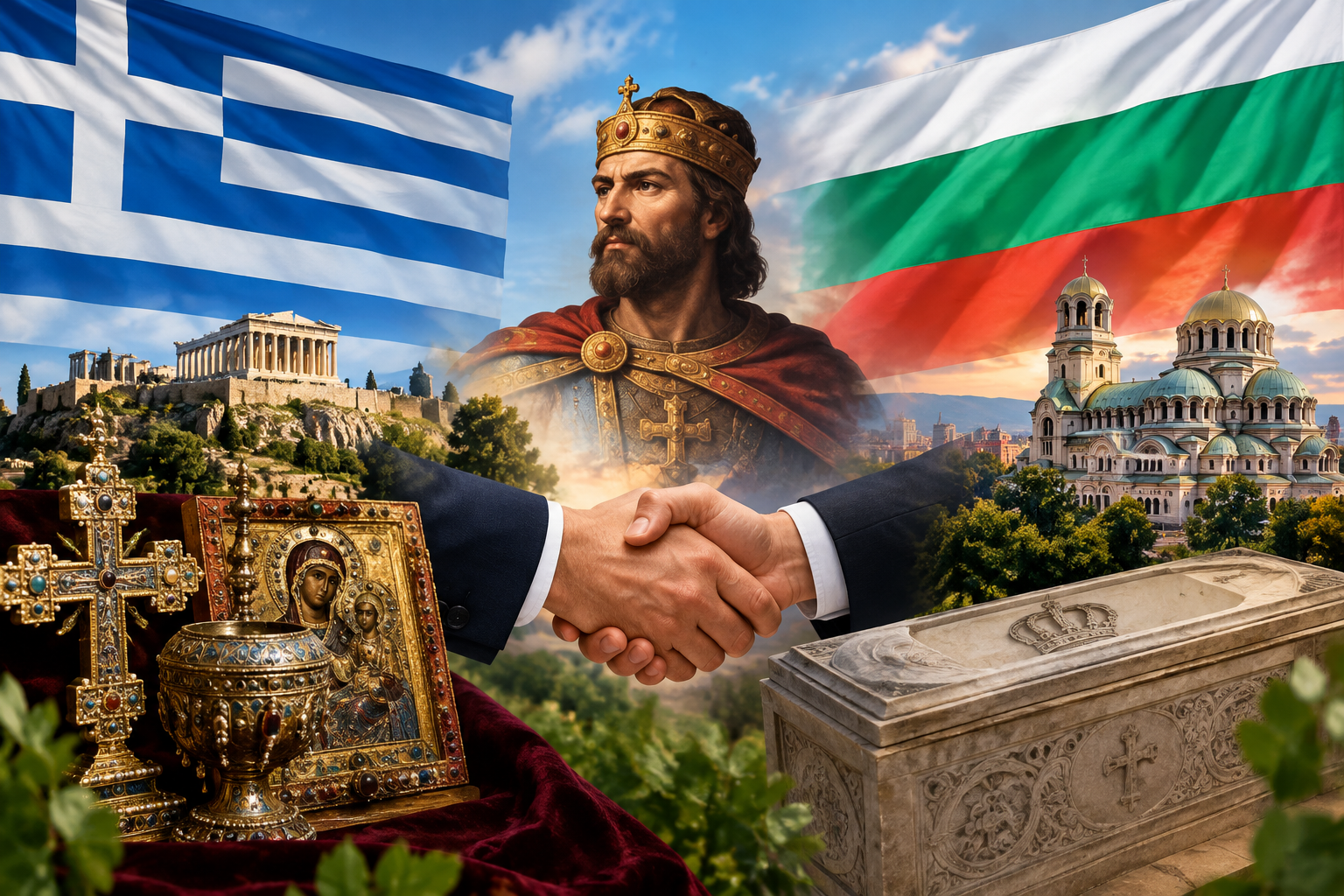
Sofia and Athens have reached a historic agreement under which the remains of Tsar Samuel of Bulgaria will be returned to Bulgaria, while Bulgaria will reciprocally transfer 48 valuable ecclesiastical artifacts to Greece.
The artifacts originate from two monasteries in northern Greece: the Monastery of Panagia Eikosifinissa in the Pangaion Mountains and the Monastery of St. John the Baptist near Serres. According to the Greek side, the items were removed from the monasteries during the first half of the 20th century, including during World War I.
The Greek state says that the objects were taken in 1913, 1917 and 1942. Some were returned after World War I, while others remained in Bulgarian museums, libraries and ecclesiastical collections. Bulgarian authorities have pointed to the historical and legal complexities surrounding the dispute, including the fact that some of the objects have been part of protected public and scholarly collections for decades.
At the center of the agreement are the remains attributed to Tsar Samuel, who ruled the Bulgarian Empire from 997 to 1014. The remains were discovered in 1965 by Greek archaeologist Professor Nikolaos Moutsopoulos during excavations at the Basilica of St. Achillius on an island in the Small Prespa Lake. They were found together with other anthropological material in four sarcophagi.
The remains have been preserved at the Museum of Byzantine Culture in Thessaloniki. Under the agreement, they will be formally handed over to Bulgaria on October 3 in Thessaloniki and transported to Sofia aboard a Bulgarian Spartan military aircraft. They will then be placed in a specially prepared sarcophagus at the historic St. Sofia Church.
Bulgarian Prime Minister Rumen Radev described the agreement as the result of decades of efforts and thanked Greek Prime Minister Kyriakos Mitsotakis for what he called the political will and vision that made the agreement possible. Radev said that the memory of Samuel should unite rather than divide the two countries.
The agreement represents a significant cultural and diplomatic development in relations between Bulgaria and Greece, combining the repatriation of historical remains with the reciprocal transfer of religious and cultural heritage.