Following the Republicans’ midterm election defeat, the president says the United States will maintain the current military status quo while keeping pressure on Tehran through a naval blockade of the Strait of Hormuz.
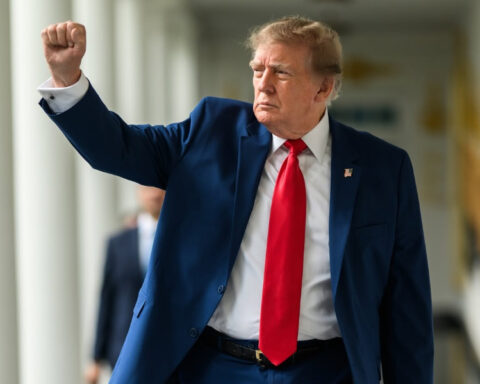
President Donald Trump has declared that the war with Iran is “effectively over,” saying the United States will hold off on further threatened military strikes while remaining prepared to resume attacks if necessary.
“Iran, militarily, is effectively over. We’re just keeping it the status quo,” Trump told reporters on Monday. “But if we do have to go back in, we are locked and loaded, and ready to go.”
Seeking to ease concerns that the Pentagon could escalate its military campaign, Trump insisted that the United States had no immediate plans to use additional force.
“The United States of America is fully locked and loaded with the best equipment ever made, and we don’t think there’s going to be any reason to use it,” he said.
Trump explained that he was holding back from further attacks at the request of countries neighboring Iran, including Qatar, Saudi Arabia, the United Arab Emirates, Bahrain and Kuwait.
However, he intends to maintain the U.S. naval blockade in the Strait of Hormuz as a way to keep economic pressure on Tehran.
Gulf leaders urge restraint as negotiations continue
Trump’s comments followed a meeting with Qatari Prime Minister Sheikh Mohammed bin Abdulrahman Al Thani, who has played a key role as an intermediary between Washington and Tehran since the United States and Israel launched the war on February 28.
The announcement marks another shift in Trump’s position. In recent months, the president has repeatedly alternated between threatening a major military escalation and suggesting that a peace agreement with Iran could be imminent.
Despite the latest statements, attacks between the two sides have continued, although at a reduced intensity.
Iranian state media reported that the United States had again struck Iran’s Qeshm Island overnight. Earlier this month, Tehran also targeted tankers in the Gulf and the Strait of Hormuz. Meanwhile, Yemen’s Houthi movement, an ally of Iran, has intensified attacks against Saudi Arabia in recent months.
Iran’s ceasefire proposal remains a major obstacle
Trump has so far refused to accept an existing Iranian proposal for a ceasefire.
Under the plan, the United States would end its blockade of Iranian ports, lift some sanctions and halt its bombing campaign. In return, Tehran would demilitarize the Strait of Hormuz, with negotiations on Iran’s nuclear program and additional sanctions to follow.
The war’s unpopularity, combined with rising gasoline prices and pressure on the broader U.S. economy, became a major factor in the Democrats’ victory in the midterm elections.
Vice President JD Vance placed much of the blame for the Republicans’ historic defeat on the conflict, acknowledging that the war had contributed to the rising cost of living for American households.
Despite what Qatari officials described as positive discussions with Trump and Vance, senior American and Gulf officials have expressed doubts that a deal is imminent.
Tehran rejects claims of progress toward a deal
The latest diplomatic developments came after Iran’s Supreme National Security Council chief, Mohsen Rezaei, accused Washington of spreading misleading information about negotiations.
“Stop manufacturing fake news about imaginary talks,” Rezaei wrote on X, adding that it was time for the United States to surrender to the seven conditions Iran has repeatedly presented.
Washington has consistently rejected Tehran’s proposal. Secretary of State Marco Rubio previously described it as “outrageous and ridiculous and really not realistic.”
Iranian Foreign Ministry spokesperson Esmaeil Baghaei defended the proposal on Monday, calling it the most reasonable offer currently available.
For now, Trump’s declaration that the war is effectively over has not translated into a formal ceasefire or a comprehensive agreement. The military standoff continues, with the Strait of Hormuz and the future of sanctions remaining central obstacles to a diplomatic resolution.