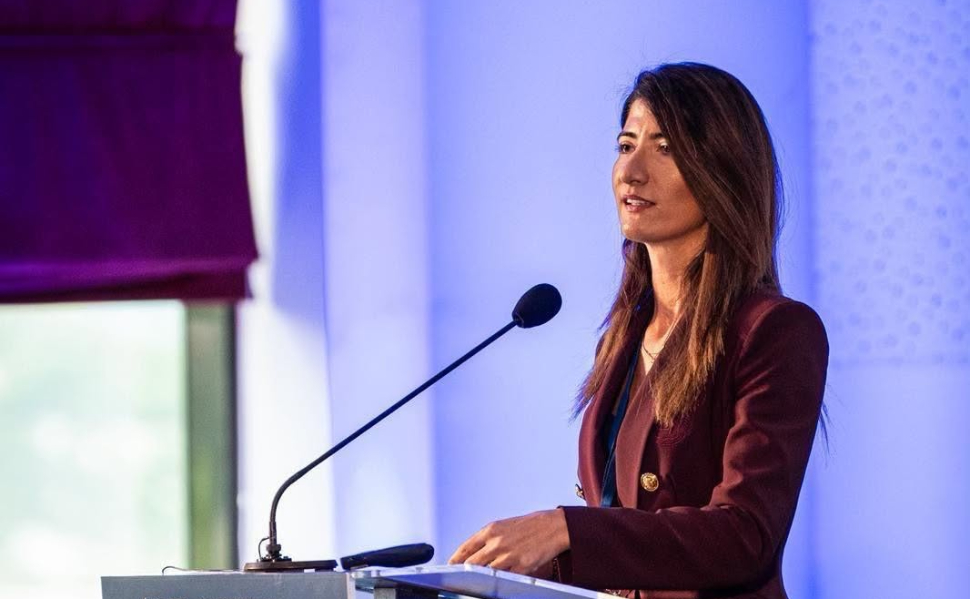
Darijana Filipović, the incoming Croat member of Bosnia and Herzegovina’s Presidency, met U.S. Chargé d’Affaires John Ginkel in Sarajevo on November 12 to discuss forming a government after the October elections and advancing the country’s bid to join the European Union.
The meeting came four days before Filipović was due to take office. According to her party, the Croatian Democratic Union of Bosnia and Herzegovina, the talks also covered cooperation with the United States on strengthening institutions, supporting reforms and carrying out economic projects. Filipović emphasized the importance of continued U.S. engagement in the country.
Filipović to Join Three-Member Presidency on November 16
Bosnia and Herzegovina’s Central Election Commission certified the results of the October 4 general election on November 3. The three members of the incoming Presidency are scheduled to take office on November 16 and serve through 2030.
Filipović, who has served in the state-level House of Representatives, will succeed Željko Komšić as the Croat member. Denis Bećirović, the Bosniak member, and Željka Cvijanović, the Serb member, each won a second consecutive four-year term.
The three-member Presidency conducts foreign policy, appoints ambassadors and represents Bosnia and Herzegovina in international organizations. The process of forming a government was a separate issue on the agenda in Sarajevo. In its account of the meeting, Filipović’s party stressed the need for political dialogue and agreement, with particular attention to the constitutional status and representation of the country’s constituent peoples.
EU Accession Still Awaits Its First Formal Conference
EU leaders agreed in March 2024 to open accession negotiations with Bosnia and Herzegovina. After the October elections, EU foreign policy chief Kaja Kallas and Enlargement Commissioner Marta Kos urged the country to complete the steps needed for member states to adopt a negotiating framework and convene the first formal accession conference.
The framework would set out how the negotiations will proceed. The conference would bring EU and Bosnian representatives together to begin that stage of the process. Both steps depend on reforms that the EU has asked Bosnia and Herzegovina to carry out.
In Sarajevo, Filipović and Ginkel discussed reforms that her party said could help public institutions function better and create better conditions for investment. The party’s account also referred to closer Euro-Atlantic integration, placing the discussion in the context of Bosnia and Herzegovina’s ties with both the EU and NATO.
The account listed broad areas for continued U.S. cooperation. The next scheduled event in the transition is Monday’s inaugural session, when Filipović will take her seat alongside Bećirović and Cvijanović.