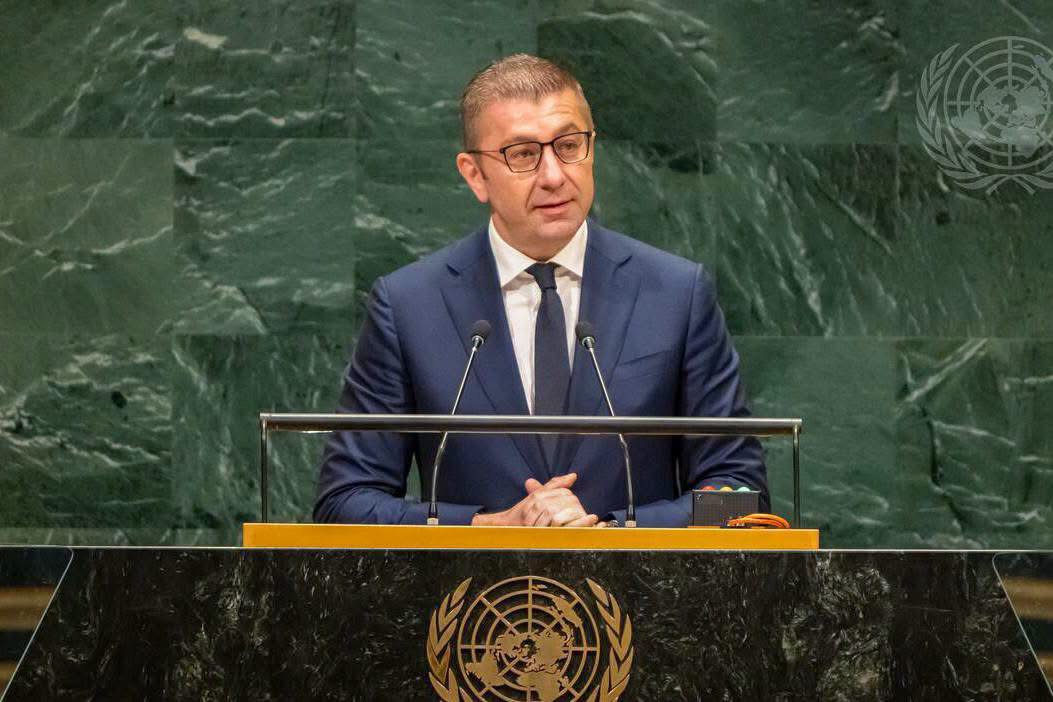
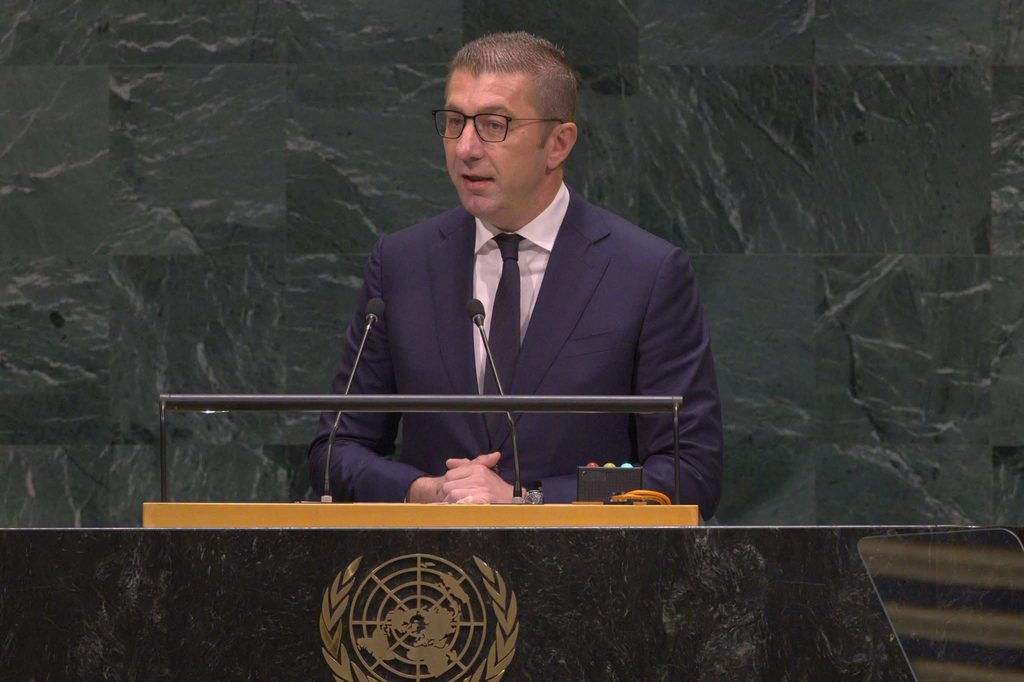
Macedonian Prime Minister Hristijan Mickoski said in his address to the United Nations General Assembly in New York that Macedonia’s European integration process has gone beyond any reasonable timeframe, calling on the European Union to provide predictability and respect the rules it has established.
“Our history has taught us that international compromises are extremely difficult and that peace, stability and integration require political courage and major sacrifices. And without intending to sound instructive, if someone wants to see an example of a country that has repeatedly given up something that naturally belongs to it as a basic right—something many people take for granted—it is enough to look at the recent history of my country,” Mickoski said.
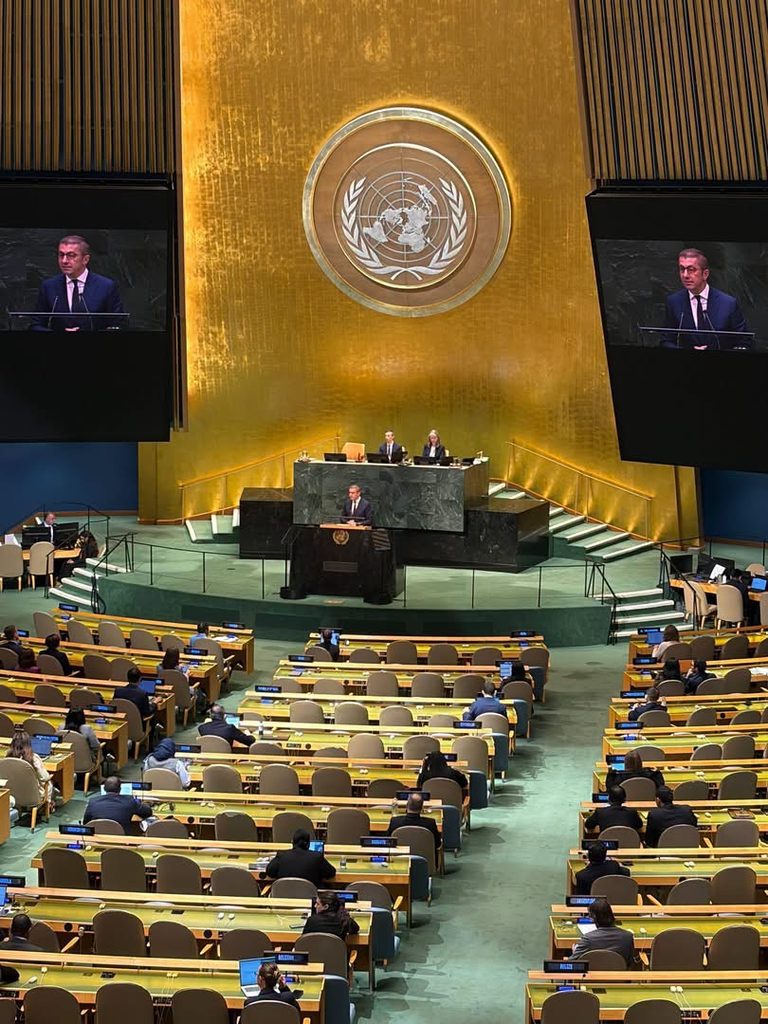
He described the country’s recent history as one marked by challenges, regional security risks, and repeated compromises and concessions made in the name of peace, cooperation and broader integration goals, often at what he described as a cost to the country’s basic sense of dignity and justice.
“We have made truly difficult decisions. We moved forward even when processes lasted longer than one generation of citizens could reasonably expect. But precisely because of this, looking at those decisions with the benefit of time and a clear awareness of reality, today I can responsibly say that trust cannot indefinitely be a one-sided obligation,” Mickoski said.
He called on the European Union to follow the same rules it expects smaller candidate countries to respect.
“If small states are expected to respect the rules, then the rules must also provide them with predictability. If candidates for membership in an organization are required to meet certain criteria, then meeting those criteria must lead to progress. If we ask citizens to trust institutions, then institutions must demonstrate that their word has value and that commitments undertaken endure,” Mickoski said from the UN podium.
“The rule that applies today cannot be different tomorrow simply because the balance of power has changed. And a commitment that has been undertaken cannot be a temporary political convenience. It must be the foundation on which people can plan their future,” he added.
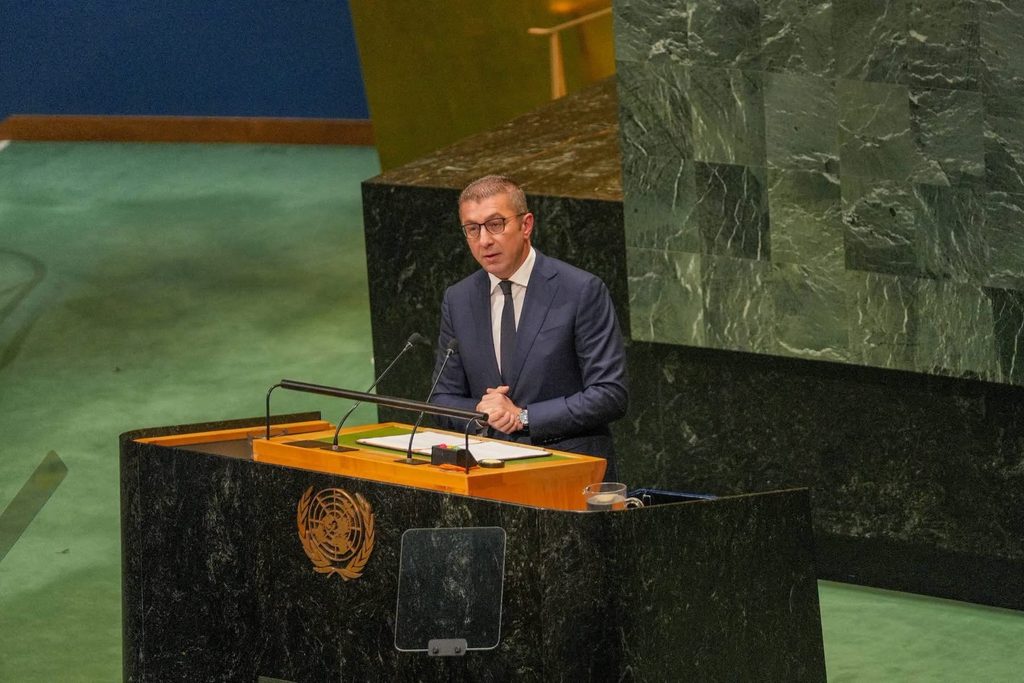
Mickoski also said citizens must see that rules are applied consistently and that compromises do not simply result in new demands for further concessions.
“We ask our citizens to believe in cooperation, good-neighborly relations, compromise and mutual respect. We tell them that lasting peace is worth more than a short-term political victory; that respecting agreements is a sign of strength and wisdom, not weakness; and that European and Euro-Atlantic integration means accepting rules that apply equally to everyone,” Mickoski said.
“But that argument becomes much harder to defend when citizens see that, in international relations, the principle sometimes gives way to power; that criteria can change while a process is already underway; or that some are expected to demonstrate consistency that others do not always demand of themselves.”
“We cannot tell people, ‘Trust the rules,’ when they see that the rules do not apply equally. We cannot convince them that compromise is a virtue if every compromise brings a new demand. And we cannot expect trust in international institutions if citizens begin to believe that their fate is more often determined by the political weight of their country than by the strength of a commonly accepted principle,” Mickoski said.
According to Mickoski, the credibility of the European Union depends on its ability to adhere to the rules governing its own processes.
“The European Union remains our natural political, economic and institutional home. And we have work to do at home as well. We must strengthen the rule of law, build more efficient institutions, create a more competitive economy and strengthen citizens’ trust in their own state. That is our responsibility, and we will not shift it to Brussels,” Mickoski said.
“At the same time, we expect European integration to remain a merit-based process grounded in measurable criteria—not a process in which bilateral issues can continually move the goalposts. We are not asking for an easier path. We are asking for a path governed by rules. We are not asking for lower standards. We are asking for standards to remain standards.”
Mickoski said this was also important for Europe’s credibility at a time when its geopolitical influence increasingly depends on its ability to turn its commitments into concrete political results and uphold the values it advocates.
The prime minister added that if the Macedonian authorities are to ask citizens to believe in compromises, those compromises must be backed by fulfilled commitments.
Speaking about the country’s strategic orientation, Mickoski said there was no ambiguity about where the country belongs.
“Macedonian citizens know where they belong. We are a NATO ally. The United States is our strategic partner. Full membership in the European Union is our strategic goal. These are not three separate policies. They are one geopolitical orientation, founded on democracy, collective security, the rule of law and an open economy,” Mickoski said.
“In a time of uncertainty, our response is not strategic ambiguity. Our response is clarity,” he added in his address to the 81st session of the UN General Assembly.
Mickoski said that clarity about the country’s alliances does not mean turning its back on the rest of the world.
“On the contrary. A state that is confident in its democratic and strategic choices can engage and cooperate with greater confidence with countries that have different histories, different interests and different political views. The world does not need another division into permanent camps. It needs competition with boundaries and rules that everyone must respect. Alliances that take responsibility. And international institutions that remain a space for dialogue precisely when dialogue is most difficult,” Mickoski said.
Toward the conclusion of his address, Mickoski turned to questions of identity and history.
“Your Excellencies, we are a small country. But we refuse to allow the size of our territory to determine the scale of our ambition. Our ambition is to become a serious state. A state that its allies can trust. A state in which young people can plan their future. A state that respects the diversity and multicultural character of its society. A state confident enough to defend its own identity without denying the identity of others. A state that knows its history but is not trapped in it. And a state that does not expect others to build it on its behalf,” Mickoski said.
“For me, that is modern sovereignty. Not isolation. Capability,” he added.
Mickoski also quoted UN Secretary-General António Guterres, who has emphasized the importance of peoples regardless of the size of their countries.
“This year, Secretary-General António Guterres reminded us that the Charter begins with the words: ‘We, the peoples.’ And he added: ‘Not we, the powerful. Not we, the winners.’ In those few words lies the reason why a small European country continues to believe in this Organization, even when it is disappointed by it,” Mickoski said.
“Because the alternative to a world governed by rules is not a world in which everyone is free. It is a world in which the strongest are the freest, while everyone else depends on their goodwill. Such a world may appear efficient for a moment. But it is never stable,” he said.
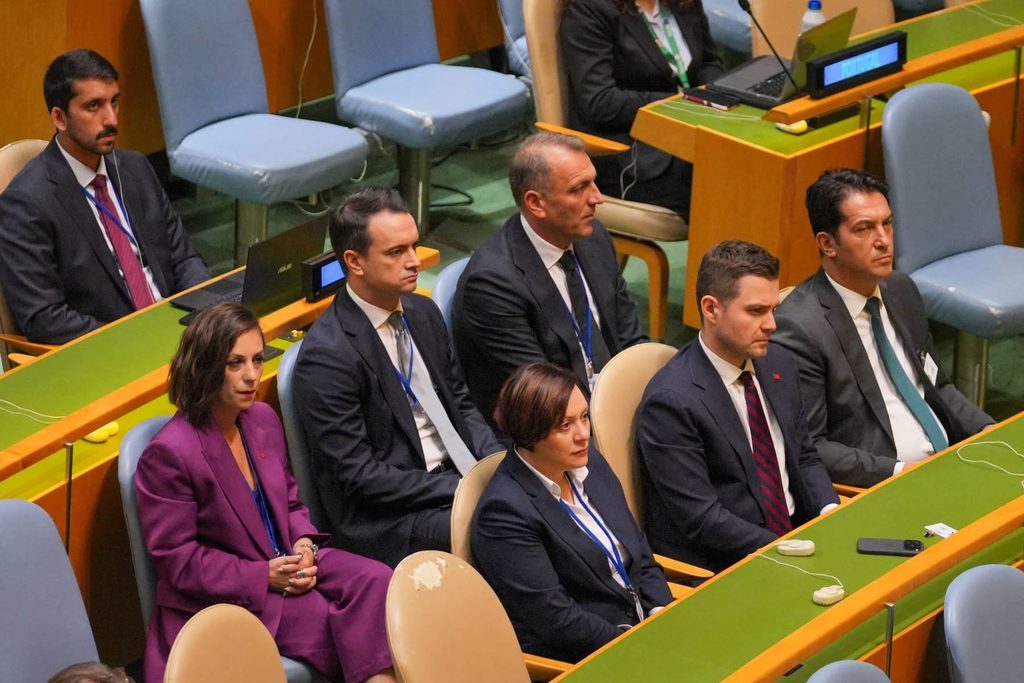
His address was followed by three ministers: Bekim Sali, in charge of European affairs; Timcho Mucunski, Minister of Foreign Affairs; and Gordana Dimitrieska-Kochoska, Minister of Finance.
photo credit: Facebook page of the primer minister Hristijan Mickoski