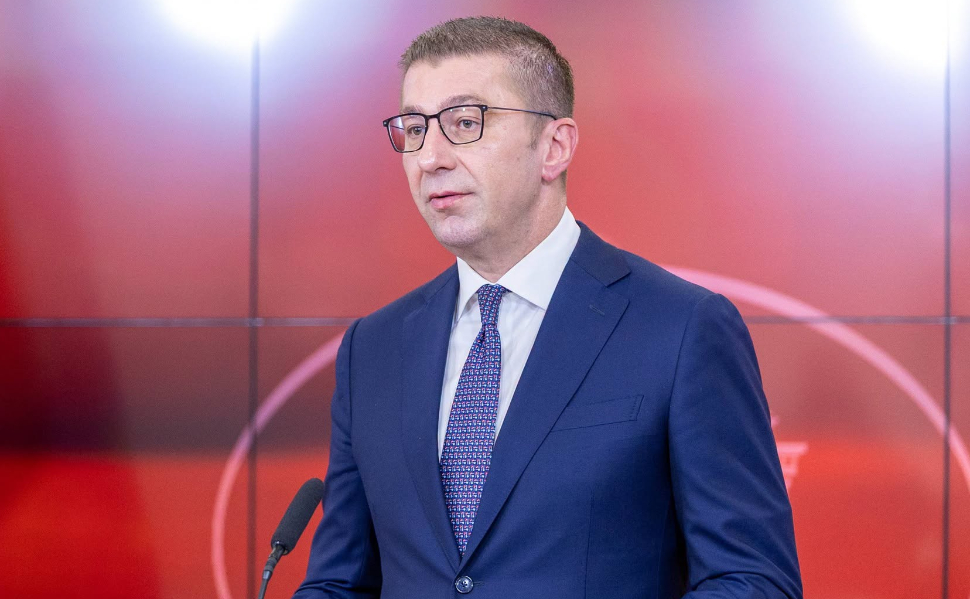
Macedonian Prime Minister Hristijan Mickoski says the European Commission’s proposed changes to the EU enlargement process show that Brussels recognizes problems caused by individual member states using vetoes over issues he considers unrelated to accession criteria.
The Commission on Tuesday proposed using qualified majority voting for opening negotiating clusters and certain intermediate decisions in accession talks. The proposal forms part of a broader package designed to prepare the EU for future enlargement and make decision-making more effective.
Mickoski argued that some EU members have used their position to raise bilateral issues that fall outside what he described as European values and the merit-based accession process.
“Obviously, the situation has been recognized there, that some member states are abusing their membership and trying to go beyond the framework of merit-based accession,” Mickoski said.
He added that he had raised the issue following meetings with German Chancellor Friedrich Merz and French President Emmanuel Macron in Tivat.
Mickoski Sees Opportunity in Gradual EU Integration
The Commission’s package also aims to make the EU enlargement reform more closely linked to gradual integration. Candidate countries could gain earlier access to selected EU policies and parts of the single market if they meet the necessary conditions. The Commission specifically identified energy, transport, digital policy and defense as areas where integration could deepen before full membership.
Mickoski said Macedonia has a strong chance of participating in this process. According to him, the country would need to meet three sets of conditions.
He identified country-specific reforms as the first requirement. The second concerns alignment with the EU’s common foreign and security policy, while the third involves reforms to the public procurement system.
“We have two of the three,” Mickoski said, adding that the government was waiting for the European Commission to specify the remaining reform requirements.
The Commission has confirmed that gradual integration will remain conditional on progress in accession preparations, readiness in individual policy areas and strategic alignment with the EU. The measures would also be reversible if the required conditions were no longer met.
EU Proposes Qualified Majority Voting for Accession Steps
Mickoski described the proposed EU enlargement reform as an attempt to reduce the ability of individual member states to use bilateral disputes to block candidate countries.
He linked the initiative to his government’s position on constitutional amendments required for Macedonia’s accession process. Mickoski has advocated that such changes should become effective after the country completes its EU negotiations.
The European Commission’s proposal does not eliminate unanimity from the entire accession process. Instead, it recommends qualified majority voting specifically for opening negotiating clusters and other intermediate decisions. Enlargement would remain merit-based, with each candidate’s progress determined by its reforms.
The proposals still require discussion among EU institutions and member states. The Commission has invited the European Parliament and Council to move forward with preparations for future enlargement.