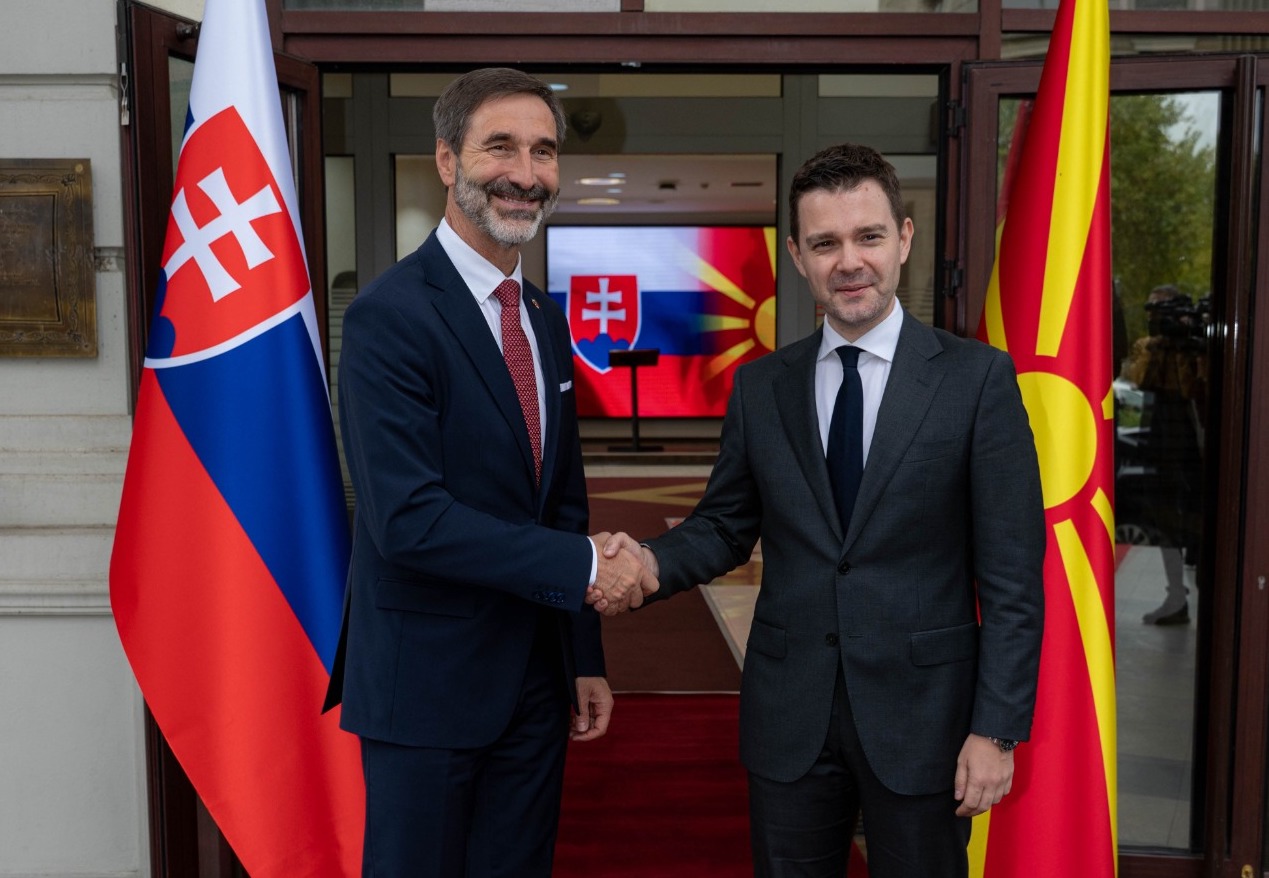
Slovak Foreign Minister Juraj Blanár says the EU must send a clear signal that membership is a realistic prospect for the Western Balkans, while Macedonia’s Foreign Minister Timčo Mucunski warns that there is no guarantee of a solution to the dispute with Bulgaria.
Slovakia opposes what it describes as double standards in the European Union’s enlargement process and supports Macedonia’s efforts to join the bloc, Slovak Foreign and European Affairs Minister Juraj Blanár said during an official visit to the country.
Blanár called on Brussels to provide a clear signal to Western Balkan countries that EU membership remains achievable, warning that growing frustration among candidate countries could weaken the region’s ties with the Union.
“We must send a clear signal to the region that membership in the European Union is realistic. Otherwise, frustration among candidate countries will grow, and we could lose this region,” Blanár said.
He argued that countries pursuing European integration should not face different criteria, stressing that Macedonia can count on Slovakia’s strong support for its EU accession.
Blanár also referred to the Thessaloniki Summit and its declaration, which reaffirmed the European perspective of the Western Balkans. He said the commitments made at the summit have not been fully implemented.
Mucunski: No guarantee of a solution with Bulgaria
Macedonia’s Foreign Minister Timčo Mucunski said the government remains in communication with European institutions and EU member states interested in helping find a rational and sustainable solution to the dispute with Bulgaria.
However, he stressed that there is no guarantee an agreement will be reached and said the government would not accept a temporary arrangement that merely postpones the problem while leaving the country facing the same difficulties in the long term.
“There is no guarantee that a solution will be reached. Our government is not prepared to accept a solution that temporarily patches up the problem but, in the long run, puts the country in the same situation it is in today,” Mucunski said.
A meeting with Bulgaria’s representative, Petrova-Chamova, has not yet been scheduled. Mucunski said he hopes an opportunity for talks could arise in December on the sidelines of ministerial meetings of NATO and the Organization for Security and Co-operation in Europe (OSCE).
He also announced that discussions with official Sofia are expected to continue after Bulgaria’s elections.
Slovakia proposes regional cooperation on EU enlargement
Mucunski referred to his meeting last week in Montenegro with French Minister for Europe Benjamin Haddad, reiterating that Macedonia has no alternative to European integration.
Blanár, meanwhile, proposed holding a meeting in Macedonia under the so-called Slavkov format, which brings together Slovakia, the Czech Republic and Austria, to discuss the country’s European integration and the wider enlargement process.
He said Slovakia opposes drawing a distinction between the Western Balkans and Eastern Europe in the EU enlargement process. Bratislava supports a broader and stronger European Union, he added, in which countries join according to their level of preparedness.
The visit highlighted Slovakia’s stated support for Macedonia’s EU aspirations and renewed attention to the challenges surrounding the country’s accession process, particularly its unresolved dispute with Bulgaria.