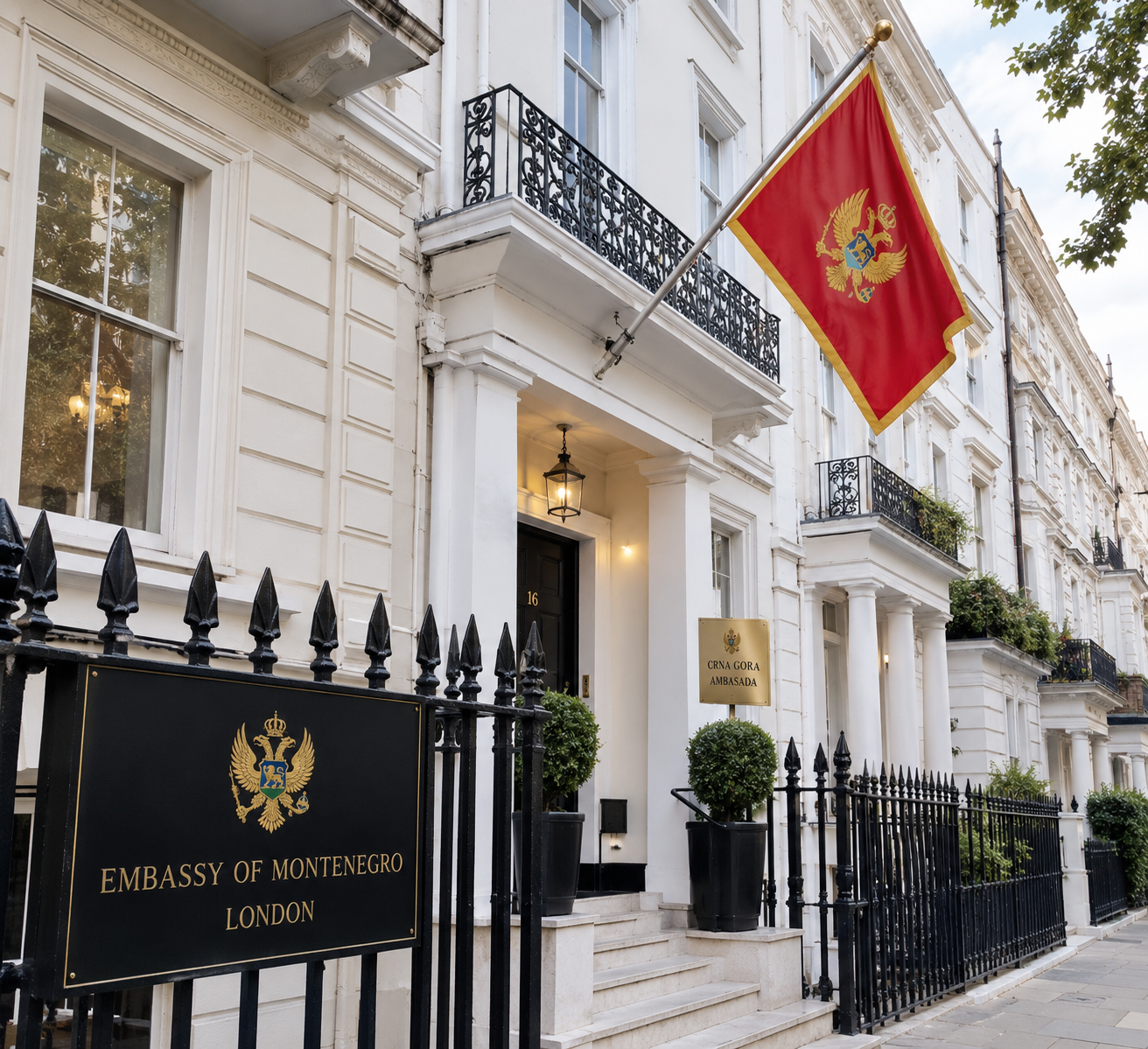
A five-bedroom family home in London’s Pimlico neighborhood has become Montenegro’s embassy, triggering complaints over its flagpole and appearance. One longtime resident has taken the dispute to the High Court, arguing that local authorities failed to consider the impact on her health.
A diplomatic mission is usually expected to build relationships between countries. But Montenegro’s new embassy in an elegant London neighborhood has created tension closer to home, with a dispute between neighbors escalating into a legal challenge.
The controversy centers on a five-bedroom house on Cambridge Street in Pimlico, where the conversion into Montenegro’s embassy has drawn objections from residents concerned about the building’s appearance, planning permission and the impact of a diplomatic mission in their residential street.
The dispute has reached the High Court, highlighting the challenges smaller countries can face when establishing diplomatic premises in some of London’s most expensive neighborhoods.
Montenegro’s flag becomes a neighborhood flashpoint
The first objections emerged in the spring, when residents complained to local authorities about the embassy’s flagpole and the country’s red flag with gold trim.
One resident described the flagpole and flag as an eyesore among the street’s Grade II-listed properties. Another argued that the flag’s bright colors disrupted the harmony of the white, late-Regency-style façades designed by architect Thomas Cubitt.
Some neighbors were also unhappy that planning permission had not been sought before the flagpole and embassy sign were installed.
Tensions eased somewhat after Montenegro’s chargé d’affaires hosted a drinks reception for local residents. One neighbor reportedly remarked that it might have been more diplomatic to organize the gathering at the beginning.
The reception, however, did not resolve the disagreement for everyone.
Resident challenges Westminster Council
Diana Simpson, who lives with her parents on Cambridge Street and has reportedly resided there for more than three decades, brought a legal challenge against Westminster City Council.
Simpson is seeking a judicial review of the council’s decision and potentially compensation. According to the report, she argues that the authorities failed to properly consider her circumstances when the embassy subsequently sought permission for the change of use and the installation of the flagpole.
Simpson, the daughter of a former American diplomat and a graduate of an Ivy League university, lives with several diagnosed health conditions, including clinical anxiety, long COVID and a functional neurological disorder. She receives disability benefits.
In her legal submission, she said the arrival of the embassy had significantly affected her sense of security and regularly disrupted her sleep.
She described sometimes feeling compelled to sleep in a different room from the one she had occupied throughout her life. Noises at night, she said, could trigger a fear response, even though she recognized that the possibility of someone entering her bedroom from the embassy was very small.
Simpson also questioned whether remaining in her longtime home was still sustainable, saying that leaving would mean losing her connection to a close-knit local community.
Her legal arguments include alleged failures by the council to account for her health conditions, act reasonably and conduct an adequate public consultation. She contends that residents’ objections were not properly considered after the Foreign Office had given its approval.
Council rejects the allegations
Westminster City Council has rejected Simpson’s claims, arguing that the embassy’s presence does not amount to a likely interference with her home or her private and family life.
The council has asked for the case to be decided without a hearing. A spokesperson said the authority is legally required to make decisions in accordance with applicable planning policies.
The case is being considered by High Court judge Mould.
Smaller countries face a London property challenge
Although the dispute is unusual, it reflects a broader challenge for smaller countries seeking diplomatic premises in London, where rising rents and property sales can force embassies to reconsider their locations.
Many major countries traditionally maintain their diplomatic missions in prestigious districts such as Belgravia, South Kensington, Knightsbridge and Mayfair. Smaller states may want to remain close to these diplomatic hubs without paying the same high property costs.
The United States, for example, operates from a purpose-built, 12-storey embassy building south of the River Thames.
Montenegro chose a different approach, establishing its embassy in a converted family home in Pimlico, near Victoria coach station.
The arrangement has placed its diplomatic presence directly among residential properties, where neighbors have raised concerns about the change in the street’s character.
Turkmenistan embassy faces similar objections
Montenegro is not the only country to encounter resistance over a residential-style embassy in London.
Turkmenistan has also opened an embassy in a converted family home on Victoria Road in Kensington. The property is around two kilometers from the French Embassy, located opposite the Natural History Museum.
That move has prompted complaints from local residents as well.
During a public consultation organized by the Royal Borough of Kensington and Chelsea, one resident criticized what they described as a lack of consideration for immediate neighbors and said they would investigate whether any irregularities had occurred.
The property housing the Turkmenistan embassy is reportedly owned by Tengku Fahad, 32, the son of Malaysia’s late king, who was educated at Eton.
Together, the two cases illustrate the competing interests involved when diplomatic missions move into established residential neighborhoods: countries need affordable and suitable premises, while residents seek to preserve the character and quiet of their streets.
For Montenegro, the dispute over its London embassy has become more than a question of a flagpole or a planning application. It is now a legal battle over how local authorities balance planning rules, residents’ concerns and the presence of a foreign diplomatic mission.