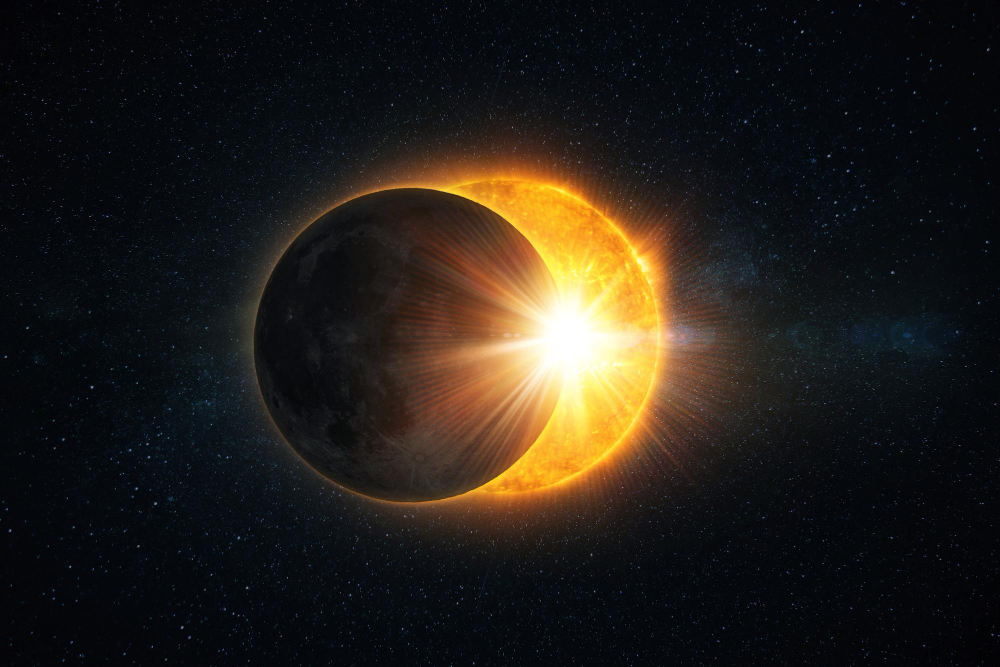
A total solar eclipse on August 12 will sweep across parts of Greenland, Iceland and Spain, while a much wider area of the Northern Hemisphere will experience a partial eclipse. The total phase will also be visible over northern Russia, the Atlantic Ocean and a small part of Portugal.
For the first time in more than a century, a total solar eclipse will reach mainland Spain. Darkness will descend across parts of the Iberian Peninsula close to sunset as the Sun, Moon and Earth align.
Totality Could Last Up to Two Minutes and 18 Seconds
The eclipse path will begin near the North Pole before turning south. The total phase will last for up to two minutes and 18 seconds, with the longest duration occurring off the western coast of Iceland.
The spectacle will eventually end over the Mediterranean Sea. In Spain, the eclipse will take place near sunset, creating unusual viewing conditions as daylight fades.
A partial eclipse will cover a considerably larger area. It will be visible across much of Canada, the northern United States, most of Europe and parts of northwestern and western Africa, with visibility extending from Alaska toward Siberia.
In many locations along the western part of the eclipse path in continental Europe and Africa, the Sun will set while it is still partially eclipsed. This will make it appear as though the partially covered Sun is disappearing below the horizon.
Another Longer Eclipse Expected in 2027
The total solar eclipse on August 12 will be followed by an even longer eclipse next summer. On August 2, 2027, southern Spain is expected to be among the main viewing areas for a total eclipse lasting up to six minutes and 23 seconds.
That 2027 eclipse is also expected to cross Morocco, Algeria, Libya, Egypt, Saudi Arabia, Yemen and Somalia. The 2026 eclipse, by comparison, will have a maximum duration that is almost three times shorter.
NASA announced that it would provide a live broadcast of the August 12 eclipse.