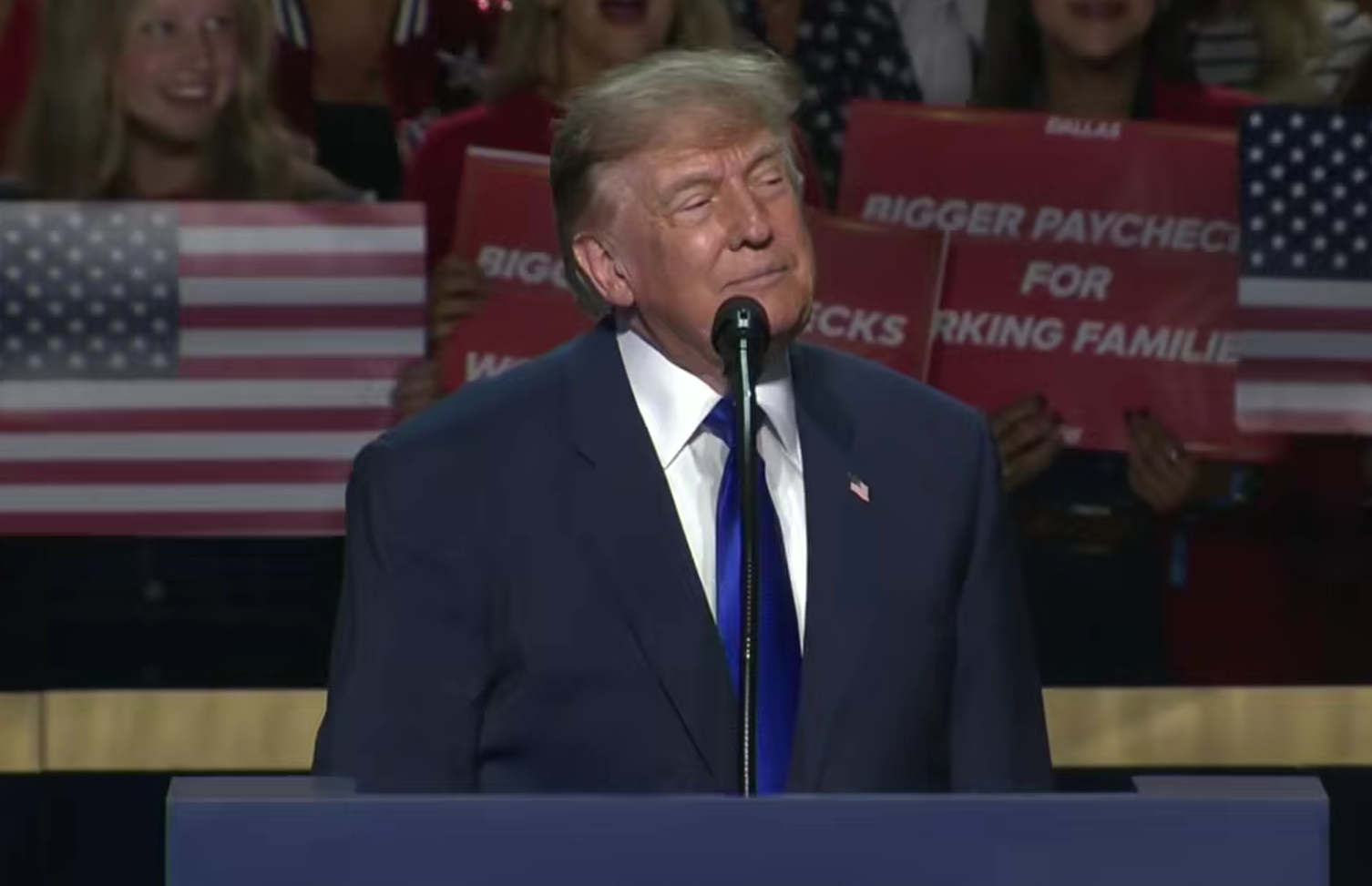
President Donald Trump has offered every American adult a $5,000 “Trump dividend” if Republicans retain control of Congress in November, a proposal estimated to cost $1.35 trillion that has already raised questions about its legality. The announcement came during a 105 minute primetime address at the Republican Party’s first ever midterm convention in Dallas, an event so heavily focused on the president that RNC Chairman Joe Gruters informally dubbed it “Trumpapalooza.”
With approximately 270 million adults potentially eligible, the proposal would dwarf previous direct payment programs in American history. Trump provided few details about how the money would be funded or distributed, while legal experts pointed to federal laws prohibiting payments intended to induce people to vote or register.
The convention, held in a 21,000 seat arena with visibly empty upper sections during Trump’s speech, highlighted the gamble Republicans are making by tying their midterm campaign closely to a president facing historically low approval ratings. Poll released over Labor Day weekend found that 32% of Americans approved of Trump’s job performance, while a different survey put his approval at 33%, down from 47% at the beginning of his second term.
Trump’s economic ratings are even weaker. Only 17% of respondents in the cited polling approved of his handling of inflation and the cost of living, while 69% disapproved. With gas prices around $4.15 per gallon and the war with Iran continuing beyond six months, Democrats have opened a seven point lead on the generic congressional ballot, contributing to an enthusiasm gap that could benefit the opposition.
Trump Dividend Puts GOP Midterm Strategy Under Pressure
Trump’s speech largely avoided the issues voters identify as their top concerns, particularly the Iran war and affordability, and instead focused on cultural issues and attacks on Democrats. He claimed to have completed “the greatest two years in the history of the presidency,” described Democrats as “dangerous, radical and weird,” and urged supporters to “pretend that I’m on the ballot.”
He also promised that oil prices would fall once the United States wins the war with Iran, defending the conflict as necessary to prevent Tehran from acquiring a nuclear weapon. Analysts, however, have questioned whether Iran’s nuclear capabilities have actually been eliminated. Some Republicans at the convention also expressed concern about the duration of the conflict, with Alabama state Representative Ernie Yarbrough saying voters want greater clarity about whether the war could become an endless cycle.
The event exposed divisions within both parties. Several Republicans facing difficult races skipped the convention, including Representative Tom Barrett of Michigan and Senators Dan Sullivan of Alaska and Susan Collins of Maine, all of whom are facing strong Democratic challengers. At least 16 candidates in competitive House and Senate contests attended, including Texas Attorney General Ken Paxton and Ohio Senator Jon Husted.
Democratic divisions were also highlighted when Pennsylvania Senator John Fetterman appeared in a prerecorded video praising Republican Senator Dave McCormick as his “great friend” and saying he would work with Trump to protect Pennsylvania’s steel industry. Fetterman, who has increasingly clashed with the progressive wing of the Democratic Party, denied speculation that he could leave the party, but his appearance nevertheless offered Republicans a notable example of cross party support.
$5,000 Promise Faces Legal and Political Questions
Whether the $5,000 Trump dividend will energize Republican voters or ultimately appear to be a desperate campaign gimmick remains uncertain. The proposal’s legality is also unclear, particularly because federal statutes including 18 U.S.C. § 597 and 52 U.S.C. § 10307(c) prohibit paying or offering to pay people for voting or registering to vote.
The distinction between a general economic payment and a payment explicitly tied to voting or registration could become central to any legal challenge. Trump has not yet provided enough details about the proposed program to determine precisely how it would be structured or whether Congress would need to authorize the payments.
With less than two months until Election Day, Republicans are hoping the Dallas convention can reverse a political trajectory that has included recent losses by Trump backed candidates in primaries in Florida, Tennessee and Michigan. The timing also puts the campaign in competition with major sporting events and other programming for voters’ attention.
For now, the Republican Party is placing significant political weight behind Trump as he asks voters to focus on the promise of a potentially historic payment. Whether the $5,000 Trump dividend becomes a rallying point for the GOP or another controversy surrounding the president’s midterm strategy could help shape the final weeks of the 2026 campaign.