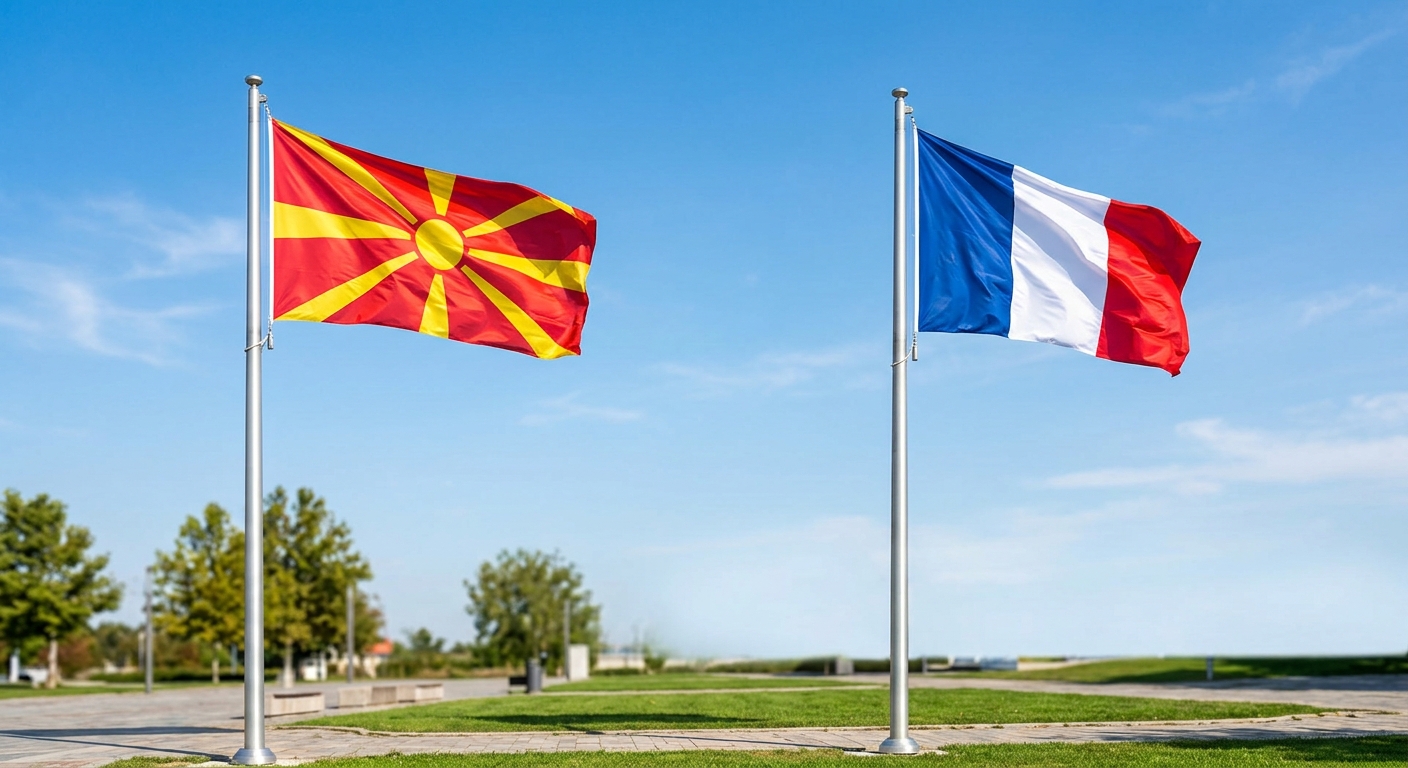
A delegation from the French Senate’s France-Western Balkans Friendship Group is visiting Macedonia on September 24 and 25, bringing parliamentary diplomacy and European integration into focus. Led by Marta de Cidrac, president of the friendship group, the delegation includes senators Arnaud Bazin, who is responsible for Macedonia within the group, Alain Milon and Laurence Harribey. The two day visit includes meetings with senior Macedonian officials, parliamentarians, students and representatives involved in the country’s European integration process.
The visit is taking place as France and Macedonia continue to develop their political relationship, with European Union membership remaining one of the central areas of cooperation. France has publicly supported Macedonia’s European perspective and maintains that the country’s path toward the EU is an important part of its engagement with the Western Balkans.
French Senate Delegation Strengthens Parliamentary Ties With Macedonia
During the first day of the visit, the French senators are scheduled to meet Parliament Speaker Afrim Gashi. The delegation will also hold discussions with members of the Macedonian parliamentary group responsible for cooperation with the French Parliament. The meetings are expected to provide an opportunity to discuss parliamentary cooperation as well as broader bilateral and European issues.
The French Senate’s France-Western Balkans Friendship Group is specifically structured to maintain parliamentary contacts across the region. Its current leadership includes Marta de Cidrac as president, while Arnaud Bazin serves as the delegated president for Macedonia. The group’s work reflects a wider French effort to maintain direct political dialogue with Western Balkan countries at a parliamentary level.
Parliamentary diplomacy has become an established part of France’s relationship with Macedonia. The French National Assembly also maintains a France-Macedonia friendship group, demonstrating that contacts between the two countries extend beyond government to government meetings. French parliamentary documents have previously described these friendship groups as a way to strengthen political exchanges and support dialogue surrounding Macedonia’s European integration.
The delegation’s schedule also includes a visit to the French Institute in Skopje. The institution represents another dimension of bilateral relations, with cultural and educational exchanges complementing political cooperation. On September 25, the senators are expected to visit the French International School in Skopje, where they will meet with students. The educational stop gives the delegation an opportunity to see another area in which links between France and Macedonia are being maintained and developed.
European integration is expected to be an important part of the second day of the visit. The delegation will meet members of Macedonia’s National Council for European Integration, a parliamentary body involved in discussions connected to the country’s EU accession process. The senators are also scheduled to meet President Gordana Siljanovska Davkova, giving the French delegation an opportunity to exchange views with one of the country’s highest constitutional officials.
France’s position on Macedonia’s European future has been expressed repeatedly in recent years. France’s foreign ministry describes bilateral political relations as good and steady and says they have been developing positively. Paris has also publicly supported Macedonia’s European perspective and played a significant diplomatic role in the region, including during the 2001 crisis and in supporting the implementation of the Prespa Agreement.
France and Macedonia Keep EU Integration on the Agenda
The parliamentary visit follows other high level contacts between the two countries during 2026. In April, Macedonia’s Foreign Minister Timcho Mucunski visited Paris, where discussions with French officials focused on strengthening bilateral relations, political dialogue and cooperation, as well as reaffirming French support for Macedonia’s European integration. Economic cooperation was also identified as an area for further development.
The timing of the Senate delegation is also significant because France has been active in discussions about the future of EU enlargement. French parliamentary activity during 2026 has included attention to the progress of Western Balkan candidates and to questions surrounding the enlargement process. A French Senate committee delegation visiting Albania and Montenegro in June described the Western Balkans as an important area of European policy and discussed the state of accession negotiations and France’s growing engagement in the region.
For Macedonia, the European path remains closely connected to a broader set of political and institutional questions. The country became an EU candidate in 2005 and formally opened accession negotiations in 2022, but the process has yet to move into the full negotiating stages that Macedonia has sought. Constitutional changes connected to the EU negotiating framework remain an important part of the discussion surrounding the country’s accession path.
The French delegation’s visit therefore comes at a time when parliamentary contacts can provide another channel for discussing the practical and political challenges surrounding enlargement. While a friendship group does not negotiate accession terms itself, such groups can create space for lawmakers to exchange views, explain national positions and maintain political communication alongside formal government and EU institutions.
The final part of the delegation’s program will have a historical character. The senators are scheduled to visit the French military cemetery in Skopje and lay a wreath in memory of French soldiers who died on the Eastern Front. The ceremony connects the modern diplomatic relationship between the two countries with a much older historical relationship and provides a formal moment of remembrance during the delegation’s visit.
Overall, the French Senate delegation’s two day visit brings together several strands of the relationship between France and Macedonia: parliamentary cooperation, education, cultural exchange, bilateral political dialogue and European integration. The meetings in Skopje are not expected to resolve the larger questions surrounding Macedonia’s EU accession, but they provide another opportunity for direct communication between French and Macedonian institutions. With France continuing to engage in Western Balkan affairs, the visit highlights the importance of maintaining political dialogue as Macedonia works toward advancing its European path.