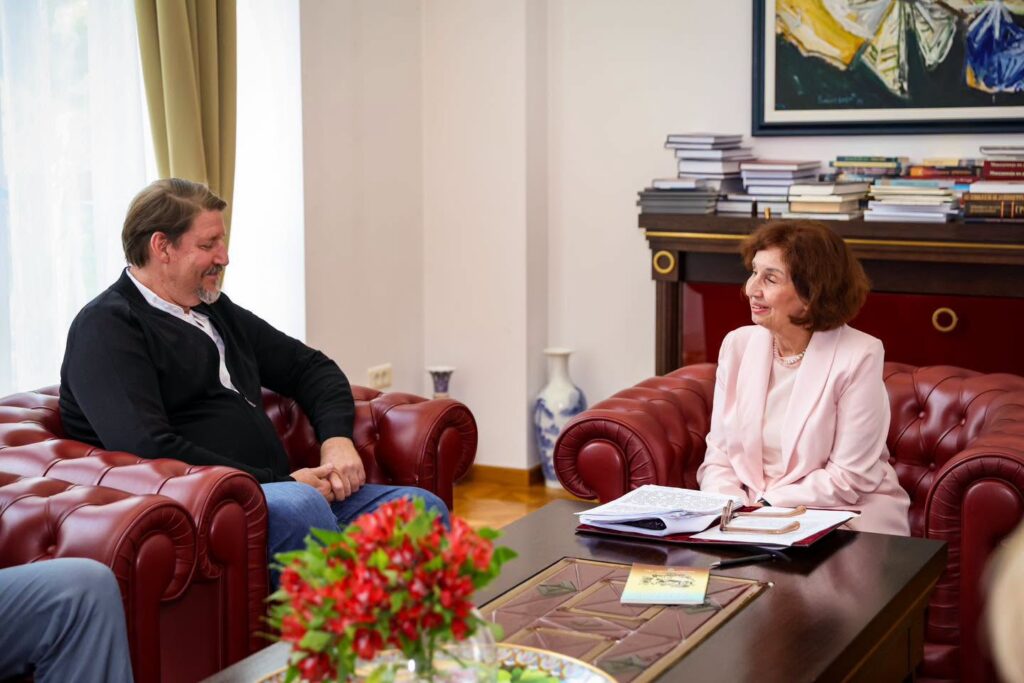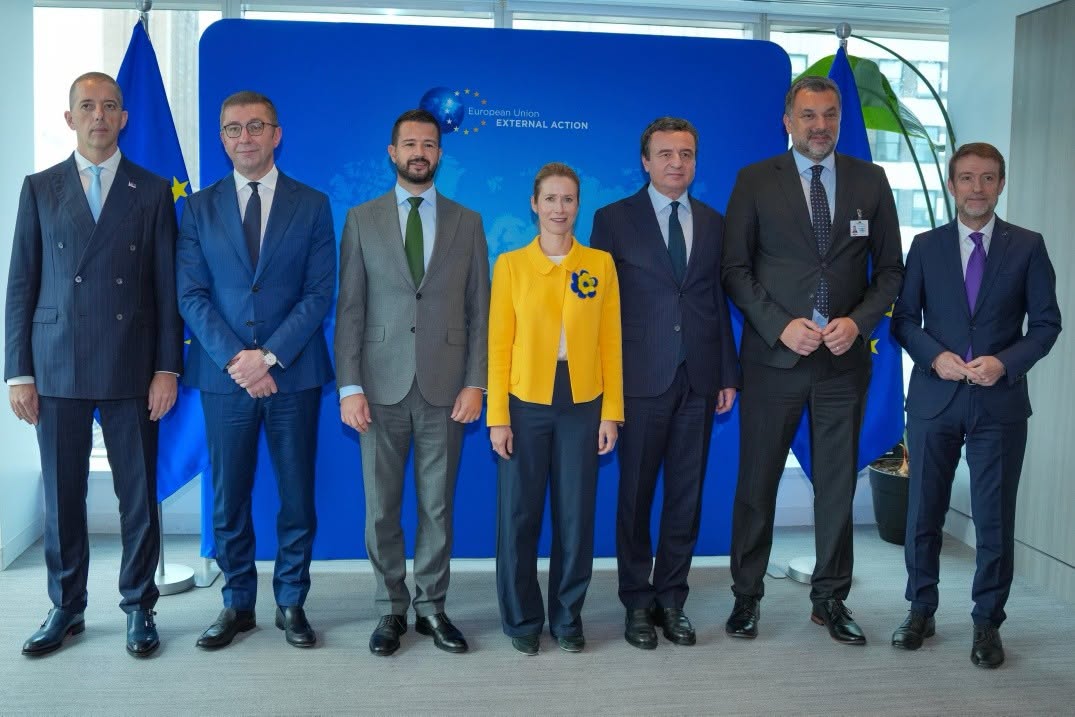
Macedonia’s Prime Minister Hristijan Mickoski met with EU High Representative for Foreign Affairs and Security Policy Kaja Kallas and other Western Balkan leaders in New York during the 81st United Nations General Assembly. The meeting focused on regional challenges, opportunities for closer cooperation and shared priorities connected to stability, security and economic development. The talks came as European and Western Balkan leaders gathered in New York for a week of intensive diplomatic meetings against the backdrop of conflicts and wider international security concerns.
Mickoski is in New York as part of Macedonia’s delegation to the UN General Assembly, where leaders are discussing a broad range of international issues. The 81st session is taking place under the theme “Restoring Trust, Managing Transformation: A United Nations That Delivers for All,” with international law, peace, security and multilateral cooperation among the major issues being discussed.
Mickoski Meets Kallas as Western Balkans Cooperation Takes Focus
The meeting with Kallas placed the Western Balkans within that wider European diplomatic agenda. Kallas has been using her presence at the UN to strengthen cooperation between the EU and international partners, with the European Union emphasizing international law, sovereignty, territorial integrity and stronger multilateral cooperation. Her schedule in New York has included meetings with EU foreign ministers and partners on issues ranging from the war in Ukraine and the Middle East to food security, maritime security and accountability.
For Macedonia, the discussions also come at an important point in the country’s European integration process. The government has repeatedly identified EU membership as a strategic objective, while reforms, regional cooperation and relations with neighboring countries remain important parts of that path. Mickoski has used his meetings in the United States to discuss Macedonia’s European perspective and its cooperation with European and international partners.
During his visit, Mickoski also met Croatian Prime Minister Andrej Plenković. According to Mickoski, their conversation included Macedonia’s European perspective, good neighborly relations, regional cooperation and the continuation of reforms in line with European standards. Croatia, which joined the European Union in 2013, has also been involved in discussions concerning EU enlargement and the integration of countries in Southeast Europe.
The Western Balkans meeting with Kallas comes as the EU continues to emphasize closer engagement with the region. The bloc considers the stability and development of Southeast Europe an important part of the wider European security environment. Cooperation between the EU and Western Balkan countries has increasingly included security, economic development, connectivity, energy and resilience alongside the traditional focus on enlargement.
Macedonia’s position within the region is also shaped by its membership in NATO. The country joined the alliance in 2020, giving it a formal role in Euro-Atlantic security structures while its government continues to pursue EU membership. Mickoski has emphasized that Macedonia intends to remain engaged in international efforts focused on peace, stability and cooperation.
Mickoski’s New York Meetings Highlight European and Global Priorities
The Prime Minister also participated in a high level discussion in New York titled “Reaffirming the Promise of Peace: Using the Power We Have,” hosted by Finnish President Alexander Stubb. The discussion focused on peace, dialogue, responsible leadership and the role of states and international institutions in responding to global challenges.
Mickoski separately met with Stubb, with the two leaders discussing the importance of respecting international law and strengthening multilateral cooperation. The meeting also addressed the broader objective of building a stable and secure Europe. These issues have taken on additional importance during this year’s UN General Assembly, where European leaders are dealing with continuing conflicts and growing concerns about the effectiveness of international institutions.
The European Union has made multilateralism and international law central themes of its participation in the General Assembly. EU leaders have called for stronger international cooperation at a time when conflicts in Europe and the Middle East are affecting security, energy markets, food supplies and international relations. Kallas has also highlighted the need for partnerships beyond Europe to address shared security and economic challenges.
For the Western Balkans, the international environment makes regional coordination particularly significant. Countries in Southeast Europe face shared challenges involving economic development, infrastructure, migration, energy security and relations with the EU. The region is also closely connected to wider European security developments, making dialogue between its governments and EU institutions an important part of maintaining stability.
Macedonia has continued to present itself as a country seeking closer integration with European structures while maintaining its role within NATO. Mickoski’s meetings in New York therefore combine regional diplomacy with the country’s longer term foreign policy priorities. The discussions do not by themselves represent a new agreement or a change in Macedonia’s formal EU status, but they provide another opportunity for the government to raise regional and European issues directly with senior European officials.
The UN General Assembly has provided a particularly active setting for those discussions this year. Alongside the formal sessions, governments are using the week for bilateral and regional meetings designed to build support for cooperation on security, economic development and international law. The EU’s program in New York has included meetings with countries and organizations from different regions, reflecting its effort to strengthen partnerships around common international priorities.
Mickoski’s meetings with Kallas, Stubb and Plenković therefore form part of a broader diplomatic effort during his participation in the UN General Assembly. For Macedonia, the focus remains on regional cooperation, Euro-Atlantic partnerships, reforms and its stated objective of advancing toward the European Union. The meetings also underline the importance of maintaining dialogue at a time when European security and international cooperation are facing significant pressures.
As the UN gathering continues, discussions involving Macedonia and the wider Western Balkans are likely to remain connected to the region’s European perspective and the broader question of how international institutions can respond to today’s security and economic challenges. For Skopje, maintaining engagement with EU officials and neighboring countries remains an important part of its foreign policy agenda, while the outcomes of those diplomatic contacts will depend on further negotiations and developments after the New York meetings.