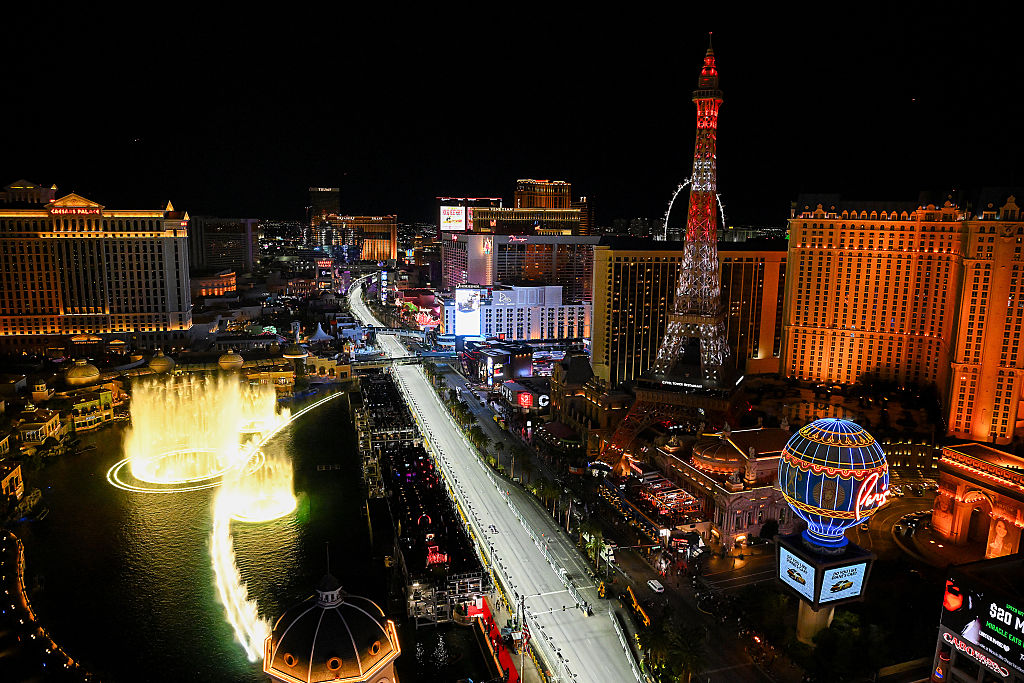
The Formula 1 race on the streets of Las Vegas has become one of the most anticipated events in motorsport. It is a spectacular combination of glamour, breathtaking speed and unpredictable action beneath the city’s dazzling night lights. From its early days on a hotel parking lot to today’s state-of-the-art street circuit, this desert city has a racing story worth exploring.
Track Facts and Features
The Las Vegas Strip Circuit is 6.201 kilometers (3.8 miles) long. Drivers complete 50 laps, covering a total race distance of approximately 310 kilometers. The circuit runs counterclockwise and features 17 corners, combining long straights with technically demanding slower sections.
Because of its exceptionally long straights, teams must configure their cars with reduced aerodynamic downforce, making the circuit particularly challenging for drivers.
The distance from the starting grid to the braking point before the first corner is just 150 meters, while the time lost during a pit stop is approximately 20 seconds.
The desert’s low nighttime temperatures create another challenge, making it difficult for drivers to bring their tires up to the ideal operating temperature. As a result, mistakes under braking can become more frequent.
A Fascinating History
Although today’s circuit looks like something from a science-fiction movie, Formula 1 first came to Las Vegas in the early 1980s.
Back then, the race was known as the Caesars Palace Grand Prix and was held on the enormous parking lot of the famous hotel.
Alan Jones won the inaugural race in 1981, while Michele Alboreto claimed victory the following year. Interestingly, Nelson Piquet and Keke Rosberg secured their respective Formula 1 World Championship titles at those races, both finishing fifth.
The old circuit was so physically demanding that Piquet reportedly had to lie down for 15 minutes after the race to recover from the heat and exhaustion.
Records and Incredible Speeds
Formula 1’s return to the entertainment capital of the United States in 2023 brought a series of records and unforgettable moments.
The official race lap record is held by Max Verstappen, who recorded a time of 1:33.365 in 2025.
The highest recorded speed at the circuit is an astonishing 368.9 km/h (229.2 mph), achieved by Alex Albon in 2024.
Fans also remember the inaugural modern-era race in 2023 for its remarkable number of overtakes: 181 in total, the highest number recorded at any Grand Prix that season. Oscar Piastri made the most overtakes, with 20.
That same race is remembered for Charles Leclerc’s dramatic move on the final lap, when he overtook Sergio Perez to claim second place.
Previous Winners
Since the race returned to the Formula 1 calendar in 2023, two drivers have shared the victories.
Max Verstappen made history as the first winner of the modern Las Vegas Grand Prix in 2023, then repeated the achievement in 2025.
Between Verstappen’s two victories, George Russell won the 2024 race for Mercedes. His teammate at the time, Lewis Hamilton, finished second, giving Mercedes a one-two finish.
The probability of a Safety Car appearance on this street circuit is estimated at around 50 percent, meaning drivers and race strategists must always be prepared for unexpected developments. This uncertainty is part of what makes the nighttime race so exciting for motorsport fans.
The Las Vegas Grand Prix has successfully combined America’s love of entertainment with the highest level of motor racing. With Formula 1 cars racing past iconic casinos and illuminated landmarks, it offers much more than an ordinary sporting event. It is a full-scale spectacle of speed, technology and showmanship.