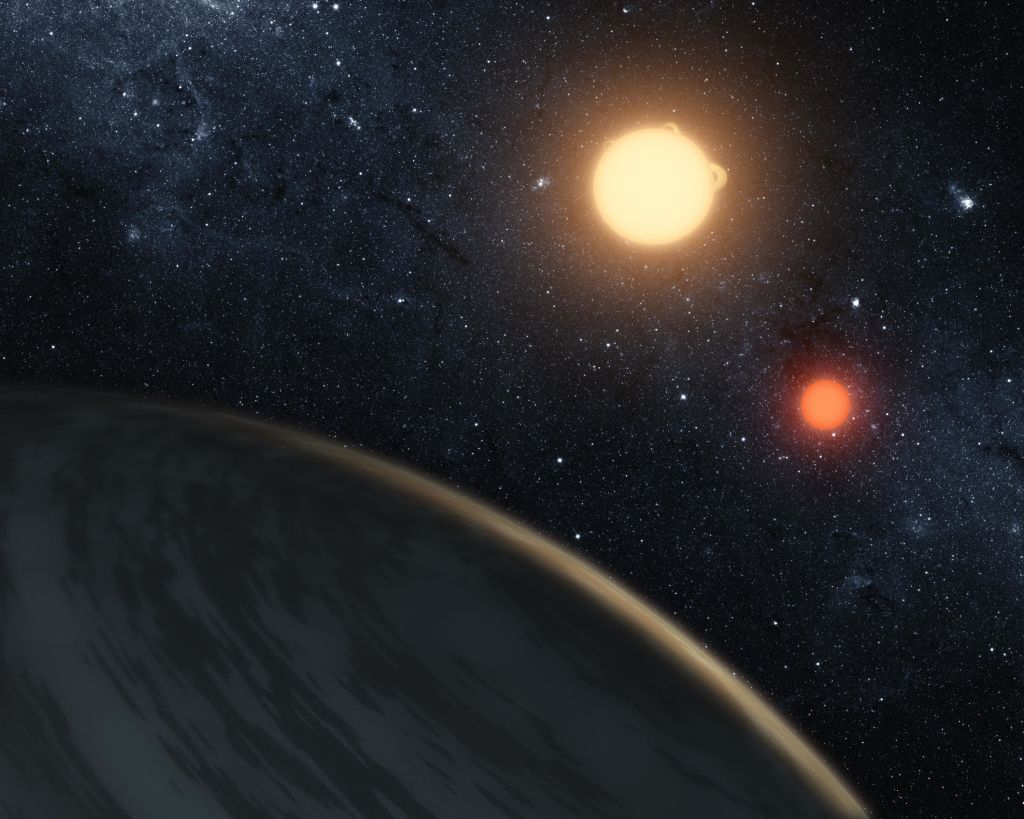
A distant planet known as TOI-2535 b has seemingly vanished from astronomers’ observations after a neighboring world dramatically altered its orbit, researchers say. Scientists expect it could become visible again in 30 to 50 years.
Astronomers believe they have identified the first known case of a disappearing planet after a distant world suddenly stopped passing in front of its host star.
The planet, designated TOI-2535 b, has been observed for several years and is classified as a “hot Jupiter” – a gas giant orbiting extremely close to its star. Its year lasts just 8.25 Earth days.
However, earlier this year, the planet’s transits disappeared entirely, leaving researchers with an unusual astronomical mystery.
Scientists believe the planet itself is still there. Instead, gravitational forces from another, previously unseen planet may have tilted its orbit, moving it out of the alignment needed for telescopes on Earth to detect it.
Astronomers commonly discover exoplanets by observing the slight decrease in a star’s brightness when a planet passes in front of it. This method, known as the transit method, was used by NASA’s Transiting Exoplanet Survey Satellite (TESS) to identify TOI-2535 b in 2019.
By monitoring the system over the following seven years, researchers noticed increasingly unusual changes. The planet began crossing in front of its star at irregular times, sometimes as much as six hours earlier or later than expected. Its transits also became progressively shorter and less pronounced before disappearing altogether.
The researchers suspect that the gravitational influence of a neighboring planet is causing the two worlds to interact, making their orbital planes wobble and gradually move out of alignment with Earth’s line of sight.
“We think of the universe as resembling clockwork, where everything is regular, but that’s not true. If there are multiple planets in a system, they can affect each other’s orbits. We know of a few systems that are like this,” said Samuel Yee, one of the authors of the study.
“This is the most extreme example we’ve seen because the two planets are interacting so strongly. The planet’s orbit is tilting so quickly that its transit disappeared while we were watching.”
According to the researchers, TOI-2535 b could become visible again within the next 30 to 50 years. The second, previously undetected planet responsible for the orbital changes might be observable even sooner.
The phenomenon has similarities to the reason solar and lunar eclipses are relatively rare on Earth. Although the Moon orbits our planet every month, its orbital plane is tilted relative to Earth’s path around the Sun. If the two orbital planes were perfectly aligned, eclipses would occur much more frequently.
The discovery offers astronomers a rare opportunity to observe how planets gravitationally influence one another and how planetary systems can change over time.