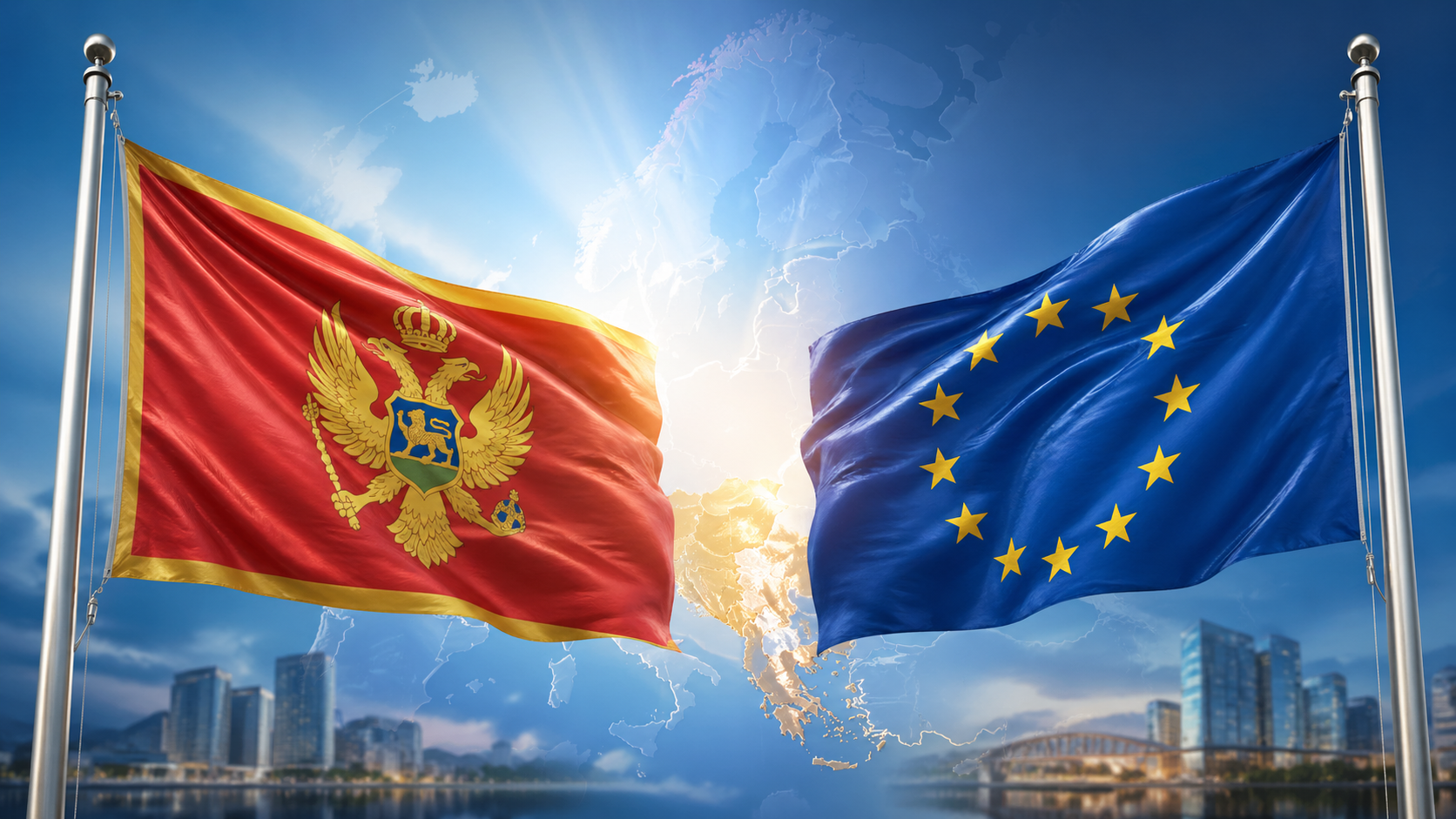
Montenegro has taken another important step toward membership in the European Union after EU member states agreed to begin preparations for the country’s accession treaty. In Podgorica, Minister of European Affairs Maida Gorčević described the move, together with the closing of negotiation chapters, as the beginning of the “final round” of Montenegro’s fourteen-year path toward the EU.
The decision does not mean that membership is guaranteed or completed. Instead, it places Montenegro in one of the most sensitive stages of the process, both technically and politically. The accession treaty is the document that defines the conditions under which a country joins the European Union, but its preparation goes hand in hand with continued reforms and the closing of the remaining negotiation chapters.
Montenegro became an EU candidate country in 2010 and opened accession negotiations in 2012. According to the European Commission, all 33 negotiation chapters have been opened, while 14 have been provisionally closed so far. The most recent chapter to be closed was Chapter 21, which covers trans-European networks, including transport, telecommunications and energy infrastructure.
For years, Brussels has viewed Montenegro as the most advanced Western Balkan country in the enlargement process. European institutions have mentioned 2028 as a possible political target for membership, provided the country continues reforms and successfully closes the remaining chapters.
EU Enlargement Commissioner Marta Kos said the start of accession treaty preparations recognizes Montenegro’s progress, but also sends a clear message that further work is expected from Podgorica. The main priorities remain the rule of law, institutional stability, the fight against corruption and alignment with European standards.
Montenegro’s progress is also being watched as a test of the European Union’s renewed enlargement policy. After years of slow movement in the region, Montenegro is seen as a chance for the EU to show that enlargement can still produce concrete results.
For Podgorica, the coming months will be crucial. Symbolic progress will now have to be turned into closed chapters, adopted reforms and a prepared membership treaty.
Montenegro remains the smallest country in the region, but also the one closest to EU membership. Its path forward, however, will depend heavily on domestic political stability. The message from Brussels is clear: the opportunity is historic, but limited in time, and progress will be measured by real reforms rather than political announcements.