National AI Centre Presented in Skopje
Macedonia has officially presented “Vezilka”, a national centre and factory for artificial intelligence, described as a strategic project intended to connect the country with the European artificial intelligence ecosystem and provide access to advanced infrastructure, supercomputing capacities and new opportunities for research, innovation and digital development.
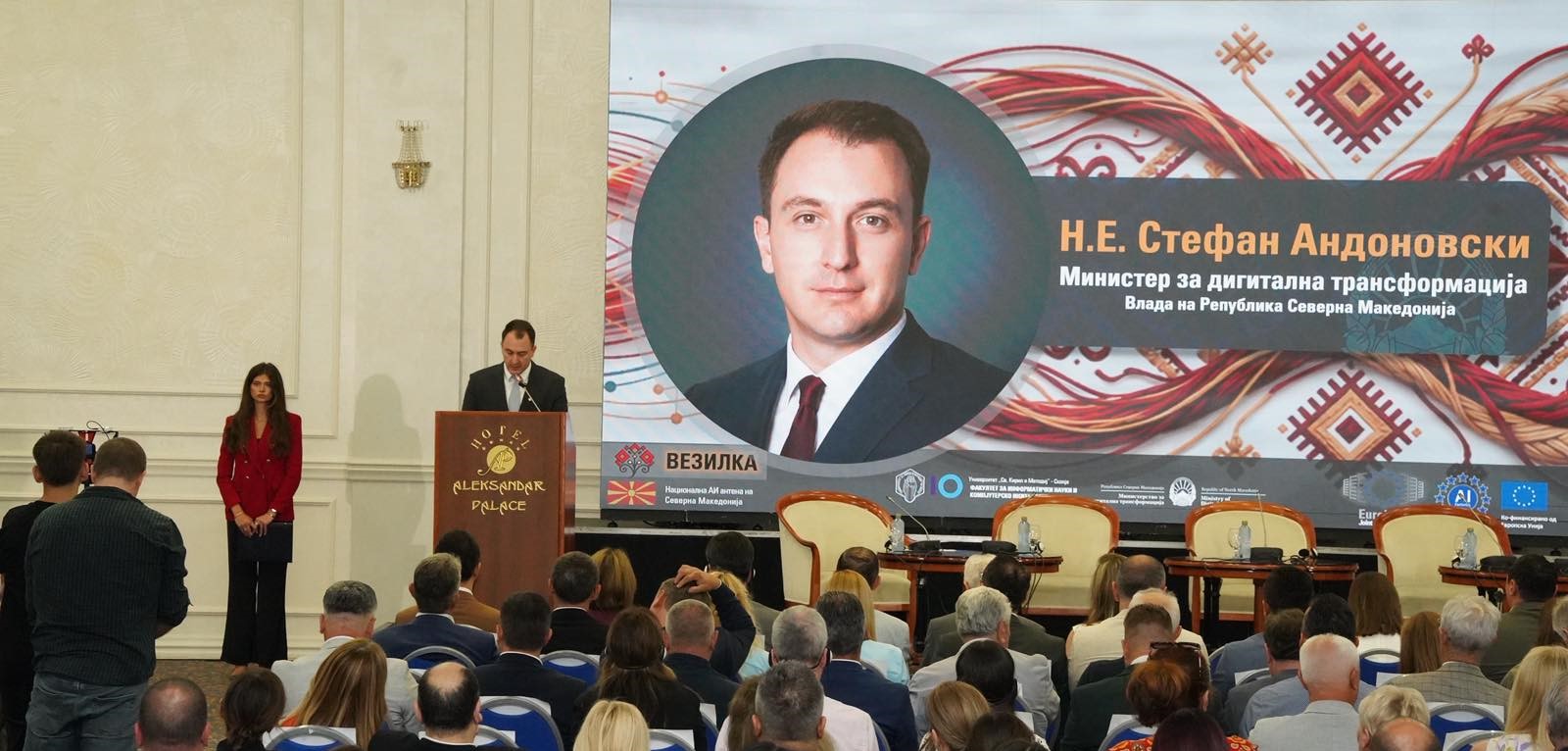
The project was promoted in Skopje in the presence of Prime Minister Hristijan Mickoski, Minister of Digital Transformation Stefan Andonovski, UKIM Rector Biljana Angelova, EU Ambassador Michalis Rokas, students and representatives of the academic community. The project was presented by Prof. Dr. Dimitar Trajanov from the Faculty of Computer Science and Engineering, who is also the project leader.
“Vezilka” is implemented by the Faculty of Computer Science and Engineering at the Ss. Cyril and Methodius University in Skopje, in cooperation with the Ministry of Digital Transformation. The project is connected with the European network of artificial intelligence centres and is expected to give Macedonian researchers, universities, start-ups, businesses and institutions access to European AI infrastructure and advanced supercomputing capacities.
Financing and European Support
The project is supported through cooperation between the state, the academic sector and the European Union. The reported total value is around 6.5 million euros, with part of the funding provided by the state, part by the faculties, and the rest by the European Union. In another presentation of the project, it was stated that around 6 million euros of financial support had been secured through the European Union, the Horizon Europe programme and the EuroHPC initiative, with co-financing from the Ministry of Digital Transformation and FINKI.
“Vezilka” is being realized through a strategic partnership with the Greek artificial intelligence factory “Pharos”. Through that partnership, Macedonia is joining a broader European and regional ecosystem for the development of trustworthy and innovative artificial intelligence. The centre is expected to act as an AI Factory Antenna connected to “Pharos”, enabling access to European supercomputers for the development, training and testing of advanced AI models.
The project places Macedonia within a wider European framework in which AI factories are understood as ecosystems that connect computing power, data, talent and institutional support. Through this connection, Macedonia is expected to gain access to advanced tools, data spaces and computing resources intended for start-ups, companies, researchers and institutions.
Macedonian Language and Digital Tools
One of the most important elements of “Vezilka” is the development of artificial intelligence models and digital tools in the Macedonian language. Minister Andonovski said that the project is not only about computers, but about people, students, researchers, engineers and entrepreneurs. He stressed that the project is an investment in knowledge, a competitive economy and a future in which Macedonian talents can create and succeed at home.
Andonovski emphasized that the development of Macedonian-language models is especially important because, in the digital era, Macedonian language, culture and identity must have their place in the technologies of the future. The goal is for the Macedonian language to be equally present in future generations of AI systems.
The project therefore includes not only technological infrastructure, but also work on language and culture. According to the presented concept, the development of Macedonian language models, digital resources and tools is seen as an important part of the country’s digital presence and future technological development.
Faster Services and More Efficient Administration
A key goal of “Vezilka” is to help citizens receive faster services through the use of new technologies. The project is directed toward areas that should improve the quality of life, including healthcare, culture and public services.
Minister Andonovski said that new technologies can help create a more efficient public administration. The idea is that artificial intelligence should not remain an abstract concept, but should be used to support practical improvements in services that citizens use.
Prof. Trajanov said that artificial intelligence changes how quickly and efficiently people think and work. According to him, AI will bring many improvements to existing processes, but will also open a wide range of new industries that are not yet fully visible today. He said the country must prepare for what is coming and that Macedonia should not be only a user of artificial intelligence, but also a driver of the process.
Healthcare, Data and AI Assistants
During the presentation, special attention was given to possible applications in healthcare. Trajanov pointed out that Macedonia already has several important digital systems, including Moj Termin, the national electronic health system, Vaccination.mk, databases related to vaccination, PACS and LIS systems for radiological images and laboratory results, as well as ChatMed, a project supported by the European Union.
The idea is that these existing systems already collect large amounts of health data that could be used for the development of AI tools. Trajanov presented the concept of developing AI assistants for doctors, which would suggest possible diagnoses based on symptoms, analyses and the patient’s medical history.
The healthcare segment was presented as one example of how “Vezilka” could support practical solutions. It was also stated that artificial intelligence could support diagnostics and personalized medical care, while other fields such as agriculture, culture, public administration and energy were also mentioned as areas where AI tools could be developed.
Science, Economy and Opportunities for Young People
Prime Minister Mickoski described “Vezilka” as a project of strategic importance and an investment in the future, in the potential of Macedonian scientists, researchers, students, institutions and companies. He said that some projects should not be measured only by their financial value, but also by their ability to change the future of a society.
According to Mickoski, artificial intelligence is already creating new economic models, opening new industries and setting new standards for competitiveness. He said that the ability of a country to create knowledge and connect science with the economy is becoming essential.
Mickoski stressed that “Vezilka” is the result of a shared vision of the Government, the academic community and the European Union. He said such partnerships create lasting results because they bring together knowledge, experience and resources around a common goal: building a modern, competitive and innovative Macedonia prepared for the challenges and opportunities of the new era.
He also said the project will open new perspectives for Macedonian researchers, universities, start-ups and companies that develop products and services with high added value. According to him, “Vezilka” marks the beginning of a process that should contribute to stronger science, a more competitive economy and greater opportunities for young people.
UKIM, FINKI and the Academic Role
UKIM Rector Biljana Angelova said the project opens opportunities in the interest of society. She emphasized that through the partnership with “Pharos” from Greece, Macedonia is integrating into scientific flows. According to her, the university has an obligation to contribute to the development of artificial intelligence and a responsibility to create new generations of experts, as well as knowledge that serves progress.
The project gives the academic sector a central role. FINKI is the carrier of the project, while the broader goal is to connect universities, researchers, companies, institutions and young engineers with European resources and opportunities.
EU Ambassador: A Step in Macedonia’s Digital Journey
EU Ambassador Michalis Rokas described “Vezilka” as an important step in the country’s digital journey and one of the most ambitious initiatives showing that knowledge and talent developed locally can help shape the future of artificial intelligence.
He said artificial intelligence is transforming economies and societies and supporting businesses and public services. According to him, the question is not whether AI will shape the future, but how competitive and trustworthy that future will be.
Rokas said Europe is investing heavily in infrastructure with the aim of developing trustworthy artificial intelligence. He added that “Vezilka” represents Macedonia in this AI ecosystem and that, implemented through FINKI, it is an investment in the future. He said it could support diagnostics and personalized medical care in healthcare, improve sustainability in agriculture and help with cultural heritage in the field of culture.
A Test of Digital Maturity
“Vezilka” is also being presented as more than a technological announcement. It is described as a test of Macedonia’s digital maturity, because artificial intelligence is becoming infrastructure that shapes the economy, administration, education and culture.
The project raises the question of whether Macedonia will only use technologies created elsewhere or whether it will also take part in creating them. Through access to computing power, data, knowledge and European networks, “Vezilka” is intended to help the country build domestic capacity and reduce dependence on external platforms.
The key test will be whether the project becomes a working infrastructure for public administration, domestic companies, researchers, media, education and young engineers. Its importance will depend not only on the official launch, but on whether it produces measurable capacity, knowledge and competitiveness in the years ahead.