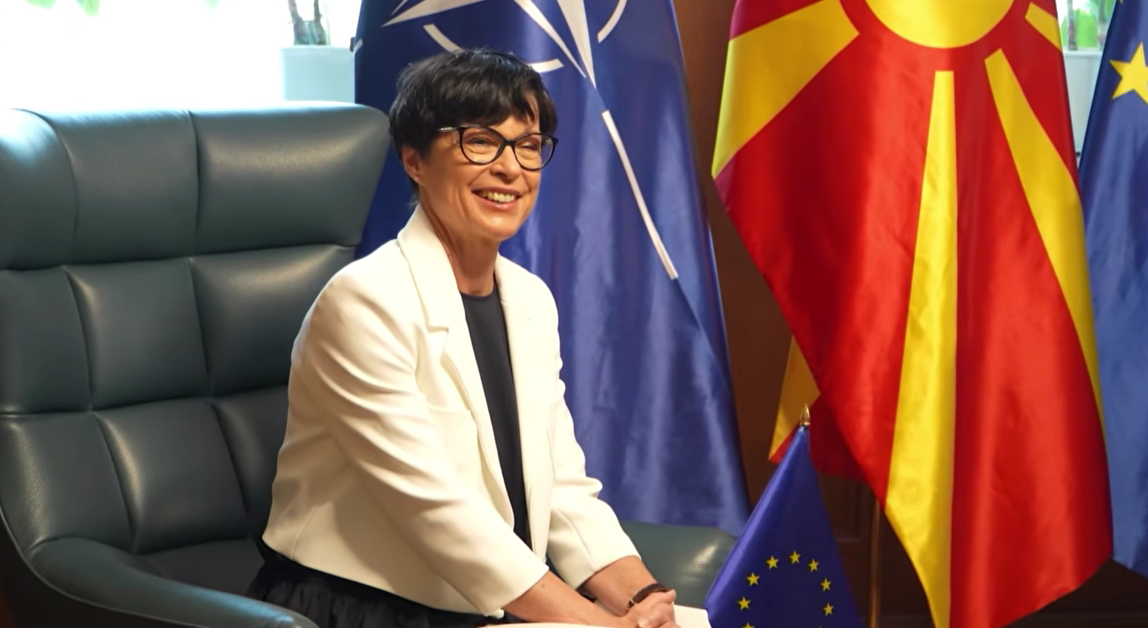
European Commissioner for Enlargement Marta Kos reaffirmed during her visit to Skopje that Macedonia’s path toward European Union membership remains open, but stressed that the implementation of the agreed constitutional amendments is still the essential next step before accession negotiations can formally move forward. During a joint press conference with Prime Minister Hristijan Mickoski, both officials reiterated their commitment to the country’s European future while acknowledging that key political and institutional challenges remain.
Kos emphasized that, alongside constitutional amendments, broad political consensus on electoral legislation and the continuation of reforms are necessary to maintain momentum in the accession process. She highlighted that Macedonian citizens are already benefiting from closer integration with the EU through initiatives such as the abolition of roaming charges, participation in the Erasmus+ program, cooperation in artificial intelligence, healthcare, cybersecurity, and funding available under the EU Growth Plan for the Western Balkans. According to the European Commissioner, full EU membership would unlock significantly greater financial support, infrastructure investment, and equal opportunities for citizens and businesses, pointing to Montenegro as an example of the increased funding countries receive as they move closer to accession.
Prime Minister Mickoski reaffirmed his government’s strategic commitment to EU membership but stressed that the accession process should be based on clear European criteria and merit based reforms, rather than becoming tied to bilateral political disputes. He stated that Macedonia will continue implementing reforms aimed at strengthening the rule of law, public institutions, and economic development while expecting equal treatment alongside other candidate countries. The government has consistently argued that maintaining public confidence in the accession process requires predictable conditions and respect for national dignity throughout negotiations.
The broader debate surrounding enlargement, however, remains complex. While EU officials continue to express support for the Western Balkans’ European perspective, analysts note that the Union’s long term budget planning and internal political priorities have raised questions about the pace of future enlargement. Discussions over the EU’s next multiannual financial framework, combined with upcoming political developments in major member states such as France, have fueled uncertainty about when new accessions may realistically occur. Serbian President Aleksandar Vučić also recently suggested that significant EU enlargement is unlikely in the immediate future, although he encouraged Western Balkan countries to continue pursuing reforms regardless of the current political climate within the Union.
Despite these uncertainties, both Brussels and Skopje agree that reforms remain the cornerstone of Macedonia’s European aspirations. While no concrete accession timeline was announced during Kos’s visit, the meeting reinforced that continued political dialogue, constitutional reform, and institutional modernization will determine how quickly the country can advance toward EU membership. For now, the prospect remains open, but progress continues to depend on fulfilling the commitments already agreed between Macedonia and the European Union.