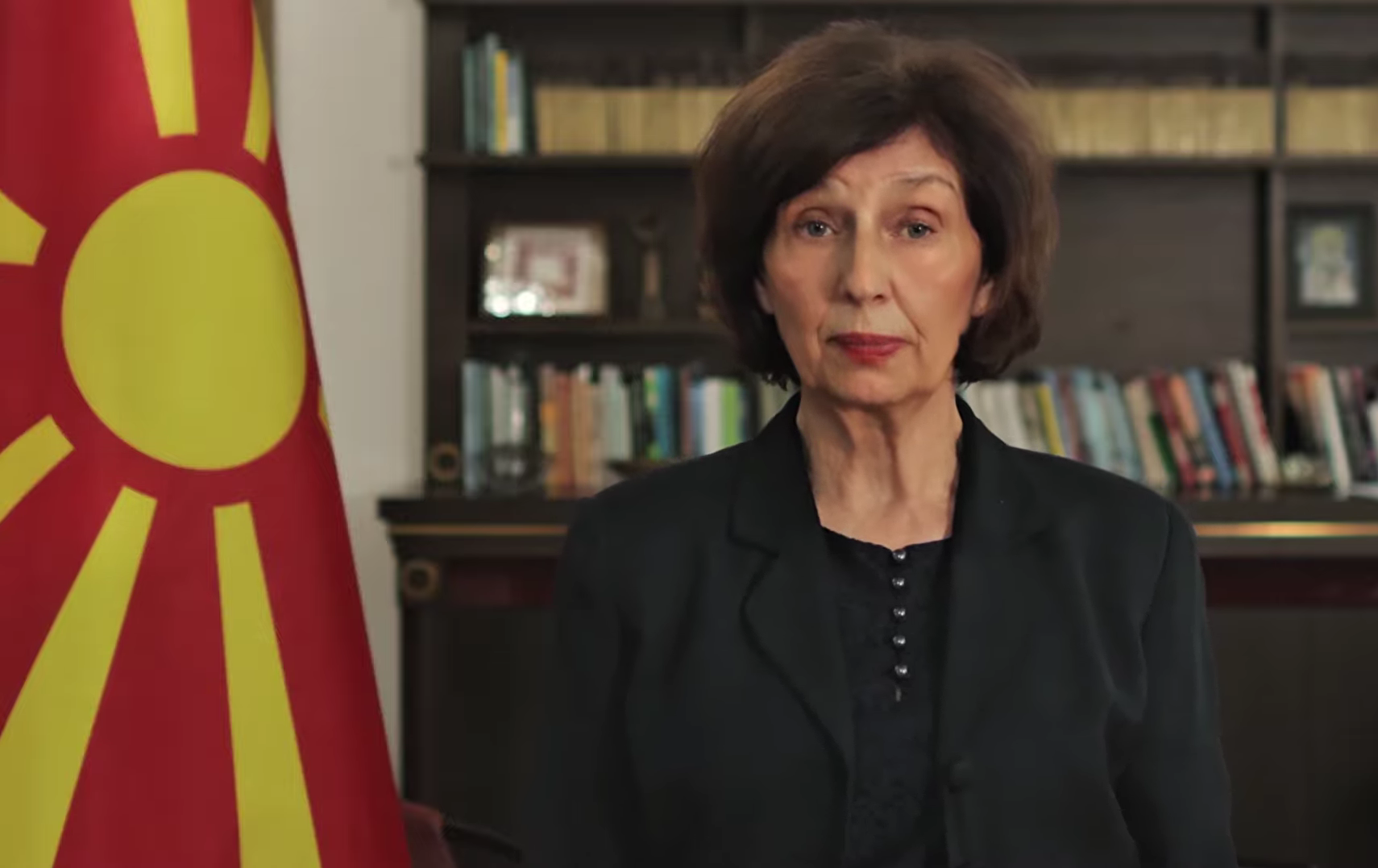
President Gordana Siljanovska Davkova officially opened the 66th edition of the Ohrid Summer Festival, one of the Balkans’ most prestigious cultural events, with a stirring address that framed art as a vital source of peace, love, and poetic transcendence in turbulent times. The festival, held in the UNESCO protected lakeside city of Ohrid, kicked off with a gala concert titled “Love” featuring world renowned operatic artists Ermonela Jaho and Charles Castronovo, accompanied by the National Opera and Ballet under conductor Marco Boemi. Siljanovska Davkova, serving as the festival’s traditional patron, used the occasion to emphasize how culture can bridge divides and nurture the human spirit.
In her opening address, the president described Ohrid as an “oasis and refuge of art,” where music, word, and dance merge into symphony against the backdrop of Samuel’s Fortress and the ancient city’s Byzantine churches. She invoked legendary past performances, Mstislav Rostropovich’s cello recitals that “moved the lake’s waves” and José Carreras’s voice that “challenged the birds like Orpheus”, to illustrate the festival’s power to transform a small Macedonian town into a global stage for human expression. For Siljanovska Davkova, “Ohrid Summer” represents more than entertainment, it symbolizes a “long and rich memory,” an enlightening mission, and a force for cosmopolitanism, interstate understanding, and intercultural dialogue that resonates far beyond the concert hall.
The 2026 edition continues a tradition that began in 1961 at the height of the Cold War, when artists from East and West gathered in Ohrid to send the message that “beauty will save the world.” Since then, the festival has hosted an extraordinary roster of classical music luminaries including Svyatoslav Richter, Grigory Sokolov, Zubin Mehta, Ennio Morricone, and Jessye Norman, performing in venues such as the 2,000 year old Ancient Theatre, the Church of St. Sophia, and the lakeside stages of Dolni Saraj. The festival became a member of the European Festivals Association in 1994, cementing its status as a cultural bridge between the Balkans and the wider European tradition. This year’s opening with Jaho, an Albanian born soprano hailed by The Economist as “the world’s most acclaimed soprano”, and Castronovo underscores the festival’s continued ability to attract top tier international talent to one of Europe’s oldest continuously inhabited cities.
The significance of the festival extends beyond aesthetics into the realm of cultural diplomacy. Siljanovska Davkova has consistently emphasized that cultural diplomacy is “far more powerful than traditional diplomacy” because it “does not rush to win, but nurtures and heals with notes and words.” In a region still grappling with historical tensions and identity politics, the Ohrid Summer Festival offers a rare space where shared artistic values transcend national boundaries. As Macedonia continues its EU accession process and navigates complex bilateral relationships, events like this serve as soft power instruments that project an image of a cultured, open, and European oriented nation. The 66th edition, running through August, promises to reinforce Ohrid’s reputation not merely as a tourist destination but as a living monument to the enduring power of art to unite, inspire, and elevate the human condition.