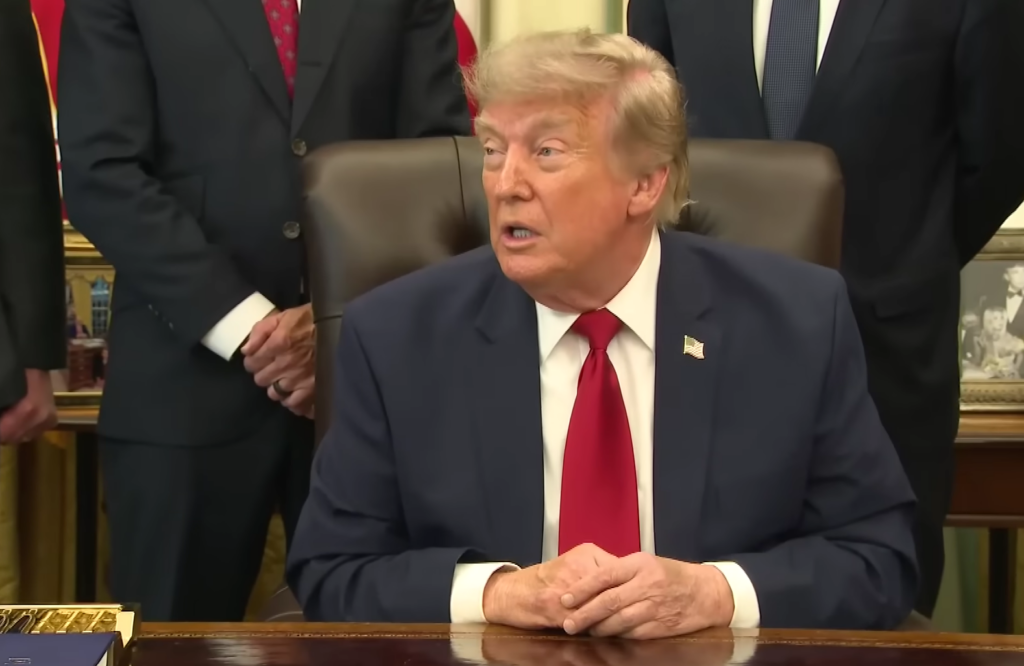
President Donald Trump declared on Monday that the United States would “probably take over” the Strait of Hormuz and should be financially compensated for guarding the vital waterway, dramatically escalating his rhetoric as US and Iranian forces exchanged heavy missile and drone attacks over the weekend. In a phone interview , Trump said America would become the “guardian angel of the strait” and demanded that wealthy Gulf nations reimburse Washington for protecting a passage through which one fifth of global oil supplies flow. The proposal came as Iran’s Revolutionary Guards announced that the strait remained closed to commercial traffic and warned that “continued interference could lead to greater incidents in the global oil and gas sector,” while Tehran struck US military facilities across the Gulf and expanded attacks to include Qatar, Bahrain, Kuwait, and Oman.
The latest exchanges mark a sharp escalation in both pace and geographic reach, casting further doubt on the June 17 interim agreement that was supposed to reopen the strait and halt hostilities during 60 days of negotiations. Iran shut the waterway on Saturday after accusing a vessel of traveling an unauthorized route, and despite Trump’s insistence that “the strait is open,” shipping data tells a different story. Only six vessels transited on Sunday, the lowest number in five weeks, and tankers have increasingly gone “dark” by disabling satellite tracking to avoid detection. Oil prices surged more than 4% on Monday, with Brent crude climbing to $79.11 and US West Texas Intermediate reaching $74.36, reversing recent declines that had followed the June ceasefire. The International Energy Agency reported that while global supply rose by 4.1 million barrels per day in June, it remained 9.4 million bpd below pre war levels, leaving markets acutely vulnerable to disruption.
Trump’s “guardian angel” proposal represents an unprecedented assertion of American control over an international waterway. “We’re going to guard it. We’re going to get paid for guarding it, a lot of money,” he said, arguing that wealthy Gulf allies “are on our side, and we can’t be expected to do that for nothing.” The idea of monetizing military protection for the strait has no precedent in international law and would likely face fierce opposition from regional powers who view Hormuz as sovereign or shared territory. Meanwhile, Iran has framed its closure as a defensive measure, with the Revolutionary Guards stating that the only way to restore regular traffic is to end US military interventions in the waterway. Trump countered that Iran had broken a “done deal,” declaring, “We’ve had 10 deals with these people, and so we’re just going to hit them very hard.” US Central Command said it struck approximately 140 Iranian military targets over the weekend, bringing the total to more than 300 across three nights of operations targeting air defense systems, coastal radar, missile and drone storage, and naval capabilities.
The regional fallout is expanding rapidly. Qatar, which has played a central mediation role, reported three people injured by falling shrapnel, including a child, and accused Iran of being “fully legally responsible.” Kuwait reported damage to an offshore oil drilling platform and one injured worker, the first direct strike on energy infrastructure in weeks. Oman, which had hosted Iran’s foreign minister for talks just hours before being targeted, summoned Tehran’s ambassador in a rare protest. Bahrain and Jordan also reported intercepted aerial attacks. With the June memorandum of understanding in tatters and both sides trading threats of further escalation, the conflict appears to be entering a new phase where control of Hormuz has become not merely a military objective but a bargaining chip in a high stakes negotiation that neither side seems willing to abandon. Trump’s proposal to turn the US into a paid “guardian” of the strait may be rhetorical brinkmanship, but it signals an American willingness to fundamentally restructure the geopolitical architecture of the world’s most important energy chokepoint.