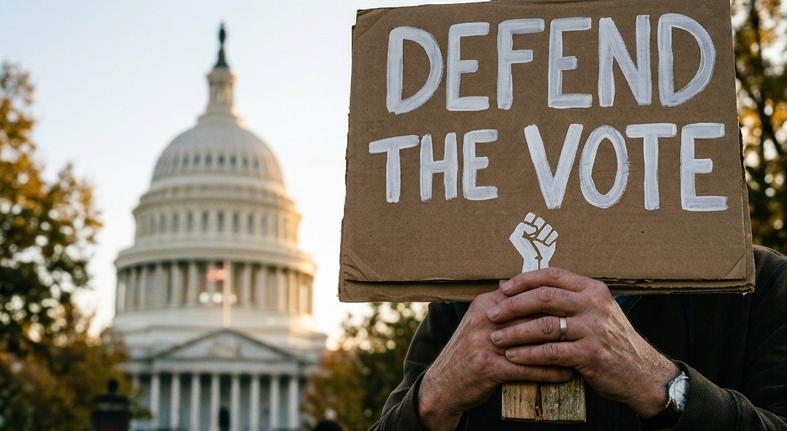
A coalition of civil rights organizations led by Reverend Al Sharpton’s National Action Network announced plans Tuesday for a major march on Washington to defend voting rights, responding to what they call a devastating Supreme Court decision that gutted a cornerstone of the 1965 Voting Rights Act. The “March on Washington 2026: Defend the Vote,” scheduled for August 28, will mark the 63rd anniversary of Martin Luther King Jr.’s “I Have a Dream” speech and the 1963 March on Washington for Jobs and Freedom. The coalition includes Martin Luther King III, labor unions, the NAACP, the National Urban League, and the Working Families Party, with Congressional Black Caucus Chair Yvette Clarke expected to attend alongside other members of Congress.
The march is a direct response to the Supreme Court’s April 29 ruling in Louisiana v. Callais, a 6-3 decision by the conservative majority that effectively weakened Section 2 of the Voting Rights Act to the point of inoperability. The case centered on Louisiana’s congressional redistricting after the 2020 census, where the state legislature initially passed a map packing several majority Black cities into a single district. When a federal court ordered a remedial map with two majority Black districts, the Supreme Court struck down the new map as an unconstitutional racial gerrymander, returning the state to the original single Black district configuration. Justice Samuel Alito wrote that allowing race to play any part in government decision making “represents a departure from the constitutional rule,” while Justice Elena Kagan’s dissent warned that the ruling allows states “to systematically dilute minority citizens’ voting power” without legal consequence. The decision has already triggered a frenzy of mid cycle redistricting across the South, with Florida passing new maps within hours of the ruling and Tennessee following days later.
Sharpton called the ruling “a bullet in the heart of the voting rights movement,” while Martin Luther King III framed the march as both remembrance and action: “Sixty three years after my father stood at the Lincoln Memorial, we are called to march again, not only in remembrance, but in action.” The coalition argues that the decision has intensified a long running fight over Black political representation and could eliminate up to 191 state legislative seats and 19 congressional seats currently held by representatives chosen through fair maps in majority Black districts. The White House defended the ruling as “a complete and total victory for American voters,” with spokeswoman Abigail Jackson stating that “the color of one’s skin should not dictate which congressional district you belong in.” Democrats countered that the decision represents the latest in a series of attacks by the conservative court against the fundamental right to vote.
The march follows a pattern of escalating civil rights mobilization under the Trump administration, including a Wall Street demonstration last year protesting corporate America’s retreat from diversity, equity, and inclusion initiatives. The coalition’s decision to return to the Lincoln Memorial on August 28 carries heavy symbolic weight, deliberately invoking the imagery and legacy of the 1963 gathering that helped catalyze the Voting Rights Act itself. Whether the march can translate moral outrage into legislative or electoral change remains uncertain, particularly with Republicans controlling both chambers of Congress and the White House. But for organizers, the stakes could not be higher, with midterm elections approaching and redistricting battles already reshaping the electoral map, the fight over voting rights has become a fight over the very architecture of American democracy.