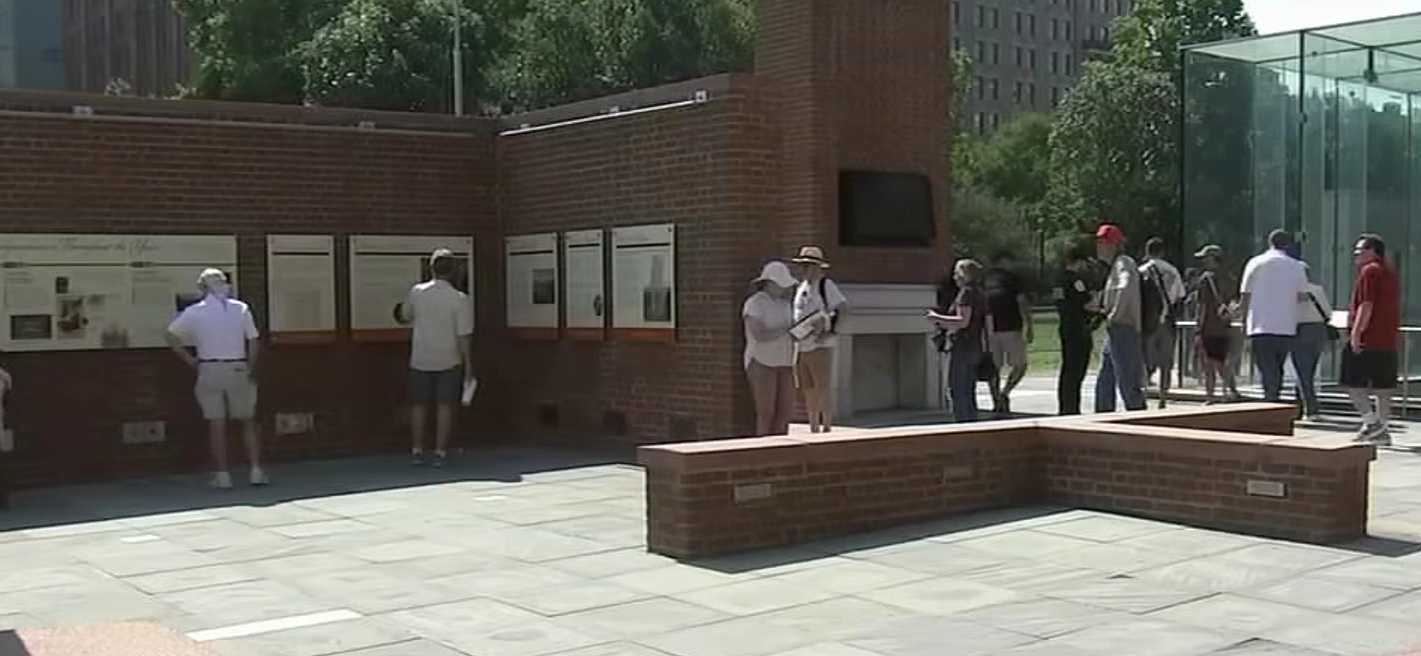
The Trump administration has installed revised historical panels at the President’s House in Philadelphia’s Independence National Historical Park, replacing an exhibit that detailed the lives of nine people enslaved by George Washington with a presentation that tones down the brutality of the institution. The change was carried out overnight on Wednesday, weeks after a federal appeals court overturned a lower court ruling that had blocked the administration from altering the display. While the Department of the Interior insists the new panels retain references to slavery and “acknowledge the evils” of the practice, the updated text removes explicit framing such as the headline “The Dirty Business of Slavery” and omits a map documenting transatlantic slave trade routes. Instead, visitors now encounter language centered on “Celebrating Independence Throughout the Years.” Philadelphia Mayor Cherelle Parker condemned the move as a clandestine effort to suppress a thorough accounting of the city’s history and announced the city would seek a rehearing on the legal questions involved.
The controversy is the latest flashpoint in a broader campaign by the administration to recast how federal institutions present American history. In March 2025, Trump issued an executive order titled “Restoring Truth and Sanity to American History,” directing the Interior Secretary to review and replace any monuments or exhibits that “inappropriately disparage Americans past or living” and to reinstate Confederate statues removed since 2020. The order also tasked Vice President J.D. Vance with removing “improper ideology” from the Smithsonian Institution. National Park Service staff removed the “Freedom and Slavery in the Making of a New Nation” display in January 2026, citing the executive order’s mandate against signage that “disparages Americans past and living.” A federal judge ordered the panels restored in February after the city sued, finding the removal violated a 2006 cooperative agreement, but the administration appealed and proceeded with the revised installation after last month’s appellate ruling.
The alterations have drawn sharp criticism from historians who view them as a deliberate sanitization of a painful but essential chapter of the national story. Alan Spears, senior director for cultural resources at the National Parks Conservation Association, warned that the new panels appear designed to soften the historical interpretation of slavery at a site integral to understanding the contradictions of the founding era. “I have grave concerns about how this impacts the ability of our national parks to fulfill their role as honest brokers of our shared national narrative,” Spears said. Since the 2025 executive order, more than 1,000 items across the National Park Service have been flagged for review, with content related to slavery, Japanese internment, Native American history, and LGBTQ+ rights among those targeted. The Organization of American Historians has condemned the administration’s actions as politically motivated, while civil rights groups have warned that dismantling slavery exhibits and restoring Confederate monuments could reverse decades of progress in confronting the nation’s legacy of racial oppression.
For the administration, the changes align with a stated goal of expunging what Trump has termed “anti American” ideology from cultural institutions. The president has publicly complained that museums focus too heavily on “how bad Slavery was” and has cited “reverse discrimination” while claiming civil rights advancements have harmed white Americans. The White House has also pressed the Smithsonian to alter exhibitions, at one point removing references to Trump’s own impeachments from the American History Museum before restoring them under public pressure. Legal scholars at Yale Law Journal have characterized these efforts as executive overreach, arguing the Smithsonian operates as a trust instrumentality outside direct presidential control. Yet the administration has pressed ahead, using its authority over the National Park Service to ensure that historical sites emphasize what the executive order calls “the greatness of the achievements and progress of the American people.” As the country approaches the 250th anniversary of the Declaration of Independence, the battle over the President’s House panels encapsulates a larger struggle over whose story gets told at federally funded sites. With Philadelphia vowing to continue its legal fight and historians warning that the integrity of the park system itself is at stake, the dispute shows no sign of ending at the courthouse door.