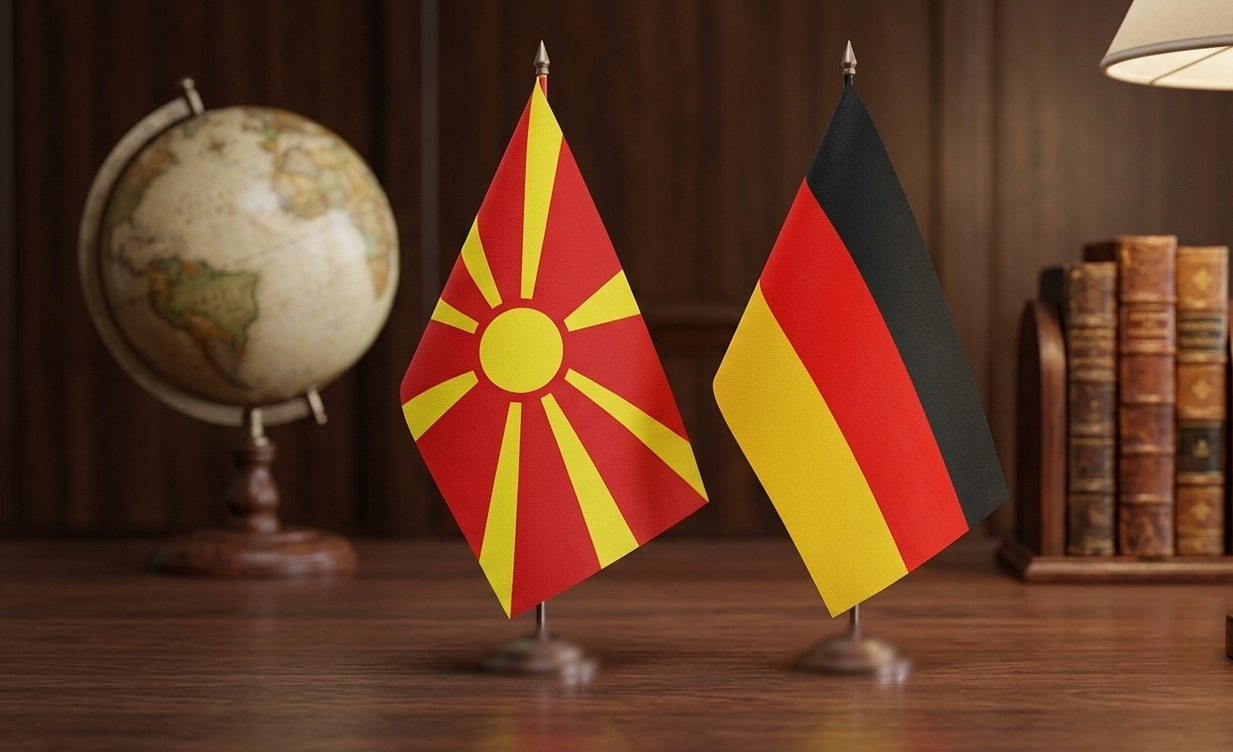
The chief of Germany’s armed forces, General Carsten Breuer, visited Skopje this week to advance a strategic partnership that is pushing military cooperation between Berlin and Macedonia into a new phase. During meetings with Defense Minister Vlado Misajlovski, President Gordana Siljanovska Davkova, and Prime Minister Hristijan Mickoski, Breuer and his hosts confirmed their commitment to NATO aligned security, army modernization, and expanded defense capacity. The visit underscores Germany’s growing interest in the Western Balkans as a stability anchor at a time when the region faces renewed geopolitical pressure.
Breuer praised Macedonia as a “factor of stability” that strengthens both the alliance and European security. “Our cooperation should remain practical and of military significance,” he said, highlighting a recent agreement to exchange military equipment between the two countries’ armed forces. Macedonia’s army chief, Major General Sashko Lafchiski, emphasized the concrete results already achieved through joint training and education. A significant number of Macedonian personnel have trained at German military centers, bringing back expertise that has been integrated into domestic units and command structures. “We especially value the professionalism and standards they bring into our military units, as leaders in the command structures of the Army,” Lafchiski said. His own career reflects deep Western integration, a graduate of the U.S. Army War College and former NATO evaluator in Naples, he has commanded special forces in Iraq and was appointed chief of the general staff by President Siljanovska Davkova in August 2024.
The talks also explored future projects in defense development and experience exchange, with both sides stressing that their dialogue must translate into tangible capability improvements. Macedonia, which joined NATO in March 2020 after resolving its long running name dispute with Greece, has been steadily aligning its military with alliance standards. The country contributes troops to NATO missions including KFOR in Kosovo and forward land forces in Bulgaria, Romania, and Latvia. Germany’s engagement, including the equipment exchange and training pipelines, offers Skopje a key partner as it works to modernize a force of roughly 8,000 active personnel and meet the 2% of GDP defense spending target. With Breuer’s visit adding high level momentum, the partnership signals that Berlin views the Western Balkans not as a peripheral concern but as an integral part of Europe’s collective defense architecture.