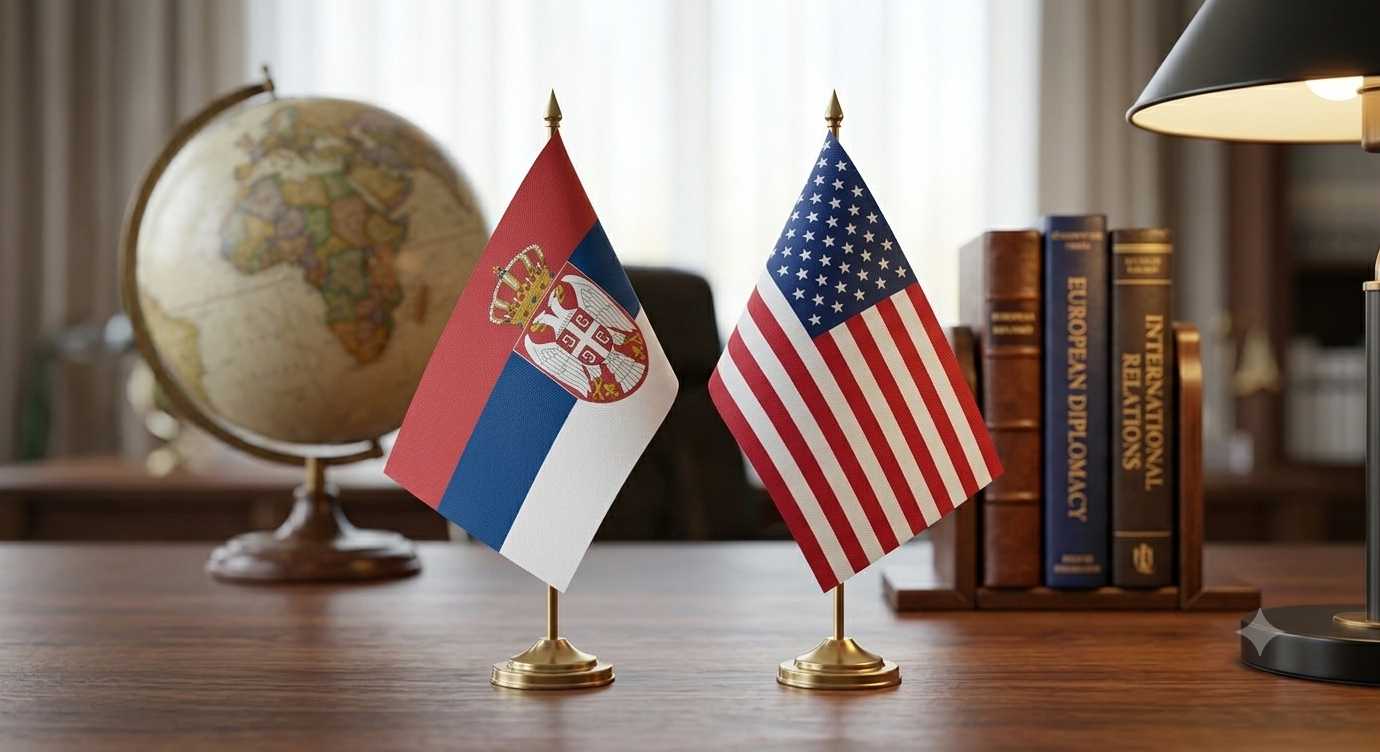
Serbia and the United States are inaugurating a Strategic Dialogue in Washington on Friday, a move both sides are framing as a historic milestone that elevates bilateral relations to a new level of institutional cooperation. Serbian Foreign Minister Marko Djuric will meet with US Deputy Secretary of State Christopher Landau for the inaugural session, which the State Department has described as reflecting “a new era in U.S.–Serbia relations.” The dialogue will cover regional peace and stability, business and educational ties, and what Washington calls “building a more prosperous future.” For Belgrade, the format offers a structured channel to advance its interests while maintaining the delicate balancing act between EU candidacy, NATO partnership, and open channels to Moscow and Beijing that has defined President Aleksandar Vučić’s foreign policy.
The launch comes against a starkly contrasting backdrop in Kosovo. Washington indefinitely suspended its planned Strategic Dialogue with Pristina last September, citing Prime Minister Albin Kurti’s actions as having “increased tensions and instability” and reduced the possibility of productive cooperation. Former Kosovo Prime Minister Avdullah Hoti warned that Pristina risks economic and political isolation if its current approach continues. Analysts see the asymmetry as deliberate. Petar Ivic of the Pupin Initiative called the Serbia dialogue a confirmation that Washington recognizes Belgrade as “an important strategic partner and future ally,” arguing that Kosovo’s leadership “failed to prove themselves constructive partners” while Serbia positioned itself as more credible and reliable. The timing also reflects post 2022 shifts, Serbia no longer conducts military exercises with Russia, held its first NATO exercise in May 2026, and has deepened joint training with the United States through the long running Platinum Wolf program.
Yet not all observers view the dialogue as transformative. Luke Zaner, a senior fellow at the Center for American Progress, cautioned that it is “a dialogue, not a strategy”, an important institutional step that creates opportunities but does not by itself fundamentally alter relations. He noted that the Trump administration approaches regional partnerships transactionally and that Serbia should not assume it now occupies a position above other Western Balkan countries. The dialogue’s real value, Zaner argued, will depend on concrete outcomes rather than ceremony. For Vučić, who has leveraged Serbia’s strategic ambiguity to extract concessions from multiple powers, the format validates his approach of engaging with Brussels, Washington, Moscow, and Beijing simultaneously. Whether that flexibility can be sustained as the dialogue produces specific demands, particularly on Kosovo recognition and sanctions alignment, remains the open question that will define whether Friday’s handshake translates into lasting strategic partnership.