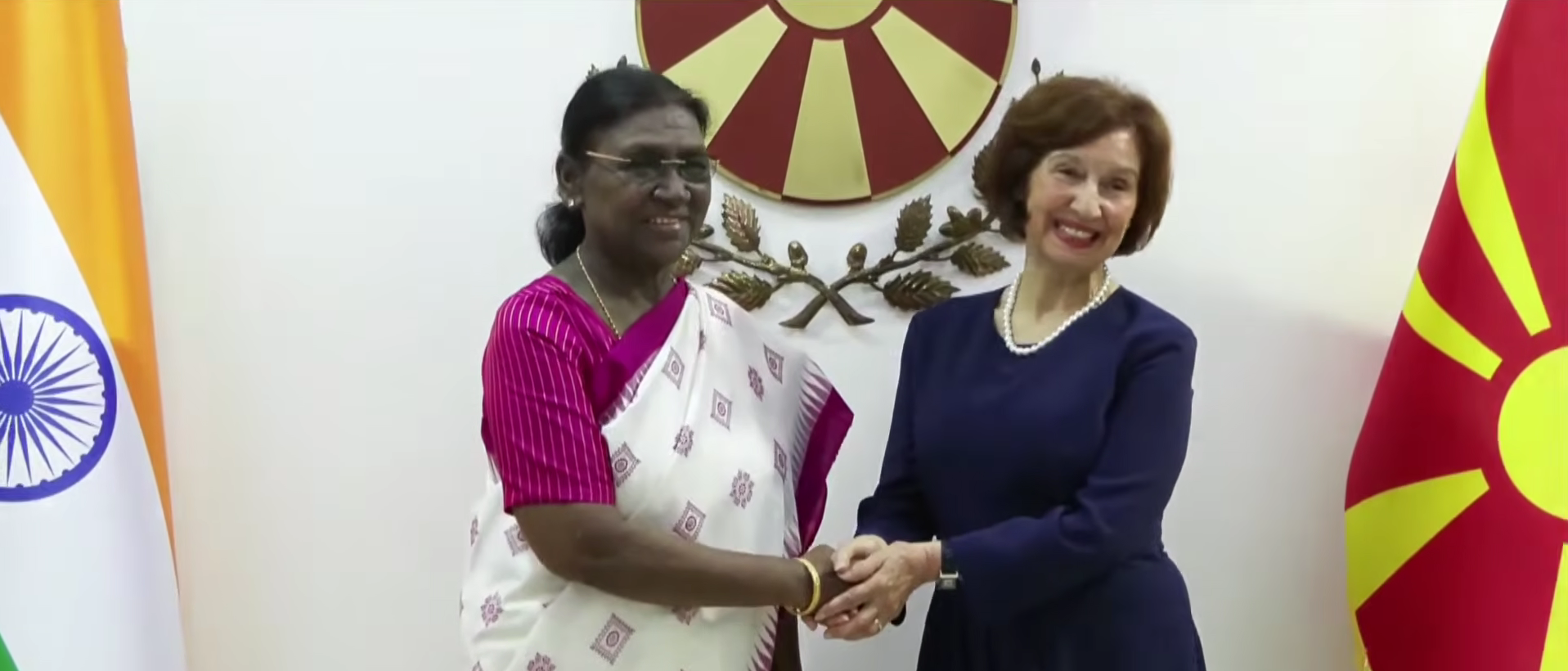
Indian President Droupadi Murmu has become the first Indian head of state ever to visit Macedonia, arriving in Skopje on July 20, 2026, for a two day state visit that both sides hope will open “a new chapter” in bilateral relations. The visit, part of a broader tour that includes Moldova and Romania, saw Murmu hold delegation level talks with President Gordana Siljanovska Davkova, meet Prime Minister Hristijan Mickoski, and address the National Assembly. The two presidents confirmed friendly relations and mutual respect, agreeing to intensify political dialogue and elevate bilateral ties to a higher level through more frequent, better structured, and more ambitious contacts between governments, ministries, parliaments, and institutions.
The symbolic dimension of the visit was carefully choreographed. On the second day, Murmu and Siljanovska Davkova visited the Memorial House of Mother Teresa, born Anjezë Gonxhe Bojaxhiu in Skopje in 1910, and the City Museum of Skopje, where they unveiled a bust of Mahatma Gandhi. The choice was deliberate, Mother Teresa, who became an Indian citizen in 1951, represents the deepest cultural bridge between the two nations. From there, the delegation traveled to Ohrid to visit the Saint Naum monastery complex and churches in the Old Town, blending spiritual heritage with diplomatic outreach. The itinerary reflected India’s soft power approach, honoring shared values while laying groundwork for concrete economic cooperation.
The economic agenda was equally ambitious. At the India-Macedonia Business Forum, held on July 21, both sides agreed to double bilateral trade volume, currently hovering around $37 million annually, reaching at least $400 million within five years. President Murmu identified numerous sectors for strengthened cooperation, automotive industry, pharmaceuticals, healthcare, IT and IT enabled services, business process outsourcing, renewable energy, agriculture, food processing, machinery, logistics, and advanced manufacturing. A memorandum of cooperation in healthcare was signed, with both sides agreeing to promote traditional medicine. Nirmal Kumar Minda, President of ASSOCHAM (the Associated Chambers of Commerce and Industry of India), emphasized India’s strengths as home to the world’s largest digital infrastructure, a vibrant investment ecosystem, and one of the youngest workforces globally. He framed Macedonia as an attractive destination for Indian companies seeking European market access, citing its strategic location at the crossroads of European corridors, skilled workforce, and favorable investment climate.
The visit comes at a pivotal moment for both countries. India is actively expanding its footprint in Eastern Europe, with Murmu’s tour reflecting “the importance India attaches to strengthening its bilateral ties with these countries along with India’s engagement with the wider Eastern European region,” according to India’s Ministry of External Affairs. For Macedonia, a small EU candidate country with a population of roughly 1.8 million, the courtship by the world’s most populous nation and fifth largest economy offers a chance to diversify its foreign partnerships beyond the EU and traditional Balkan neighbors. Diplomatic relations were established in 1995, and while bilateral trade has grown steadily, it remains modest, Indian exports totaled $32.84 million in 2024, with Macedonia running a significant trade deficit. The two countries have signed agreements on investment protection, visa exemptions for diplomatic passports, and double taxation avoidance, but economic ties have yet to match their political warmth.
Whether the $400 million trade target and the flurry of memoranda translate into tangible investment depends on follow through. Macedonia’s EU candidacy gives it preferential access to European markets, but its small domestic market, bureaucratic challenges, and ongoing rule of law concerns may give Indian investors pause. For now, the visit itself is the message, after 30 years of diplomatic relations, India and Macedonia have finally put a presidential stamp on a partnership that has long existed on paper. As Murmu herself put it, her visit will “open a new chapter in bilateral relations and strengthen partnerships between Macedonia and India, but also elevate them to a higher level.” The bust of Gandhi now stands in Skopje. The test is whether the trade figures will stand up to the same scrutiny.