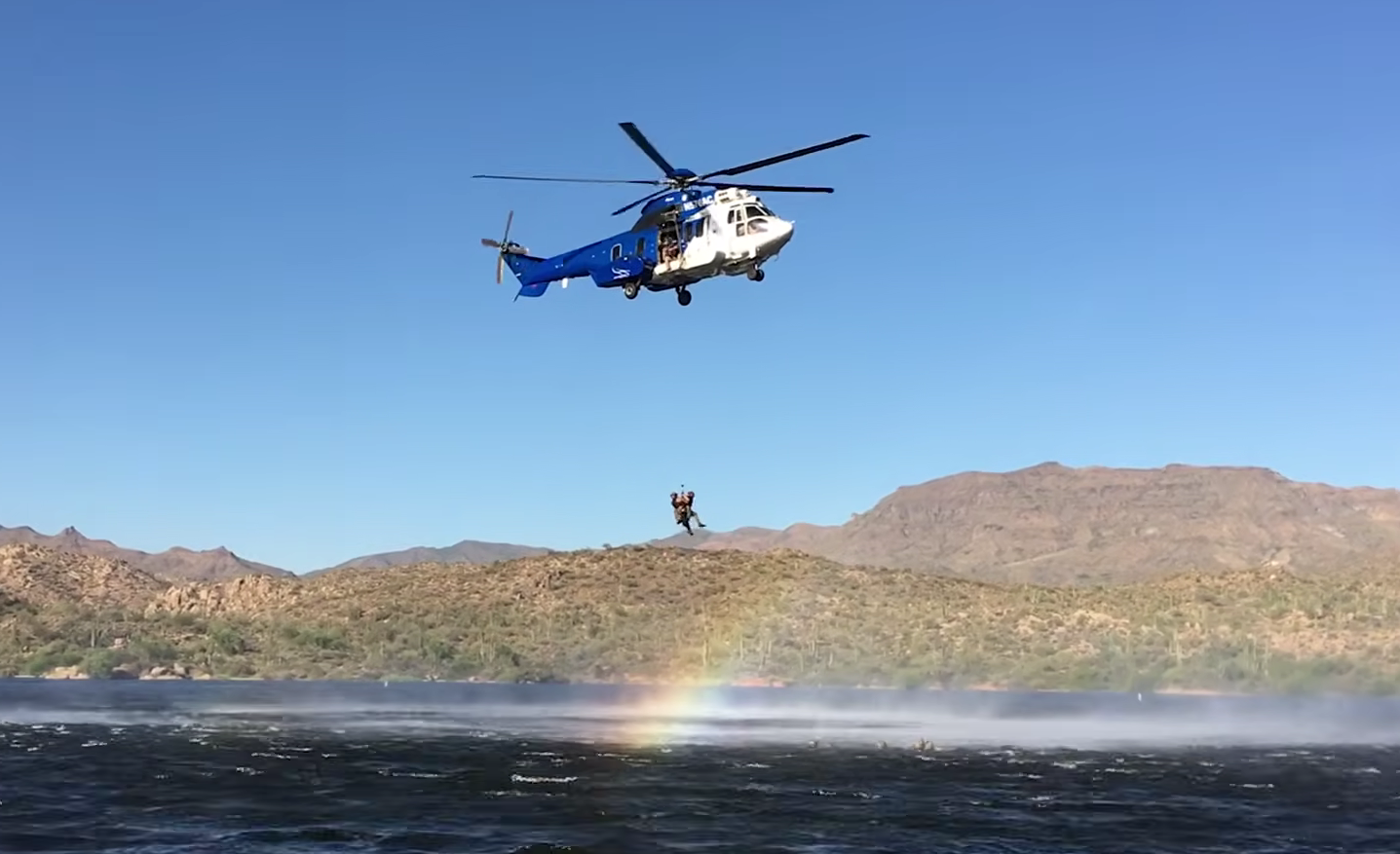
Serbia has offered to deploy an Airbus H215 Super Puma helicopter to help Spain combat devastating wildfires that have scorched vast areas of the Iberian Peninsula.
The move marks a significant contribution to the European Union’s coordinated disaster response.
The Spanish Ministry of Interior confirmed that Belgrade’s offer came through the EU Civil Protection Mechanism, with the Serbian aircraft and crew set to join firefighting efforts across the Ávila, Madrid, Toledo and Castellón regions.
The Serbian contingent will operate alongside aerial assets and personnel from Greece, Italy, Portugal and Turkey as part of one of the largest multinational firefighting operations in recent European history.
The deployment underscores both Serbia’s growing integration into European emergency response frameworks and the sheer scale of the crisis unfolding in Spain, where multiple simultaneous blazes have pushed national resources to their limits.
Serbia Deploys Super Puma for Spain Wildfires
The Serbian Ministry of Interior’s Helicopter Unit operates three Airbus H215 Super Puma aircraft.
The heavy lift twin engine helicopters are derived from the proven Super Puma family, which has accumulated more than six million flight hours worldwide.
The H215 is a versatile multi role platform capable of carrying up to 19 passengers, lifting external loads of 4,500 kilograms and dropping up to 4,000 liters of water per pass using bucket or belly-tank systems.
Serbia ordered the three H215s for its police helicopter unit in 2019 alongside nine H145M helicopters.
The deliveries were originally scheduled for 2021–2022 as part of a broader modernization of Serbia’s aerial fleet, whose origins date back to 1967.
The unit’s roles span personnel transport, search and rescue, border monitoring, VIP transport, medical evacuation and aerial firefighting.
That makes the Super Puma well suited to the demanding conditions of Spain’s fire zones.
The aircraft’s ability to operate in harsh environments, including extreme heat and continuous icing conditions, will be critical as Spanish firefighters battle blazes in rugged terrain where ground access is severely limited.
Spain Faces Severe Wildfire Season
The Serbian deployment comes as Spain faces one of its most severe wildfire seasons on record.
The fire that originated in Burgohondo, Ávila, has burned approximately 50,000 hectares and covers a perimeter of roughly 280 kilometers.
Third Vice President Sara Aagesen described it as the largest wildfire in Spanish history.
Combined with fires in Madrid and Toledo, the total burned area has reached 77,000 hectares, affecting 90,000 people.
Of those, 60,000 have been evacuated and another 30,000 confined.
A separate blaze in Vall d’Uixó, Castellón, has burned 6,500 hectares and forced 16,600 evacuations.
Throughout 2026, 153,000 hectares have been affected by fires across Spain, six times the area burned by the same date in 2025.
A total of 32 large fires have been recorded.
EU Mobilizes Firefighting Resources
The EU has mobilized six aircraft from Greece, Italy and Turkey, along with 134 personnel and 41 vehicles from Portugal.
The bloc has also activated its rescEU strategic reserve fleet of 22 planes and five helicopters.
Commissioner Hadja Lahbib has pledged that Europe will stand with Spain until the fires are out, reflecting the bloc’s recognition that no country should face disasters of this magnitude alone.
For Serbia, the mission represents both a practical demonstration of its emergency response capabilities and a symbolic affirmation of its commitment to European solidarity.
The deployment comes as Serbia continues its long journey toward full EU membership.