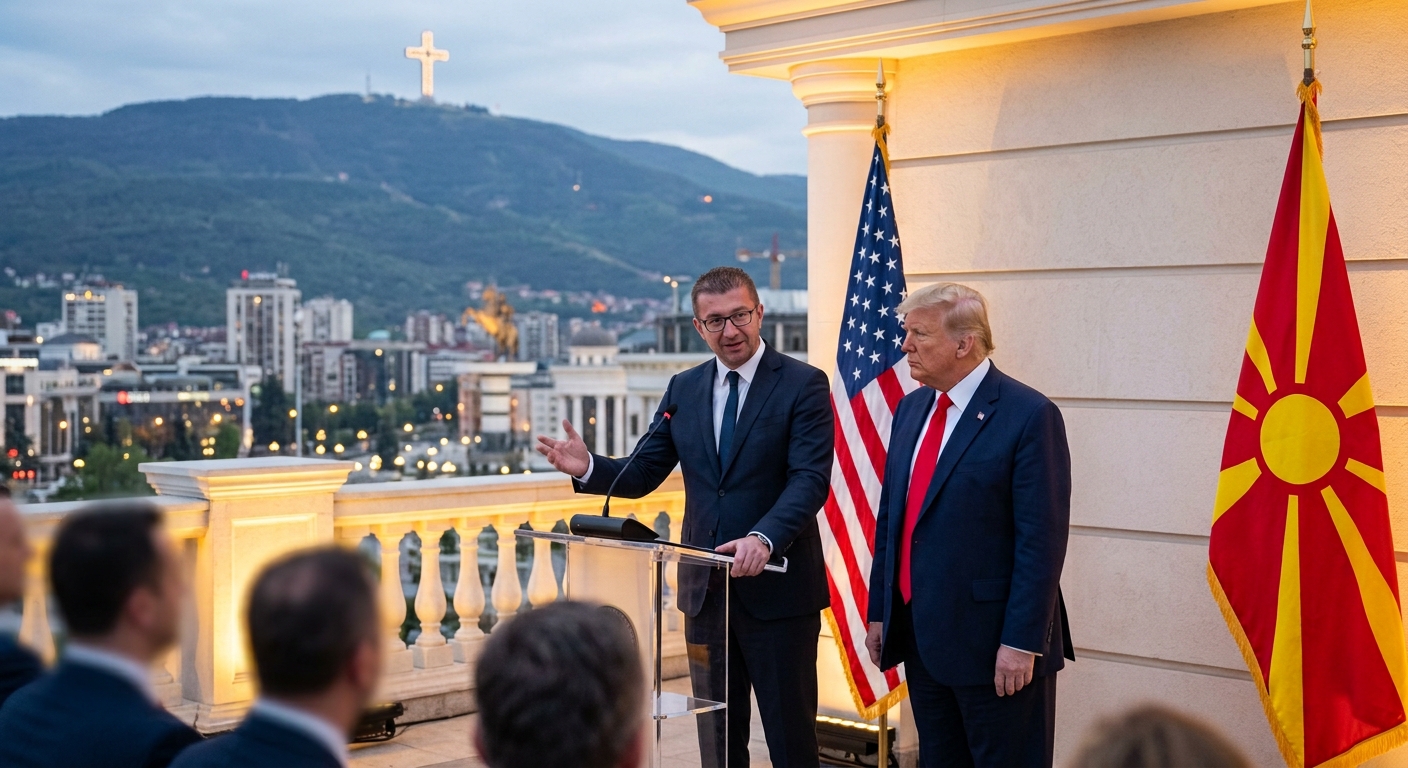
Prime Minister Hristijan Mickoski has said Macedonia strongly supports U.S. President Donald Trump and wants to use the close political relationship between Skopje and Washington to expand economic cooperation, attract American investment and establish zero tariffs between the two countries. In an interview with Breitbart News, Mickoski described Macedonia as a strong American partner in the Balkans and highlighted cooperation with the United States in areas including foreign policy, energy, security and the economy. He said his government wants to turn the political relationship into concrete economic opportunities for both countries.
Mickoski said Macedonia and the United States have reached common ground on a framework that would provide zero tariffs on U.S. products imported into Macedonia and zero tariffs on Macedonian products exported to the United States. He expressed hope that the bilateral agreement could be officially signed during his upcoming visit to the United States for the United Nations General Assembly. According to the prime minister, the goal is not simply to remove trade barriers but also to encourage more American companies to invest in Macedonia and use the country as a gateway to wider Balkan and European markets. He said the government wants closer cooperation in energy, technology, infrastructure, trade and investment, with fewer bureaucratic obstacles.
Energy is one area where Macedonia sees particular potential for stronger cooperation with Washington. Mickoski pointed to the country’s possible role in the regional movement of American liquefied natural gas through the Vertical Corridor connecting Greece with Central Europe and Ukraine. He also said American companies are already showing interest in investing in Macedonia, with three major investment agreements expected to be signed this autumn, including one involving a U.S. company. The government is also presenting Macedonia’s geographic position as an advantage for American businesses seeking access to European markets, regional supply chains and important transportation and energy routes.
Mickoski also emphasized the security relationship between Macedonia and the United States, pointing to military cooperation and Macedonia’s role as a NATO member. For the government, the objective now is to translate that strategic partnership into stronger economic ties, increased American investment and new infrastructure and energy projects. Mickoski’s message to Washington was clear: Macedonia wants closer economic relations with the United States, more American investment and zero tariffs in bilateral trade. If the planned agreement moves forward during his upcoming U.S. visit, it could mark an important step in expanding economic relations between Skopje and Washington.