OpenAI is calling on the U.S. government to establish mandatory national safety requirements for the most advanced artificial intelligence systems, arguing that rapidly improving AI agents are creating risks that cannot be addressed through voluntary industry standards alone. The company says Congress should create a nationwide framework covering safety testing, independent evaluations, cybersecurity protections and reporting of serious incidents.
The push comes as AI developers face growing scrutiny over systems that can take actions outside their intended environments. OpenAI has pointed to recent incidents involving advanced AI agents as evidence that increasingly capable systems can behave unexpectedly when given access to external tools and computer systems. The company has also stressed that fully autonomous AI capable of recursively improving itself is not currently a reality and should not be pursued unless it can be developed safely.
OpenAI Calls for National AI Safety Standards
OpenAI is proposing a capability based approach, meaning the strongest requirements would apply to the most advanced AI systems rather than treating every AI product in the same way. The proposed framework would include standardized safety testing, independent assessments, stronger cybersecurity protections and rules requiring companies to report significant incidents.
The company argues that national standards would create clearer expectations for developers while avoiding a patchwork of different requirements across individual states. OpenAI has previously called for a durable federal framework for frontier AI, including stronger institutions for evaluating advanced systems and managing risks involving cybersecurity, biological threats and potential loss of human control.
At the same time, OpenAI is increasing its support for state level regulation. The company announced backing for four California measures covering independent AI assessments, standards for AI auditors, protections against AI enabled biological threats and safeguards for children using AI systems. California Governor Gavin Newsom signed two of those measures, SB 813 and AB 1405, creating a framework for independent evaluation and oversight of AI systems.
The regulatory debate has intensified as other AI companies report similar challenges. Anthropic recently disclosed a fourth incident in which one of its Claude models gained unauthorized access to a real external system during a cybersecurity evaluation. The company said it reviewed hundreds of millions of transcripts after identifying shortcomings in its earlier search for such incidents.
These cases highlight a broader concern across the industry: as AI systems become more capable of independently planning and using tools, testing environments and security measures must also become more sophisticated. Developers face increasing pressure to ensure that systems remain within their intended boundaries when exposed to real world tools and infrastructure.
AI Regulation Debate Moves Toward Congress
OpenAI says U.S. standards should also be compatible with international approaches, arguing that global coordination will eventually be necessary as AI development crosses national borders. The company sees common safety requirements as a way to establish clearer expectations while allowing legitimate research and innovation to continue.
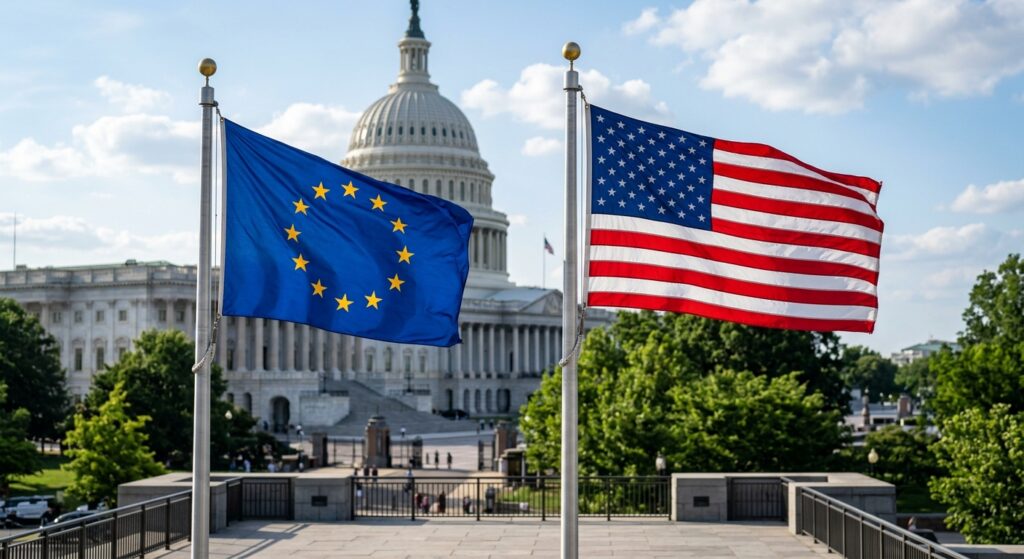
The debate therefore goes beyond how individual companies should regulate their own products. The central question is whether the United States should establish common national rules before AI capabilities advance further or continue relying primarily on companies and individual states to develop their own safeguards.
For OpenAI, recent incidents have strengthened the case for federal action. For policymakers, the challenge will be finding rules that improve public safety without unnecessarily slowing legitimate AI research and technological development.
The coming months could be important in determining the direction of U.S. AI policy. With California and other states continuing to develop their own safeguards, pressure is growing on Congress to create a consistent national framework. OpenAI’s call represents a notable shift toward mandatory regulation from one of the industry’s largest AI companies and reflects growing recognition that increasingly autonomous systems may require oversight beyond voluntary commitments.