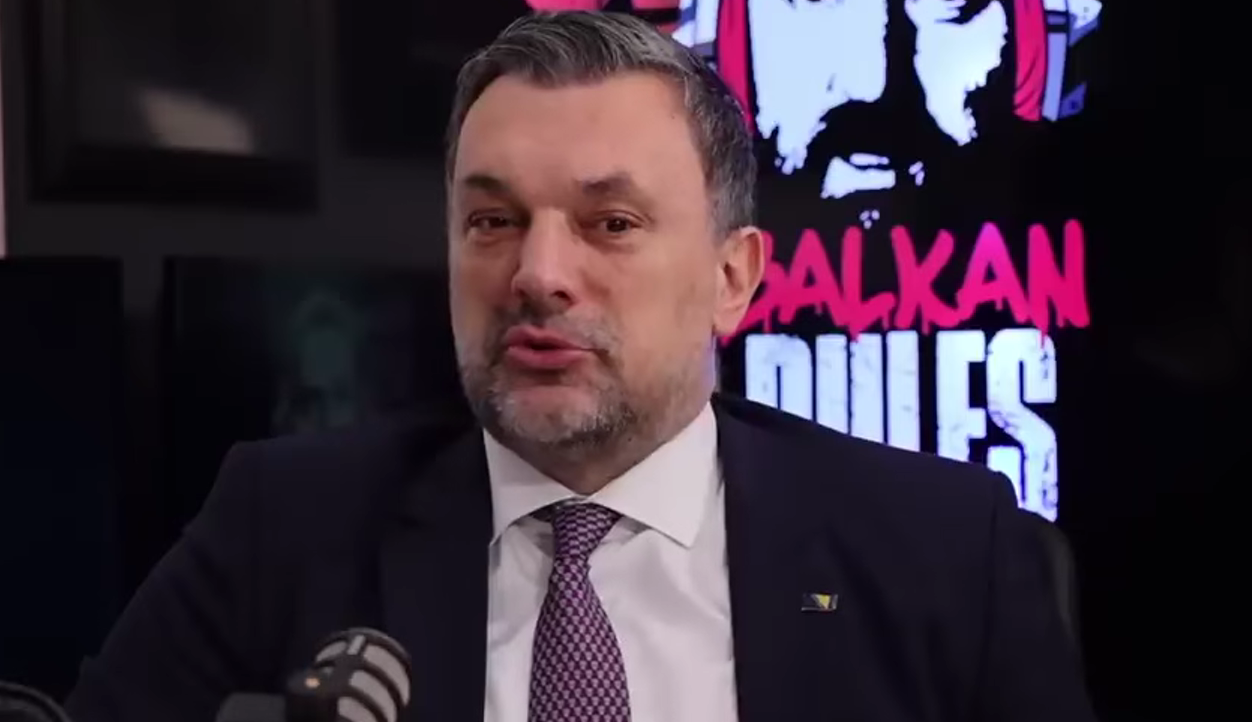
Bosnia and Herzegovina’s Foreign Minister Elmedin Konaković has reaffirmed the country’s commitment to European Union membership during meetings with Western Balkan partners on the sidelines of the 81st United Nations General Assembly in New York. At an informal gathering hosted by EU High Representative for Foreign Affairs and Security Policy Kaja Kallas, discussions focused on foreign policy, regional security and the European future of the Western Balkans. Konaković used the meeting to emphasize that Bosnia and Herzegovina EU membership remains one of the country’s main strategic and foreign policy objectives.
The meeting came as European officials continue to connect enlargement with wider questions of security, democratic governance and regional stability. Kallas’s UN General Assembly program has focused on strengthening international partnerships and defending international law and multilateral cooperation, making the Western Balkans part of a broader European foreign policy discussion.
Konaković also addressed recent developments involving Serbia and public commemorations surrounding former Bosnian Serb military commander Ratko Mladić. He argued that Bosnia and Herzegovina’s concerns should not be interpreted as opposition to the Serbian people or as a dispute over competing versions of history. Instead, he framed the issue around the actions of political authorities and public institutions and their implications for reconciliation and regional relations.
The legal record surrounding Mladić is established through international criminal proceedings. The International Criminal Tribunal for the former Yugoslavia convicted him of genocide, crimes against humanity and violations of the laws or customs of war, and the conviction was upheld on appeal. The International Court of Justice separately found in 2007 that Serbia violated its obligations under the Genocide Convention by failing to prevent the Srebrenica genocide and by failing to fully cooperate with the ICTY concerning Mladić. The court did not, however, find that Serbia itself was legally responsible for committing the genocide.
Konaković argued that questions surrounding remembrance, accountability and reconciliation are also relevant to the European integration process. His position reflects a broader argument that EU enlargement involves more than adopting legislation and meeting technical benchmarks, particularly when issues involving democratic institutions, rule of law and regional stability are involved.
Bosnia and Herzegovina EU Membership Remains Linked to Reforms
Bosnia and Herzegovina has already taken several important steps toward EU membership. The country applied for membership in 2016 and received candidate status in December 2022. In March 2024, the European Council decided to open accession negotiations, while the European Commission has continued to identify reforms that must be completed before the negotiations can move into their next substantive stages. Bosnia and Herzegovina remains a candidate country, and accession negotiations have not yet been formally opened.
The pace of the accession process remains closely connected to domestic reforms. EU priorities include strengthening democratic institutions, the rule of law, judicial independence, fundamental rights and public administration. In June 2026, European Council President António Costa said Bosnia and Herzegovina was only a few steps away from the next tangible phase of the accession process, while urging political leaders to accelerate reforms and align national legislation with EU standards.
Another issue highlighted by Konaković was Bosnia and Herzegovina’s alignment with the EU’s Common Foreign and Security Policy. He said the country achieved full alignment with EU foreign policy positions during 2025 and maintained that alignment in 2026. He presented this as more than a technical part of the accession process, describing it as a strategic choice about Bosnia and Herzegovina’s international orientation.
The issue has become more significant as European governments respond to Russia’s war against Ukraine and a changing security environment. Bosnia and Herzegovina has aligned itself with EU positions on a number of international issues, while the EU continues to emphasize that candidate countries are expected to progressively align their foreign and security policies with the Union.
Regional Security Adds Another Dimension to EU Integration
Konaković also connected EU integration with the wider European security architecture. He argued that instability in the Western Balkans cannot be separated from broader European security concerns and called for a credible and predictable enlargement process based on the same standards for all candidate countries. His comments reflect Sarajevo’s position that EU membership should remain a realistic strategic objective rather than simply a long term political aspiration.
Security cooperation was another major part of the discussion, particularly the role of EUFOR Althea in Bosnia and Herzegovina. Konaković said the country attaches importance to the continued presence of the EU led mission and the extension of its mandate. EUFOR has operated in Bosnia and Herzegovina since 2004 and is tasked with supporting a safe and secure environment while also working with the country’s armed forces. The EU continues to describe the mission as an important part of its security engagement in Bosnia and Herzegovina.
The mission also has a broader political significance because the EU sees stability in Bosnia and Herzegovina as closely connected to the country’s European future. EU officials have repeatedly emphasized support for Bosnia and Herzegovina as a sovereign and territorially intact state and have urged political leaders to focus on reforms required for EU accession.
For Bosnia and Herzegovina, the challenge is therefore taking place on several connected fronts. The country must advance domestic reforms, maintain alignment with EU foreign policy positions and preserve political stability while dealing with unresolved regional questions and the legacy of the 1990s conflict. At the same time, Brussels is seeking greater progress from all Western Balkan candidates as the EU places renewed emphasis on enlargement as part of its broader geopolitical strategy.
Konaković’s remarks in New York ultimately placed Bosnia and Herzegovina’s EU ambitions within this wider political and security framework. His message was that Sarajevo wants to continue moving toward the EU on the basis of established standards rather than seeking exceptions, while also emphasizing the importance of consistency in how those standards are applied across the region.
The meeting with Kallas also demonstrated the continued importance of direct dialogue between EU officials and Western Balkan governments. With Bosnia and Herzegovina still working toward the next stage of its accession process, discussions about the rule of law, foreign policy alignment, reconciliation and security are likely to remain closely connected to the country’s European path. The immediate challenge for Sarajevo will be translating its stated commitment to EU membership into the reforms and political decisions required to advance the formal accession process.