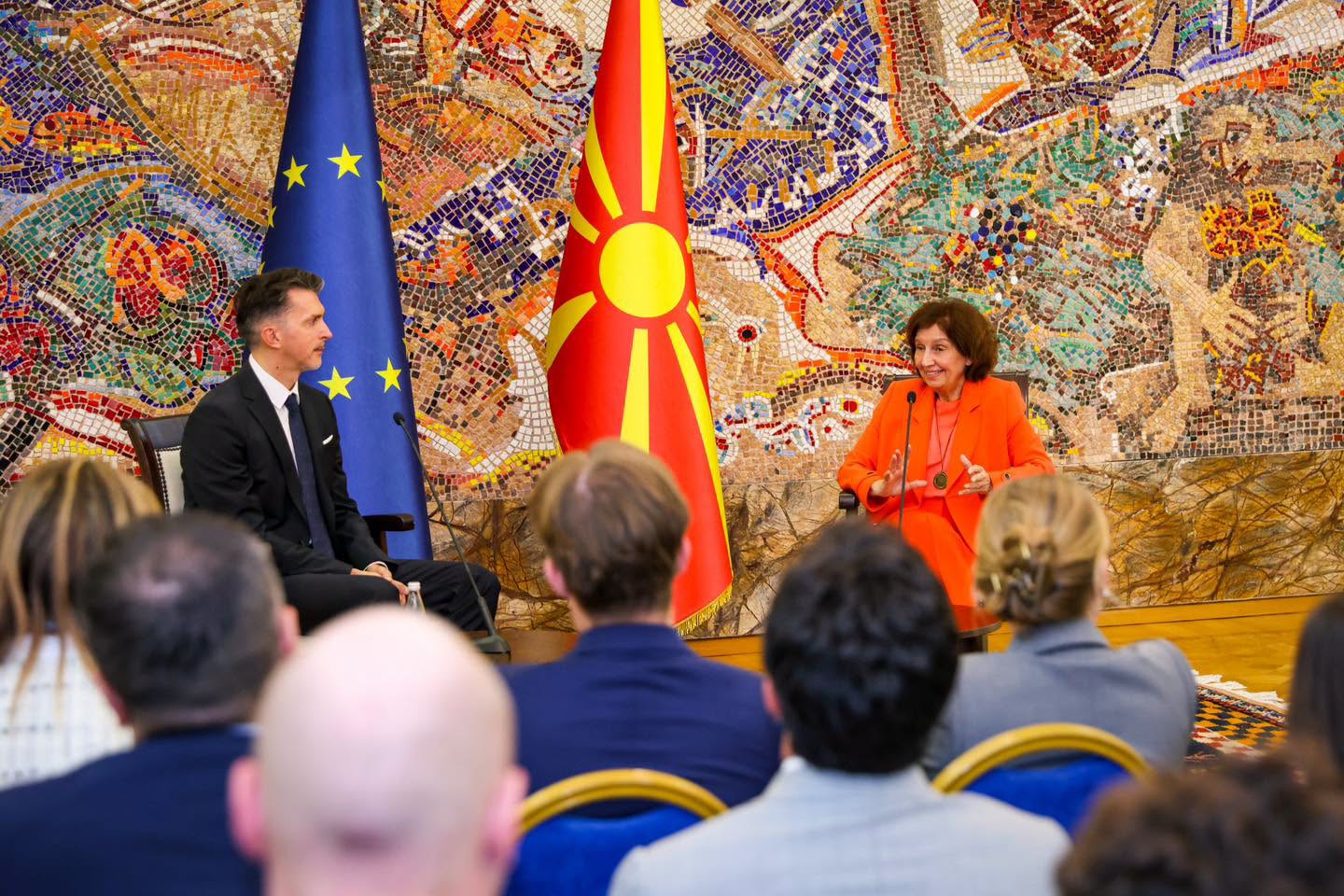
Macedonia’s European integration process and the future of the Western Balkans were at the center of a meeting between President Gordana Siljanovska Davkova and students from the College of Europe’s Tirana campus. The discussion took place at Villa Vodno in Skopje during a study visit focused on how European integration is transforming countries across the region. Topics included Macedonia’s EU accession prospects, regional cooperation, the role of European institutions and the possibility of gradual integration before full membership.
Siljanovska Davkova welcomed the students and highlighted the importance of education, critical thinking and international dialogue in shaping Europe’s future. She described young people studying European affairs as potential contributors to peace, security and solidarity across the continent. The meeting also gave students an opportunity to engage directly with the country’s leadership and explore how political decisions, constitutional responsibilities and regional developments influence the accession process.
The College of Europe’s Tirana campus was established in 2024 and offers a postgraduate program in European Transformation and Integration, with a particular focus on the European Union and Southeastern Europe. Its curriculum examines EU institutions, enlargement policy and the political, legal and economic changes involved in preparing countries for membership. The study visit to Macedonia formed part of this broader educational approach, allowing students to connect academic discussions with the political realities of the Western Balkans.
One of the main subjects raised during the meeting was the constitutional role of the Macedonian president in domestic and foreign policy. Students asked Siljanovska Davkova how much influence the head of state can exercise in the EU accession process and how presidential responsibilities interact with the work of the government and parliament. Under the country’s constitutional framework, the president represents the state internationally and has specific responsibilities in foreign affairs, while executive authority is primarily exercised by the government.
The students also raised questions about the consequences of failing to implement decisions of the European Court of Human Rights in Strasbourg. Their interest reflected wider concerns about the credibility of European institutions and the importance of ensuring that human rights judgments are respected. Implementing court decisions is an important part of the European human rights framework because it demonstrates whether states and institutions can translate legal commitments into practical protections.
Macedonia’s EU Accession Process and Gradual Integration
Macedonia’s EU perspective was another central topic. The country received candidate status in 2005 and formally began accession negotiations in 2022. However, the process has not advanced to the opening of the first negotiating cluster because constitutional amendments required under the agreed framework remain outstanding. The issue has become a significant point of discussion in domestic politics and relations with Bulgaria, while EU institutions continue to emphasize progress on agreed commitments and broader reforms.
The European Commission’s 2025 enlargement assessment identified several areas requiring continued attention in Macedonia, including the rule of law, public administration, democratic institutions and the protection of fundamental rights. The report also noted that the country had not taken decisive steps to advance accession negotiations during the assessment period. These issues illustrate that the EU process involves both resolving specific political obstacles and carrying out sustained institutional reforms.
During the meeting, Siljanovska Davkova emphasized that regional cooperation and mutual support among Western Balkan countries are important to their shared European ambitions. She argued that closer cooperation benefits relations among countries in the region as well as their engagement with existing EU member states. Cooperation on economic development, infrastructure, security and common regional challenges can strengthen connections with the European Union while accession negotiations continue.
The president also discussed the idea of gradual integration, which has attracted growing attention in European policy debates. Under this approach, candidate countries could gain earlier access to selected EU programs, policies and economic opportunities before becoming full members. Such arrangements could offer practical benefits to citizens and businesses while encouraging further reforms and closer institutional cooperation.
Siljanovska Davkova expressed support for gradual integration as a way to deliver tangible benefits before accession, but stressed that it should not become a substitute for full membership. She maintained that enlargement must remain based on the Copenhagen criteria, which require candidate countries to demonstrate stable democratic institutions, the rule of law, respect for human rights and minority protections, as well as the capacity to adopt and implement EU rules. These standards are central to the EU’s merit based enlargement framework.
European Enlargement, Regional Cooperation and Future Prospects
The discussion also addressed the principles and values underpinning the European Union. Siljanovska Davkova stressed that EU institutions should remain committed to the principles established in the bloc’s founding treaties. In her view, the Union’s identity depends not only on administrative structures and political cooperation but also on its commitment to democracy, solidarity, fundamental rights and the rule of law.
Her comments reflected a broader debate about the future of European enlargement. The EU faces the challenge of integrating new members while maintaining effective decision making and protecting its existing standards. At the same time, candidate countries seek clearer prospects and meaningful opportunities to participate in European programs while they work through the accession process. Gradual integration is one approach being discussed to address these parallel concerns.
The students also asked about the benefits EU membership could bring to Macedonia and the advantages enlargement could offer the Union itself. Membership can provide access to the EU single market, greater opportunities for investment and mobility, and participation in common institutions and policy decisions. For the Union, enlargement can strengthen economic connections, extend cooperation and contribute to stability in neighboring regions. The specific effects, however, depend on the reforms undertaken by candidate countries and the terms of eventual accession.
Siljanovska Davkova also spoke about her responsibilities as a directly elected president, emphasizing that she represents all citizens and has a duty to encourage dialogue and consensus on matters of national importance. She presented political dialogue as particularly important for issues such as European integration, which require long term commitments and cooperation among institutions and political groups.
The meeting concluded with the students thanking the president for the exchange and inviting her to visit the College of Europe in Tirana. The invitation reflected the educational and regional character of the visit, which connected students studying European affairs with the political leadership of a country navigating a complex accession process.
The discussion at Villa Vodno highlighted the importance of maintaining dialogue between political institutions, academic communities and future European professionals. For Macedonia, the path toward EU membership remains shaped by constitutional requirements, institutional reforms and regional relations. At the same time, wider debates about gradual integration and the future of enlargement continue to influence how the Western Balkans might become more closely connected with the Union.
The meeting did not announce new accession commitments or changes to the negotiating process, but it offered an opportunity to discuss the challenges and possibilities facing the country and the region. As Macedonia continues its European path, questions about reform, regional cooperation, institutional credibility and the meaning of gradual integration are likely to remain central to discussions about its future in Europe.