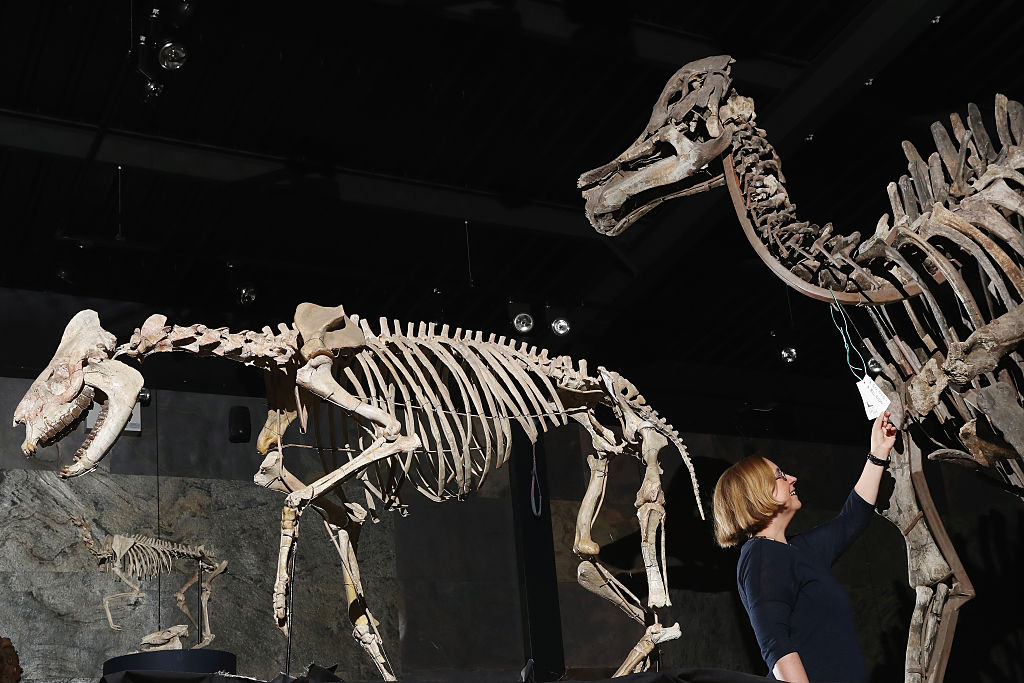
Once believed to be a juvenile Tyrannosaurus rex, the rare dinosaur fossil shattered expectations at auction in New York, reigniting debate over the private ownership of scientifically significant specimens.
A rare dinosaur skeleton known as “Jodi,” identified as a Nanotyrannus rather than a young Tyrannosaurus rex, sold for $47.3 million at Sotheby’s in New York on Tuesday, October 27, far exceeding its presale estimate of $6 million to $9 million. The buyer has not been publicly identified.
Standing approximately three meters tall, the exceptionally preserved skeleton contains around 191 fossilized bone elements, including a nearly complete skull. Sotheby’s described it as an exhibition-ready specimen.
The sale places “Jodi” among the most expensive dinosaur fossils ever sold, following the $50.1 million sale of a Tyrannosaurus rex skeleton named “Gus” earlier this year.
A Dinosaur Once Mistaken for a Young T. rex
For decades, scientists debated whether Nanotyrannus was a distinct dinosaur or simply a juvenile Tyrannosaurus rex. That debate changed following research published in the journal Nature in October 2025 by paleontologists Lindsay Zanno and James Napoli.
Their study concluded that Nanotyrannus was distinct from T. rex, supporting the view that the two predators lived alongside each other approximately 67 million years ago, during the Late Cretaceous period.
Paleontologist Megan Jenkins of the University of Portsmouth described Nanotyrannus as smaller and more slender than T. rex, with blade-like teeth adapted for slicing meat.
Before its scientific reclassification, the skeleton appeared at the Frieze Masters art fair in London in October 2023, where it was presented as a juvenile T. rex.
Discovered in Montana
The skeleton was discovered by rancher Jodi Pierson on her property in Montana’s Hell Creek Formation and excavated by commercial paleontologist Clayton Phipps. The specimen takes its nickname from Pierson.
Phipps also discovered the famous “Dueling Dinosaurs” fossil nearby in 2006, containing the remains of a Nanotyrannus and a Triceratops preserved together in what appears to be a struggle.
That discovery played an important role in research supporting the classification of Nanotyrannus as a distinct dinosaur rather than an immature T. rex.
Scientists Raise Concerns About Private Ownership
The auction has renewed concerns among paleontologists that important fossils could end up in private collections, limiting access for scientific research and public education.
Steve Brusatte, a paleontologist at the University of Edinburgh and scientific consultant for the Jurassic Park films, told the BBC that it would be distressing if “Jodi” disappeared into a private collector’s vault instead of being displayed in a museum.
With Nanotyrannus only recently established as a distinct genus, Brusatte argued that specimens such as this one could help educate and inspire future generations.
Jenkins, however, acknowledged that commercial fossil excavation requires considerable time, effort and financial investment. She said she understood why those involved would want to sell a specimen for a substantial sum and expressed hope that such fossils would eventually reach museums and the public.
The $47.3 million result highlights both the extraordinary commercial value of rare dinosaur fossils and the continuing debate over how significant scientific discoveries should be preserved and made accessible.