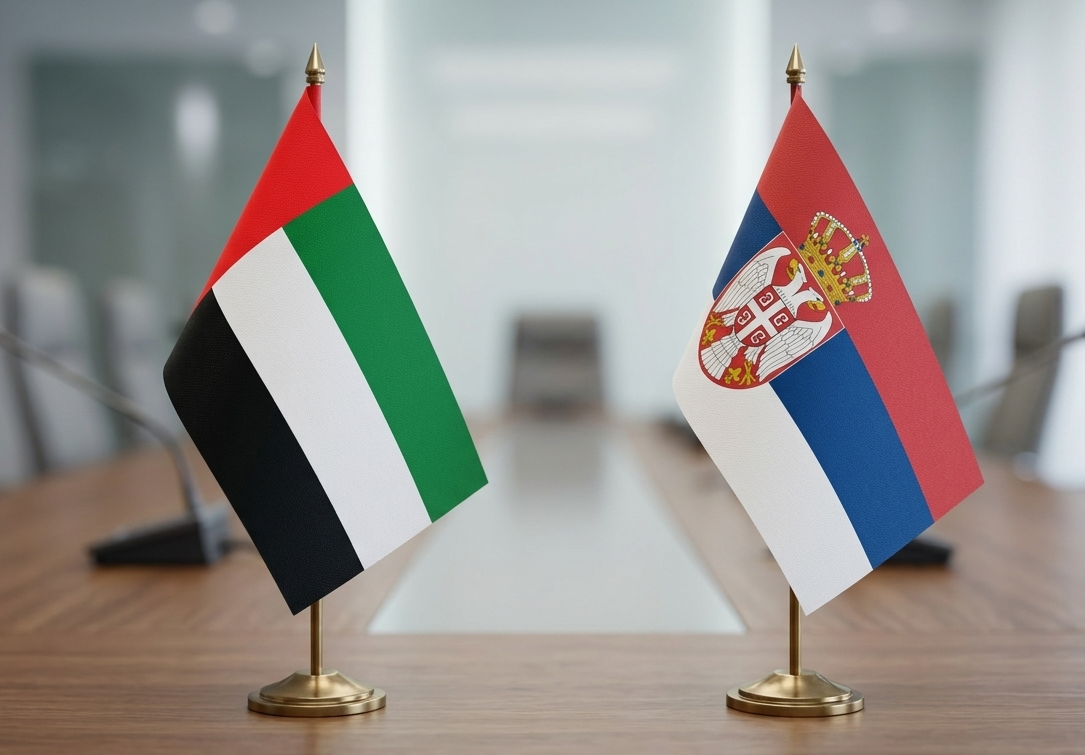
UAE President Sheikh Mohamed bin Zayed Al Nahyan arrived in Belgrade for a working visit, where he was welcomed by Serbian President Aleksandar Vučić. The meeting highlighted the close relationship between Serbia and the United Arab Emirates, with Vučić describing the ties between the two countries as a partnership based on trust, mutual respect and strong personal relations between the leaders.
Sheikh Mohamed was received at Belgrade Nikola Tesla Airport by Vučić, who publicly referred to the Emirati president as a close friend. The UAE delegation included senior officials such as Sheikh Hamdan bin Mohamed bin Zayed Al Nahyan and Sheikh Mohamed bin Hamad bin Tahnoun Al Nahyan, underlining the high level nature of the visit and the importance both governments attach to their bilateral relationship.
The visit comes as Serbia and the UAE continue to deepen their strategic partnership. Cooperation has expanded well beyond traditional diplomatic relations, with the two countries developing ties in trade, investment, energy, agriculture, food security and technology. The Comprehensive Strategic Partnership Agreement signed in 2022 provided an additional framework for expanding cooperation across these areas.
Economic relations have become one of the most important pillars of the Serbia-UAE partnership. The two countries have worked to increase investment and trade, while their Comprehensive Economic Partnership Agreement is designed to further facilitate business cooperation and investment flows. Serbian officials have presented the framework as an opportunity to attract additional investment and encourage projects involving companies from both countries.
Serbia-UAE Partnership Expands Into New Sectors
The relationship has also expanded into emerging industries and areas considered important for long term economic development. Previous high level discussions have covered renewable energy, agriculture, food security, technology and artificial intelligence. In July, Emirati officials visiting Belgrade also discussed cooperation involving youth, education, scientific research, technology and space science, demonstrating the increasingly broad scope of the partnership.
The two countries have maintained close political communication on regional and international issues as well. During previous meetings, Serbian and Emirati leaders have stressed the importance of dialogue, peaceful dispute resolution and stability in the Western Balkans. The continued frequency of high level contacts suggests that both governments view the relationship as an important channel for political and economic cooperation.
The latest visit follows several other high level contacts between Serbia and the UAE. In June, the Speaker of the UAE Federal National Council visited Serbia and conveyed greetings from Sheikh Mohamed to Vučić. Officials from both sides used the meeting to reaffirm their commitment to further strengthening the strategic partnership.
For Belgrade, stronger relations with Abu Dhabi provide opportunities to attract investment, expand trade and develop partnerships beyond traditional European markets. For the UAE, Serbia offers access to the wider Balkan and European markets while providing opportunities for cooperation in areas ranging from infrastructure and energy to technology, agriculture and food security.
The latest meeting therefore represents another step in a relationship that has developed considerably over the past decade. Although Sheikh Mohamed bin Zayed’s visit is centered on high level political dialogue, the broader Serbia-UAE partnership increasingly combines diplomacy with investment, trade and strategic economic cooperation.
Overall, the UAE president’s visit to Belgrade underlines the continued strength of relations between Serbia and the UAE. With political ties described by both sides as strategic and economic cooperation continuing to expand, the two countries appear determined to build on their existing partnership and pursue further opportunities in trade, investment, technology and other sectors in the years ahead.