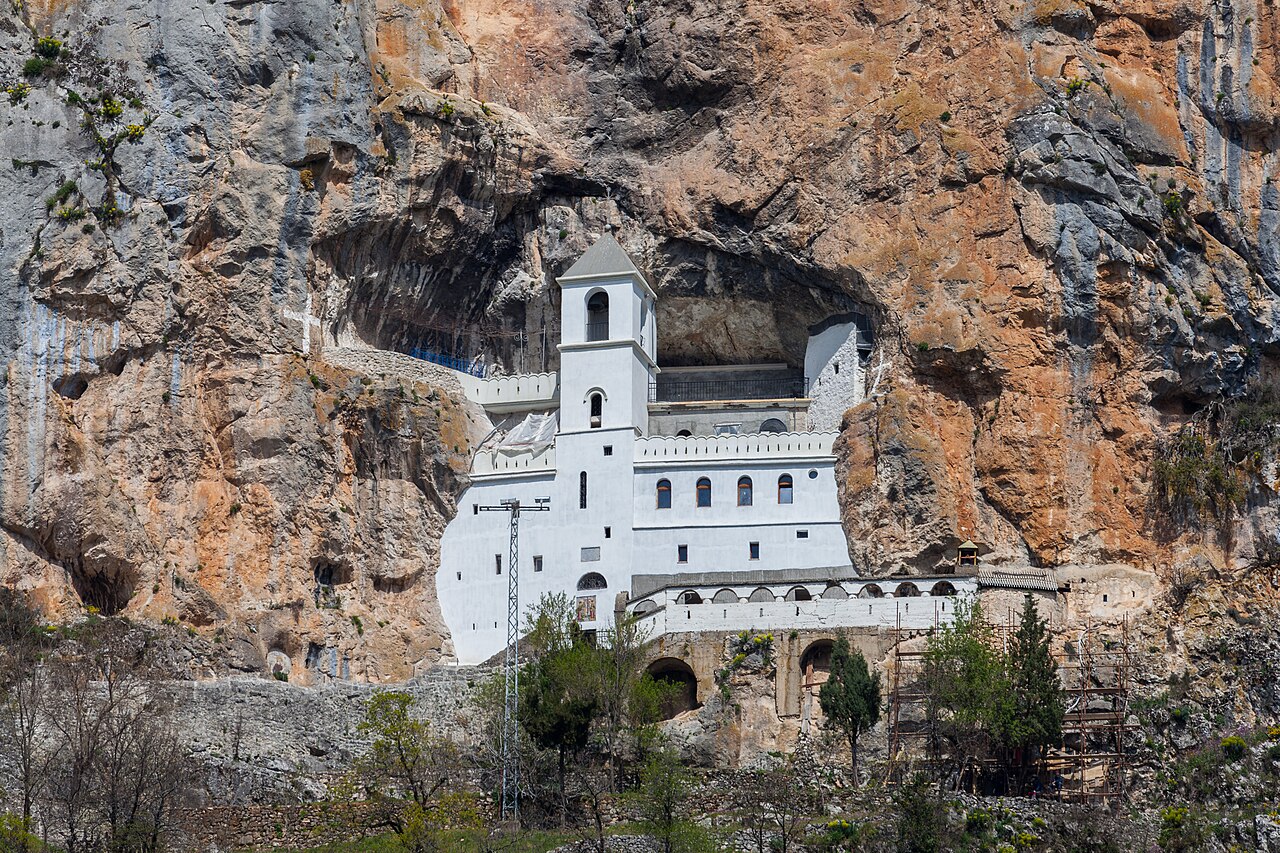
Danilovgrad Municipality President Aleksandar Grgurović has expressed serious concern over the issuance of a construction permit for a planned 67-megawatt solar power plant near Ostrog Monastery. Together with its supporting infrastructure, the facility would cover an area exceeding one million square metres.
Grgurović said that the project’s size, location and potential impact on the surrounding area placed it beyond the scope of an ordinary investment and required the full attention of both experts and the wider public. He said its proximity to Ostrog Monastery was particularly concerning because the monastery was one of Montenegro’s most important cultural, historical and spiritual symbols.
He questioned whether the institutions involved had sufficiently protected the public interest before approving the project and whether all reasonable doubts regarding the protection of cultural heritage had been addressed. Grgurović stressed that cultural heritage should not be treated as an administrative obstacle to development, but as a constitutional, legal and civilisational responsibility of the state.
According to Grgurović, Danilovgrad does not oppose investment in renewable energy or Montenegro’s energy transition, which he described as a strategic national interest. However, he argued that no development objective could justify neglecting the state’s obligation to protect cultural heritage.
He said that even the slightest possibility that a project could damage an area of national historical, cultural and spiritual importance should require the authorities to act with the highest level of caution, expertise and responsibility rather than accelerate administrative procedures. A state that easily permits interventions in an area forming part of the cultural identity of all citizens, he said, demonstrated institutional weakness and a failure to understand the values it was obliged to preserve.
Although the planned facility would not be located within the territory of Danilovgrad Municipality, Grgurović said its potential effects could not be assessed solely according to municipal boundaries. He argued that cultural landscapes, natural areas and important views formed a unified system of values that did not end at an administrative border. Residents of Danilovgrad therefore had the right to receive full information about the circumstances under which the construction permit had been issued.
Grgurović said publicly available documentation had considered the project’s visual impact, including the possibility that the solar complex would be visible from the road leading to Ostrog Monastery. He said this raised questions about how the project’s overall effect on the cultural landscape had been assessed and whether the competent institutions had examined the possible consequences in sufficient detail.
He emphasised that he was not drawing conclusions in advance or disputing the investor’s right to develop projects in accordance with the law. However, he said the public must receive complete information when a project concerns an area forming part of the identity of the entire country.
Grgurović called on the Ministry of Spatial Planning, Urbanism and State Property, as well as all other institutions involved in the procedure, to disclose whether a special assessment of the possible impact on a cultural asset of national importance and its wider surroundings had been conducted before the permit was issued. He also asked whether the Administration for the Protection of Cultural Property had participated in the process and issued an opinion or approval within its legal responsibilities.
He further requested clarification on whether the potential effects on the cultural landscape, important views and the environmental character of the area surrounding Ostrog had been analysed. Grgurović also asked whether publicly accessible three-dimensional visualisations existed to show citizens how the facility would appear from the main approaches to the monastery, and whether alternative designs or locations had been considered that could achieve the same energy objective with less impact on the area.
Grgurović said these were not political questions, but matters arising from the obligation of public institutions to make decisions of public importance fully transparent and properly justified. He argued that the seriousness of a state was not demonstrated by the number of permits it issued, but by its ability to reconcile development with values that no investment could replace.
He warned that Montenegro’s energy transition would not enjoy full public legitimacy if citizens perceived it as a process in which cultural heritage and spatial identity lacked adequate institutional protection. He called for the complete documentation to be made publicly available and for all outstanding questions to be answered clearly.
Grgurović said that if the decisions had been made lawfully and with full protection of cultural heritage, there should be no reason to withhold complete transparency. However, if heritage protection had not been treated as a priority, he said responsibility for the decision would have to be clearly established. Cultural heritage, he concluded, was not a private right that anyone could freely dispose of, but a permanent state obligation towards Montenegro’s history and future generations.