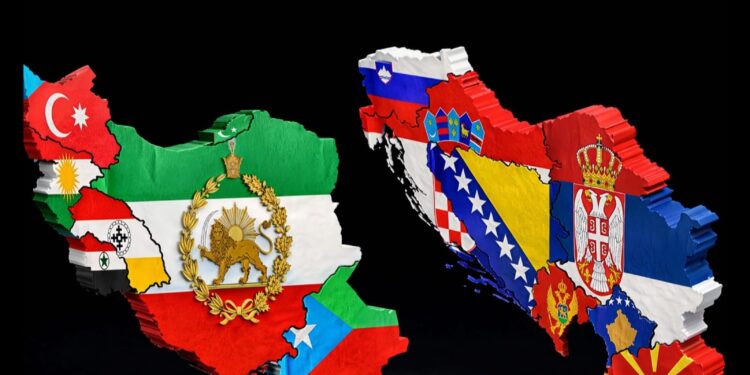
A provocative map circulating in geopolitical circles draws a direct and alarming parallel between the Islamic Republic of Iran and the former Yugoslavia. The image, featuring a skull symbol between the historical flags of the two states, raises one of the most complex questions in the Middle East: could Iran potentially break apart along ethnic and regional lines, similar to the collapse of the Yugoslav federation in the 1990s?
Although Iran is often perceived on the international stage as a monolithic state, in reality, it represents a complex ethnic mosaic. Just as Yugoslavia disintegrated into Serbia, Croatia, Bosnia and Herzegovina, Slovenia, North Macedonia, Montenegro, and Kosovo, Iran also contains internal ethnic divisions that, in a scenario of weakening central authority, could lead to its “Balkanization.”
The map analysis identifies the following potential zones of division:
- Persia (Central Iran)
The central and largest part of the territory is labeled “Persia.” Although ethnic Persians control the state apparatus, they make up slightly more than half of the total population. On the map, this region is depicted with the old Iranian flag featuring the lion and sun, suggesting a potential return to Persian nationalism rather than the current Islamic theocratic system. - South Azerbaijan (Northwest)
The northwest of Iran is home to millions of ethnic Azeris (a Turkic people). This region has strong cultural and linguistic ties to the neighboring Republic of Azerbaijan. While Azeris are deeply integrated into Iranian society, separatist sentiments occasionally emerge, fueled by linguistic and cultural discrimination. - Kurdistan (West)
Iranian Kurdistan is located along the western border. Ethnic Kurds, who are mostly Sunni Muslims in predominantly Shiite Iran, have been fighting for greater autonomy or independence for decades. This region is one of the most active points of resistance against the central government in Tehran. - Ahvaz / Khuzestan (Southwest)
The Ahvaz region (officially Khuzestan Province) has a significant Arab minority. This region is strategically critical as it contains most of Iran’s oil and gas reserves. Despite the area’s wealth, the Arab minority often complains of economic marginalization, fueling radical and separatist movements. - Baluchistan (Southeast)
In the southeast lies Sistan and Baluchestan Province, home to the Baluchi ethnic group (mostly Sunni). This is one of the poorest regions in Iran and the site of ongoing low-level armed insurgencies against Iranian security forces, driven by deep feelings of neglect and repression. - Luristan (West/Central)
This area is inhabited by the Lurs, an Iranian ethnic group with its own language and culture. Although they are closer to Persians than some other minorities, in a hypothetical scenario of total state collapse, historical tribal and regional identities could translate into demands for self-determination. - Turkmen Sahra (Northeast)
This region borders Turkmenistan and the Caspian Sea and is home to Iranian Turkmens. Like other minorities, they face cultural assimilation and seek greater rights to study their language and practice their traditions.
Although Iran’s current security apparatus is extremely strong and centralized, the history of Yugoslavia shows that multi-ethnic states with suppressed national sentiments can rapidly destabilize if the central authority loses control. Whether Iran will face the same fate depends on whether Tehran succeeds in integrating these minorities through political and economic reforms, or whether accumulated grievances will explode into a geopolitical earthquake that could reshape the Middle East.