The United States Senate voted against a resolution aimed at limiting the military authority of Donald Trump in the escalating tensions with Iran.
The proposal, introduced by Democratic Senator Tim Kaine, called for an end to any hostilities against Iran that had not been formally authorized by Congress. The measure failed after 53 senators voted against it, while 47 supported it.
Only one Democrat opposed the initiative — Pennsylvania Senator John Fetterman — while Republican Senator Rand Paul of Kentucky voted in favor.
Ahead of the vote, Senate Democratic leader Chuck Schumer criticized the administration’s approach.
“Donald Trump has pushed the United States toward confrontation without clear objectives, without a defined strategy, and without authorization from Congress,” Schumer said.
Under the U.S. Constitution, Congress has the authority to declare war. However, the War Powers Resolution—adopted in 1973 following the Vietnam War—allows the president to initiate limited military action in response to an immediate threat to the country.
Democrats argue that in the case of Iran, such an eminent threat has not been demonstrated.
The resolution is also expected to be considered in the United States House of Representatives, where Republicans hold a majority, making a similar outcome likely.
Trump Thanks NATO Chief as Alliance Monitors Iran Tensions
President Donald Trump publicly thanked Mark Rutte, secretary general of NATO, after the alliance leader indicated that many NATO members broadly support the recent U.S. strikes against Iran.
Rutte noted that several European allies remain concerned about security risks linked to Iran, citing alleged threats and attempted attacks attributed to the Iranian regime in multiple NATO countries.
He stressed that NATO remains on alert as tensions rise and reiterated that the alliance is prepared to defend the territory of its members.
According to Rutte, NATO missile defense systems recently intercepted a projectile that was reportedly heading toward Turkey, a NATO member state.
He also said the alliance intentionally avoids specifying the exact conditions under which Article 5—the collective defense clause—would be activated if a member state were attacked.
Trump: Iran Was Weeks Away From a Nuclear Weapon
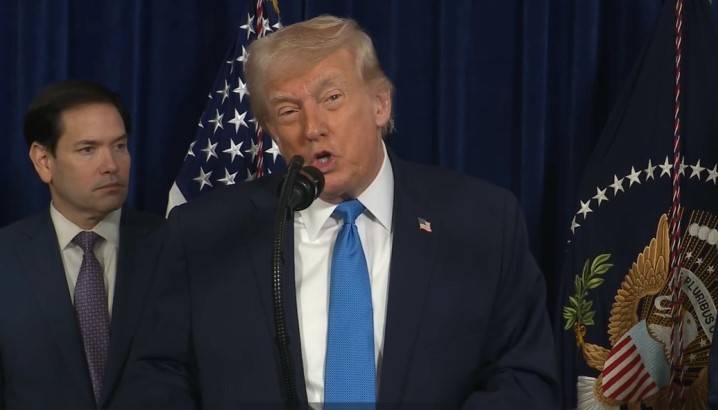
Speaking during a roundtable discussion at the White House, President Donald Trump strongly praised the ongoing military campaign against Iran, known as “Epic Rage.”
When asked to rate the performance of the U.S. military on a scale from one to ten, Trump responded that it deserved a score of “around 15.”
According to the president, the rapid military response prevented what he described as a potentially catastrophic scenario. He claimed that without U.S. intervention, Tehran could have obtained a functional nuclear weapon within just two weeks.
“We are in a very strong position. This operation demonstrates the strength of our armed forces,” Trump said, adding that the Iranian leadership is “rapidly weakening” under the pressure of the coalition strikes.
Iran Claims Missile Strike on U.S. Oil Tanker in the Gulf
Tensions further escalated after Iranian media reported that a U.S. oil tanker had been hit by a missile in the northern part of the Persian Gulf.
According to the Iranian news agency Tasnim News Agency, the vessel was struck earlier in the day by forces of the Islamic Revolutionary Guard Corps and subsequently caught fire.
“An American tanker was targeted this morning in the northern Persian Gulf by forces of the Revolutionary Guard and is currently burning,” the agency reported.
Authorities in the United States have not yet confirmed or commented on the claim.
Earlier, the Iranian Revolutionary Guard stated that it had established full control over the Strait of Hormuz, suggesting that the strategic waterway—one of the most critical routes for global energy supplies—is effectively closed for oil and gas exports.
President Donald Trump said earlier this week that the U.S. could deploy naval forces to escort commercial tankers through the narrow maritime corridor, through which roughly one-fifth of the world’s oil supply passes.