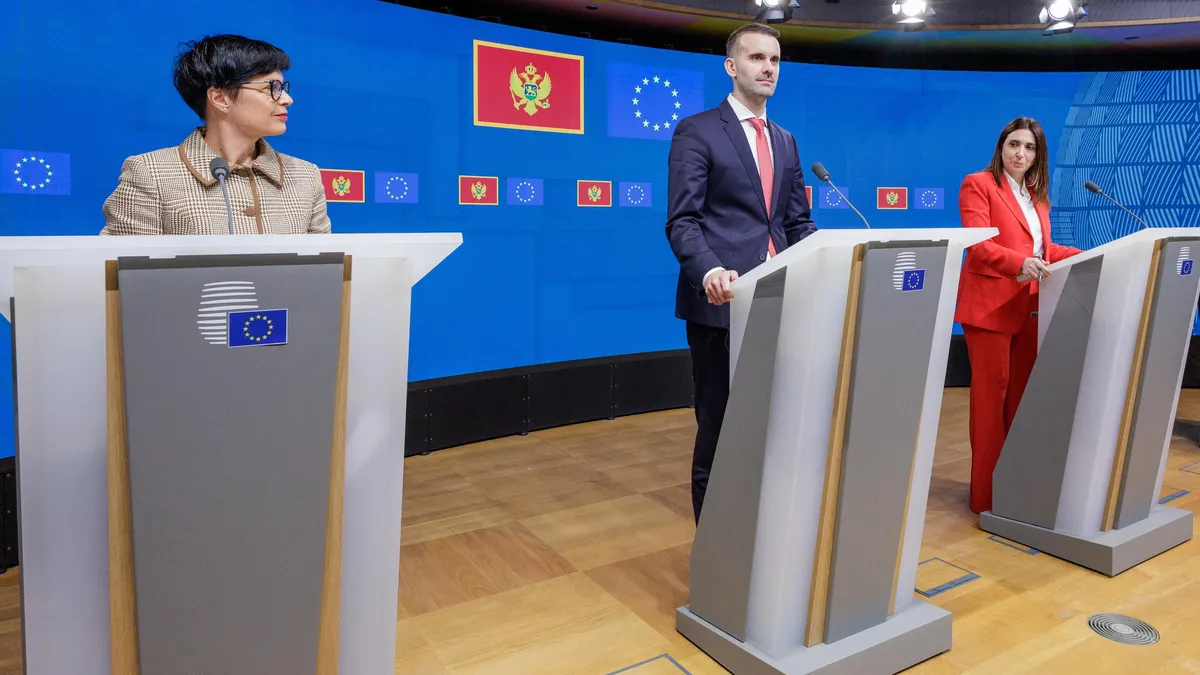
Montenegro, often considered a frontrunner on the path to European Union membership, is facing internal obstacles that threaten to slow its accession. Despite clear recommendations from Brussels, the ruling coalition in Podgorica recently approved controversial amendments to the Law on Internal Affairs and the Law on the National Security Agency—moves widely seen as counterproductive to EU accession.
On March 10, the government announced a meeting in Budapest between Deputy Prime Minister for Foreign and European Affairs Filip Ivanović and Hungarian Foreign Minister Péter Szijjártó. Ivanović’s visit, during Hungary’s election campaign, went against EU guidance advising member states and candidate countries to refrain from interfering in Hungarian domestic politics. Observers note that Ivanović, a former critic of Montenegro’s NATO membership, seems to follow a pro-Serbian political agenda, having also consulted with Metropolitan Joanikije of the Serbian Orthodox Church in Montenegro regarding European matters.
According to veteran Montenegrin diplomat Željko Perović, Ivanović’s actions are not accidental. “Part of the Montenegrin government, specifically the parties formerly aligned with the Democratic Front, openly obstruct the country’s EU path. Even ‘Europe Now,’ the largest parliamentary bloc, contributes to this slowdown, whether through action or inaction,” Perović explained. He also pointed to recent comments by the EU Commissioner for Enlargement, Marta Kos, noting that framing Albania as a front-runner should not be seen as a slight to Montenegro but as a warning from Brussels.
Former Croatian Foreign Minister Vesna Pusić has similarly criticized pro-Vučić forces within Montenegro’s government for undermining EU integration. She stressed that public statements often differ from actual behavior: “The key is not what they say, but what they do. The rapid adoption of these laws clearly delays Montenegro’s EU accession, which appears to be the intent of certain coalition members from the start.”
Perović also highlighted the negative signal sent to Brussels by the hasty passage of the Internal Affairs and National Security Agency laws. He criticized the insistence of minority parties to remain in government despite repeated missteps, describing it as a betrayal of the state.
Pusić emphasized that EU membership for Montenegro is not merely about democratization but about securing the country’s survival as an independent and sovereign state. “Forcing through these laws represents a clear attempt to hinder or delay the accession process. This obstruction stems from a strategic political choice rather than legislative necessity ”.
The adoption of these laws underlines the priority of retaining political power over EU integration for leaders like Prime Minister Dritan Abazović and the ‘Europe Now’ coalition. Parliamentary debate on the amendments is scheduled for the following Thursday despite warnings from Brussels, illustrating that maintaining control is being placed above European aspirations.
Observers note that the broader regional context—Serbia’s long-standing EU stalling tactics, similar interventions in Albania, and inconsistent messaging from figures such as Edi Rama and Aleksandar Vučić—reinforces the impression that Montenegro, as the candidate closest to accession, faces deliberate political resistance.