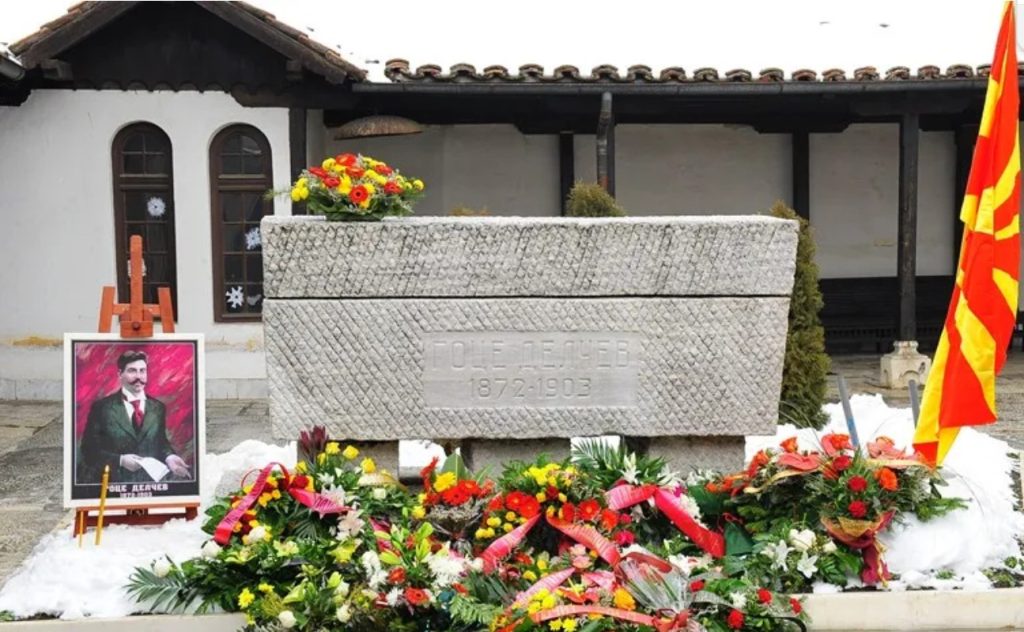
Official Commemoration and Political Presence
Macedonian political leaders marked the 123rd anniversary of the death of Goce Delchev with ceremonies, wreath-laying and statements reflecting both reverence for his historical role and differing interpretations of his legacy in contemporary politics. The central commemoration took place at the Church of St. Spas in Skopje, where a panihida service was held in honor of Delchev.
Prime Minister Hristijan Mickoski attended the ceremony and stated that Delchev was a figure “ahead of his time,” emphasizing his vision, ideological clarity and commitment to the struggle for freedom. He highlighted Delchev as a symbol of national awakening and unity, stressing that his ideas continue to resonate in modern Macedonian society.
Mickoski: Delchev as a Visionary Leader
Mickoski’s message focused on Delchev’s strategic thinking and his ability to understand the broader historical context in which he operated. He described Delchev as a revolutionary who not only fought for liberation, but also articulated a clear vision for the future, positioning him as a leader whose ideas remain relevant beyond his era.
The Prime Minister emphasized that honoring Delchev should not be reduced to formal commemorations, but should be reflected through policies and actions that align with his ideals. His remarks framed Delchev as a unifying figure whose legacy should serve as a foundation for national cohesion.
Filipche: Warning Against Political Misuse
At the same time, opposition figure Venko Filipče offered a contrasting perspective, warning that Delchev’s name is increasingly being used for partisan purposes. He stated that the legacy of the revolutionary is being misused to gain political advantage, arguing that such practices undermine the authenticity of his ideas.
Filipče stressed that Delchev’s message should be understood in its historical and ideological context, rather than being selectively interpreted to support current political narratives. His remarks pointed to the need for a more responsible and unified approach to preserving historical memory.
Broader Reflections on Legacy and Identity
Other reactions in the reports highlighted the continued importance of Delchev as a central figure in Macedonian identity. His words and ideas were described as still echoing in contemporary society, with particular emphasis on themes of unity, sacrifice and resistance.
At the same time, the anniversary reopened broader debates about whether Delchev’s legacy is being genuinely respected or politically instrumentalized. Commentaries reflected on the tension between commemorative rhetoric and actual political practice, raising questions about consistency between declared values and real actions.
A Symbol Beyond Time
Across all statements, Delchev was presented as a figure whose significance transcends historical boundaries. While political actors differed in their interpretations and emphasis, the reports consistently portrayed him as a lasting symbol of the Macedonian struggle for freedom and self-determination.
The anniversary thus became both a moment of remembrance and a platform for political messaging, illustrating how historical figures continue to shape contemporary discourse. More than a century after his death, Delchev remains at the center of national reflection, with his legacy invoked in discussions about identity, unity and the direction of the state.