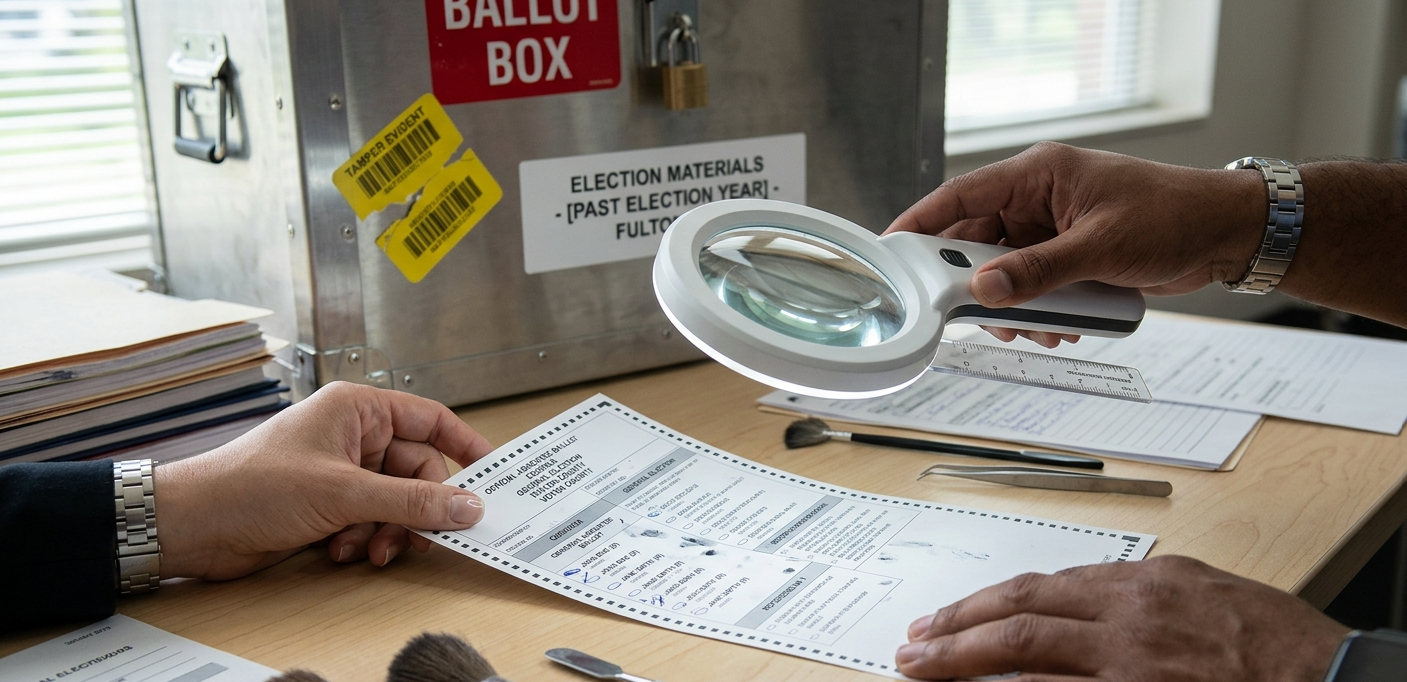
A federal judge ruled Wednesday that the Justice Department can retain more than 600 boxes of 2020 general election ballots seized by the FBI from Fulton County, Georgia, rejecting the county’s demand for their immediate return while simultaneously criticizing the bureau’s handling of the unprecedented seizure. U.S. District Judge J.P. Boulee wrote in a 68 page order that Fulton County failed to prove its rights were “callously disregarded”, the legal standard required for forced return, and did not demonstrate that it would suffer irreparable harm without the ballots, though he acknowledged the “events leading up to this case are, in a variety of ways, unprecedented” and that “the seizure in this case was certainly not perfect.” The ruling allows the FBI to continue investigating what it calls “irregularities” in the 2020 election, including alleged missing ballot images and duplicate ballots, despite a leading elections expert testifying last month that the bureau’s evidence “didn’t make sense” and that identified irregularities did not constitute crimes.
The seizure on January 28, 2026, targeted the same county where Trump famously asked Georgia Secretary of State Brad Raffensperger to “find 11,780 votes” to overturn Joe Biden’s victory, and where District Attorney Fani Willis’s election interference case against Trump and his allies collapsed after she was disqualified over conflict of interest allegations. Fulton County Board of Commissioners Chair Robb Pitts vowed to “pursue all available legal options,” agreeing with the court that the FBI warrant was defective, problematic, and troubling while strongly disagreeing with the denial of the county’s return request. The Justice Department has simultaneously issued a grand jury subpoena that is demanding Fulton County to reveal the names and contact information of all election staff and volunteers who worked during the 2020 presidential election, signaling a broadening investigation that critics fear is designed to validate Trump’s false claims of victory rather than uncover genuine fraud.
The case represents the most aggressive federal intrusion into local election administration in modern American history, occurring six years after the 2020 vote and raising fundamental questions about the balance between federal oversight and state election authority. This episode offers a stark illustration of how democratic institutions can be weaponized for political retribution, with a sitting administration using law enforcement to relitigate an election its leader lost while courts struggle to constrain executive overreach. Whether the FBI’s investigation produces credible evidence or merely fuels conspiracy theories, the damage to public trust in electoral integrity may outlast any legal proceedings, leaving Fulton County’s ballots, and American democracy, trapped in an endless cycle of biased investigation.