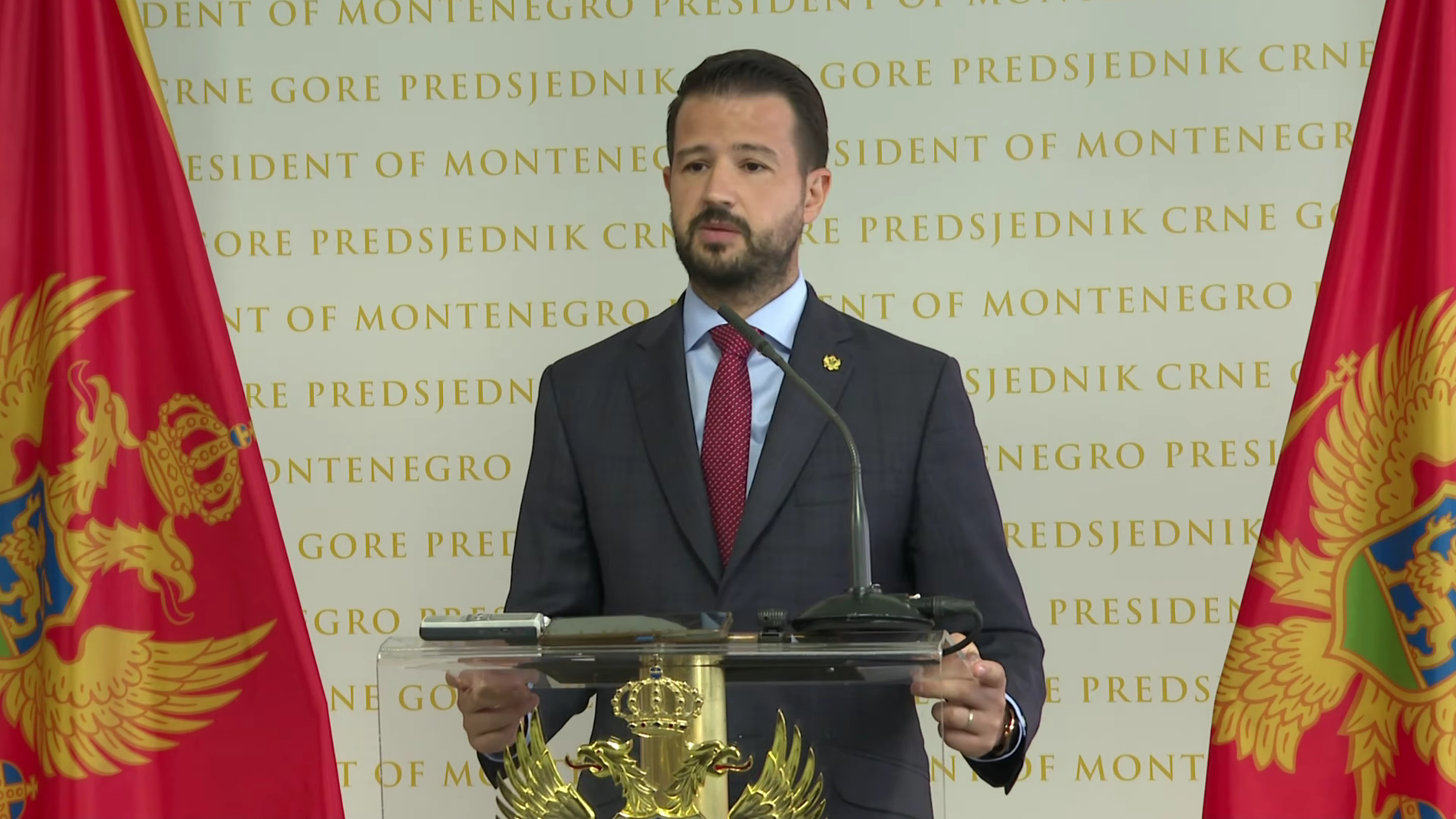
Montenegrin President Jakov Milatović has returned a controversial law to parliament that would have transferred the historic Kruševac Castle in Podgorica into the private ownership of Prince Nikola Petrović-Njegoš, head of the country’s former royal dynasty. In a forceful statement issued on June 8, Milatović’s office confirmed that the castle enjoys protected status as an immovable cultural asset under decisions dating back to 1957, 1961, and 1993, making its transfer to private hands a potential violation of both the constitution and the Law on the Protection of Cultural Property. The move sets up a direct confrontation with the ruling Europe Now Movement (PES), which shepherded the amendments through parliament just one week earlier with forty votes in favor.
The disputed legislation, adopted on June 1, amends the 2011 Law on the Status of Descendants of the Petrović Njegoš Dynasty, a statute that already granted the family significant privileges including a house in Njeguši, a 300 square meter residence in Cetinje, a 130 square meter apartment in Podgorica, and €4.3 million in state foundation funding. The new amendments would go further, handing over Kruševac Castle itself along with its associated land, while committing the state to cover reconstruction and equipping costs from the capital budget. Although the bill includes a clause preventing the dynasty from selling the property to anyone except the state, Milatović’s office argues that any transfer of ownership would contravene Article 42 of the cultural protection law, which explicitly prohibits the alienation of state owned immovable cultural assets. The castle currently houses the Museum of Contemporary Art of Montenegro, and under the proposed law, existing institutions would be allowed to remain until a new museum is constructed, subject to rent payments.
The parliamentary debate revealed the political calculations behind the legislation. PES abandoned its earlier push to remove the word “forcible” from the text describing Montenegro’s 1918 annexation by Serbia, a change that had sparked public uproar last year, and instead concentrated on expanding the dynasty’s property rights. Milatović’s veto has drawn mixed reactions, while some herald it as a stand for the rule of law and the preservation of national heritage for all citizens, others have criticized the president’s intervention. The office defended the decision as a “responsible attitude towards the protection of constitutionality and legality,” warning that giving the castle to private ownership could set a dangerous precedent enabling other dynasties to claim similar treatment of state facilities. For now, the law returns to parliament for reconsideration, leaving the fate of one of Podgorica’s most culturally significant landmarks hanging in the balance.