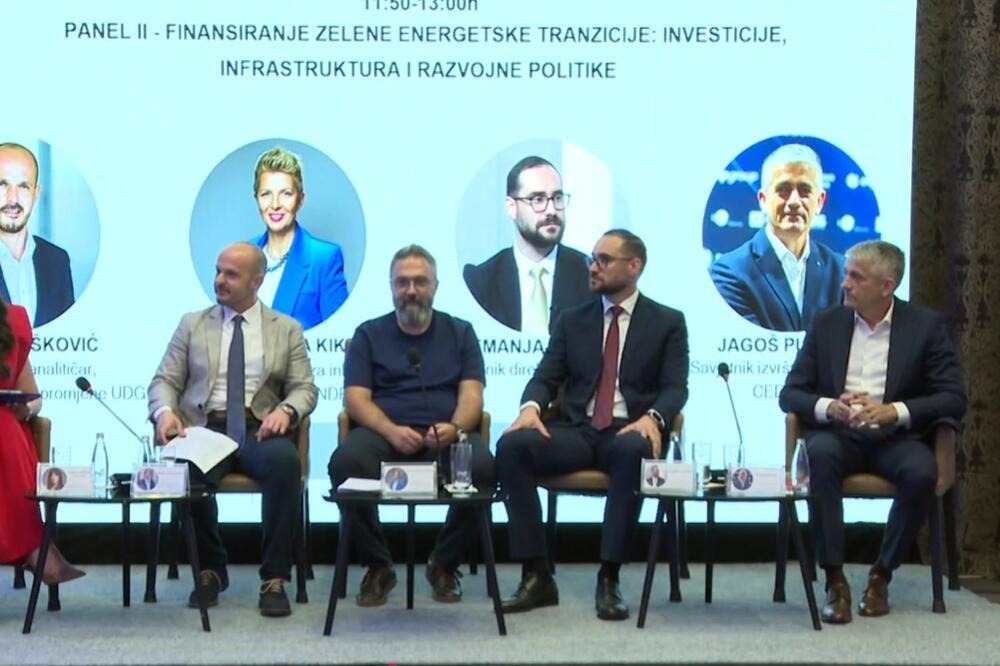
Montenegro will need around 1.7 billion euros, or roughly $1.8 billion, in investments by 2030 to carry out its green energy transition, officials and experts said at a conference in Podgorica.
The conference was held as part of the regional project “Empowering the Western Balkans through Green Industrial Policies.” Participants said Montenegro is facing one of the biggest challenges in its recent history, as the shift toward cleaner energy will require major financial resources, long-term planning and stronger institutions.
According to Ivana Vojinović, director of the Center for Climate Change at the University of Donja Gorica, Montenegro’s National Energy and Climate Plan estimates that about 1.7 billion euros will be needed by 2030 for the development and integration of renewable energy sources.
“For a small economy such as Montenegro’s, this represents a major challenge,” Vojinović said. She added that new energy laws, market premiums awarded through auctions and contracts for difference could help attract larger amounts of private capital for strategic green investments.
Economic analyst Mirza Mulešković said the full energy transition would require around 3.87 billion euros, with about 75 percent of the costs directed toward decarbonizing the energy sector.
Montenegro’s Minister of Energy and Mining, Admir Šahmanović, said the country has already laid the foundations for a more secure energy future. He noted that regulations have been aligned with European standards and that certain investments have already begun.
“The green transition will not be simple. It will be expensive and it will take time,” Šahmanović said. “But I believe future generations will be able to say that this was the period when Montenegro made a decisive step from a country that talked about its potential to one that turned it into concrete results.”
Officials from the Ministry of Ecology also warned that the current budget is not enough to support the transition. State Secretary Zoran Dabetić said the ministry needs a much larger budget in order to hire experts and strengthen its capacity.
He said Montenegro’s Ministry of Ecology would need at least 50 million euros annually to function effectively, adding that the ministry is already facing difficulties paying some contracted staff and consultants working on climate change issues.
Participants also emphasized that without strong teams and careful planning, the green transition cannot be successfully implemented. Montenegro’s Eco Fund was presented as an example of good practice, with projects focused on waste processing and the decarbonization of transportation.
By fulfilling its environmental agenda, Montenegro hopes to secure additional funding from European Union funds and accelerate its transition toward cleaner energy.