Crishock Appointed Acting High Representative After No Agreement on Schmidt’s Successor
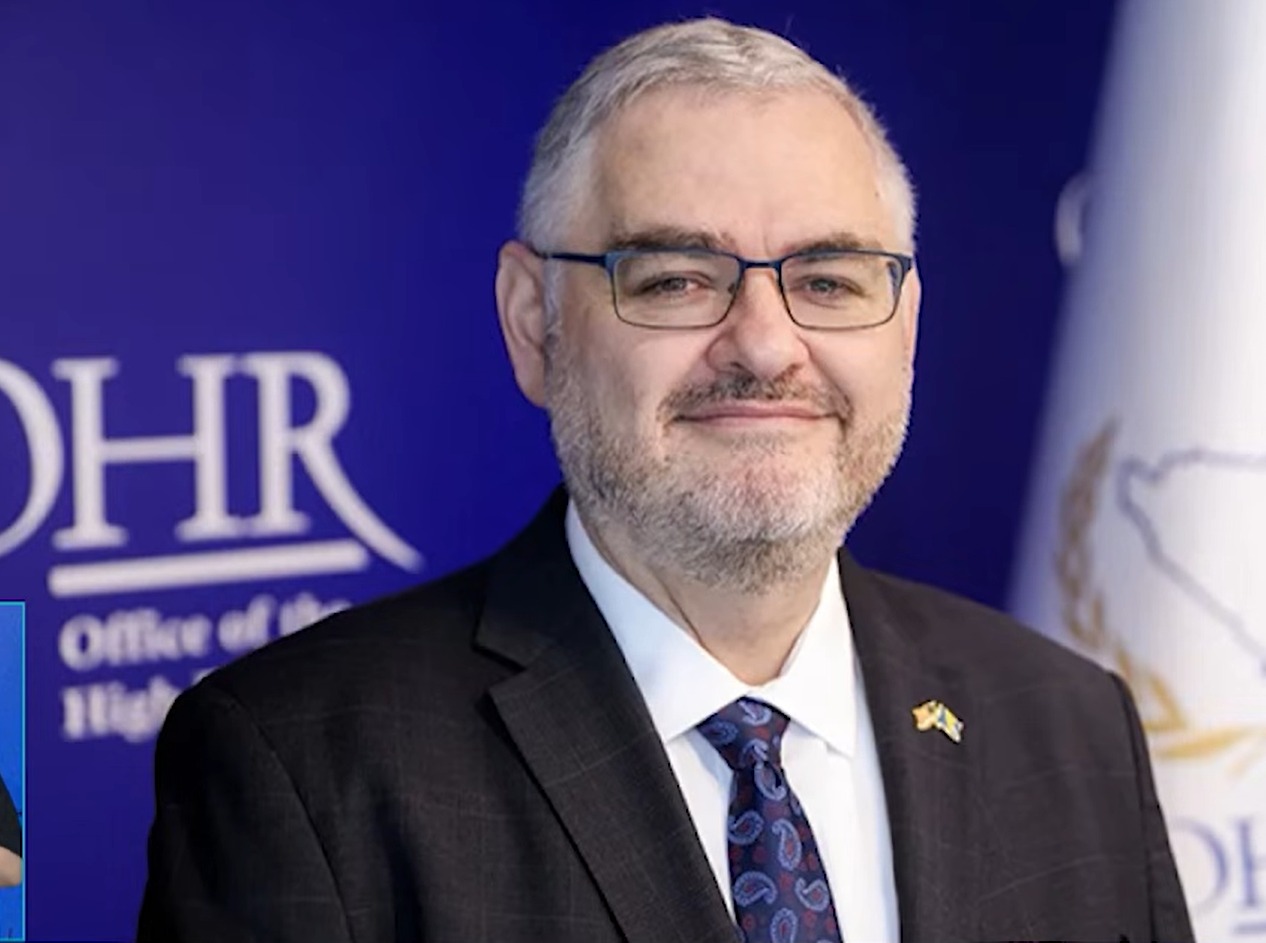
Bosnia and Herzegovina has received an acting High Representative after international diplomats failed to agree on a permanent successor to Christian Schmidt. Louis J. Crishock, who had served as Principal Deputy High Representative and Brčko District Supervisor, was appointed acting High Representative until a final decision is reached on the new head of the Office of the High Representative.
The decision was made after a meeting of the Steering Board of the Peace Implementation Council in Sarajevo on June 30. The board stated that Crishock would ensure institutional continuity, legal certainty regarding decisions made by previous High Representatives, and the continued functioning of the office under the political guidance of the Peace Implementation Council.
Crishock officially takes over the role on July 1, when Schmidt’s resignation, submitted in May, enters into force. The Peace Implementation Council committed itself to reaching an agreement on the new High Representative as soon as possible, with the goal of completing the appointment by July 14.
Second Failed Attempt to Choose a Successor
The latest meeting was the second attempt in June to choose Schmidt’s successor, but no compromise was reached. A previous session, held on June 3 and 4, also ended without agreement.
The disagreement has revealed a clear division between Washington and several European partners. The United States and Italy support Italian diplomat Antonio Zanardi Landi, while other European members of the Peace Implementation Council have backed French diplomat René Troccaz, France’s special envoy for the Western Balkans.
A possible compromise candidate, Danish diplomat Peter Sørensen, former head of the EU Delegation in Bosnia and Herzegovina, has also been mentioned.
U.S. and European Positions Diverge
The dispute over the appointment is being interpreted as part of wider differences between the United States and European partners over the future role of the international community in Bosnia and Herzegovina.
The United States has continued to support Landi, describing him as a highly qualified candidate. Washington has also stated that it remains committed to Bosnia and Herzegovina’s territorial integrity and the Dayton Peace Agreement.
The European Union, meanwhile, has said it is working with partners to select a High Representative who would reflect unity and consensus. The EU position is that the candidate should come from Europe and that the Union remains committed to the stability, security, territorial integrity and European future of Bosnia and Herzegovina as a single, united and sovereign state.
Italian Non-Paper and the Future of OHR
Ahead of the renewed attempt to reach agreement, Italy sent a non-paper to partners in the Peace Implementation Council outlining its view of the future of the Office of the High Representative.
The document presented Landi’s qualifications, but also proposed a gradual reduction of the OHR’s role. It stated that the Bonn powers should remain available only as a last resort, after all other options have been exhausted. It also stated that the new High Representative would not reverse decisions made by previous High Representatives.
According to the document, all decisions would be made in coordination with the Peace Implementation Council Steering Board. Landi’s mandate would be limited to two years, with the possibility of a two-year extension.
The proposed mandate would not be directly linked to the duration of the OHR itself. The office’s future would still depend on the fulfillment of the “5+2” agenda, which includes resolving the distribution of state and military property, implementing the final decision on Brčko District, ensuring fiscal sustainability, strengthening the rule of law, signing the Stabilization and Association Agreement and receiving a positive assessment of the political situation from the Peace Implementation Council.
So far, two of these conditions have been fulfilled: the Stabilization and Association Agreement was signed in 2008, and the status of Brčko District was defined through a constitutional amendment in 2009. The remaining conditions have been only partially fulfilled or remain unresolved.
Possible Link to South Interconnection Project
The dispute has also been linked in reports to the South Interconnection gas pipeline project, worth around one billion dollars. European officials in Sarajevo reportedly suspect that American pressure over the High Representative may be connected to that project.
The project was temporarily awarded to the American company AAFS Infrastructure and Energy, which has been described as having links to people close to U.S. President Donald Trump.
The broader context includes a previously announced shift in the U.S. approach to the Western Balkans, with a stronger emphasis on direct benefits for American companies.
Who Is Louis Crishock?
Louis Crishock is a career U.S. State Department diplomat with long experience in diplomacy and security affairs. Since August 2024, he has served as Principal Deputy High Representative in Bosnia and Herzegovina and, at the same time, as international supervisor for Brčko District, one of the country’s most sensitive administrative areas.
Before taking over as acting High Representative, Crishock was already directly involved in the work of the OHR and cooperated with Christian Schmidt on issues related to the implementation of the Dayton Peace Agreement, political stability and the functioning of institutions in Bosnia and Herzegovina.
Before arriving in Sarajevo, Crishock spent years in U.S. diplomatic service. He also worked as a fellow at the Woodrow Wilson Center in Washington, where he dealt with international relations and security issues.
Unlike some previous High Representatives who came from senior European political positions, Crishock is primarily a professional diplomat. His experience inside the OHR and familiarity with key processes were among the reasons why he was chosen to temporarily lead the office until a permanent successor is appointed.
Legal and Political Sensitivity of an Acting Role
The role of acting High Representative is not formally defined in official documents, but it has existed as a practical temporary solution before. The last and only previous example was in early 2009, when U.S. diplomat Raffi Gregorian, then Deputy High Representative, temporarily performed the role after Miroslav Lajčak resigned to become Slovakia’s foreign minister. Gregorian held the position until Valentin Inzko officially became High Representative.
This precedent is now being used to justify Crishock’s temporary appointment as a way to maintain continuity during the transition period.
Wider Consequences for Bosnia and Herzegovina
The outcome of the dispute could have consequences for Bosnia and Herzegovina because of the broad powers held by the High Representative in overseeing the implementation of the Dayton Peace Agreement.
The OHR was established after the war in Bosnia and Herzegovina to supervise the implementation of the peace agreement and help stabilize the country. Bosnia and Herzegovina still faces deep political divisions, while the issue of state property remains one of the most sensitive unresolved questions.
The way the new High Representative is eventually appointed may also influence the future role of the international community in Bosnia and Herzegovina. The dispute has already exposed differences between Washington and European partners over whether the OHR should maintain its current authority, gradually reduce its role, or be reshaped in line with Bosnia and Herzegovina’s European path.
For now, Crishock’s appointment provides continuity, but the central political question remains unresolved: who will permanently replace Christian Schmidt and what kind of mandate that person will have.