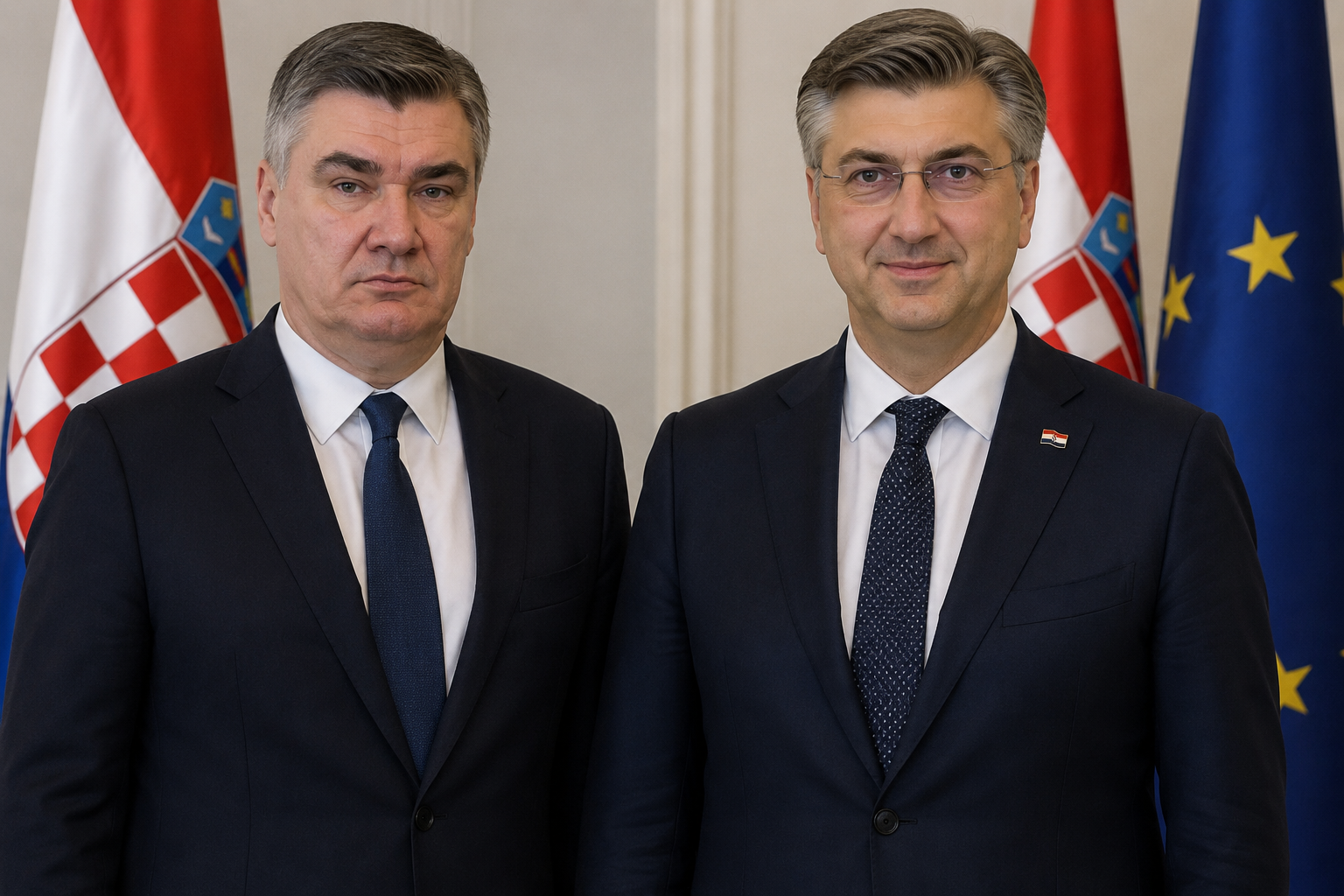
Croatian President Zoran Milanović and Prime Minister Andrej Plenković have entered another public dispute, this time over the planned participation of members of the Croatian Armed Forces in a military parade in Paris. The disagreement escalated after the government announced that Croatian soldiers would take part in the event, while Milanović, as Supreme Commander of the Armed Forces, said he would not give his consent.
Milanović stated that Croatian soldiers cannot be sent to such an event without a decision by the Supreme Commander. He said the Croatian Democratic Union, the government and the defense minister do not decide on the deployment of the army in this case. In one of his sharpest remarks, he said he did not know whom Plenković planned to send to Paris, “maybe majorettes,” adding that the army would not go.
The Croatian president said the military functions on the principle of subordination and single command. According to him, in situations involving the use or disposal of the armed forces, the final decision can be made by only one person, the Supreme Commander. He explained that many technical and material decisions fall under the authority of the defense minister, but that when he decides something cannot be done, the decision on the armed forces belongs to him.
Milanović also argued that the event in Paris was not merely a protocol activity, but a political and military event linked to the so-called “coalition of the willing.” He said this was one of the reasons he would not approve the army’s participation. He also pointed out that France had not participated in Croatia’s military parade in Zagreb last year marking the anniversary of Operation Storm and had given no explanation for its absence.
The president additionally referred to France’s sale of Rafale fighter jets to Croatia and later to Serbia. He said France had traded with Belgrade and sold more advanced goods to neighbors who, according to his remarks, are allegedly allies of Moscow. Questioning what kind of strategic partner that was, Milanović repeated that Croatia should not send its army to the Paris parade.
Milanović accused Plenković of trying to interfere in the army’s chain of command and described him as the “Croatian Aleksandar Vučić.” He claimed that HDZ wants to seize and appropriate everything, including what it does not have, in this case command over the army. He also said that some of Plenković’s associates, including his chief of staff, had allegedly contacted Chief of the General Staff Tihomir Kundid and threatened him with dismissal and retirement.
Plenković rejected Milanović’s accusations and insisted that the planned participation in Paris was protocol and ceremonial, not a military mission. He said it was not an EU, NATO or coalition mission, but participation by Croatia as a country with a strategic partnership and excellent bilateral cooperation with France.
The prime minister announced that Defense Minister Ivan Anušić would ask the Chief of the General Staff to ensure Croatian soldiers’ participation in the ceremony in Paris. Plenković also accused Milanović of promoting an isolationist policy and said his positions were contrary to the policies of the European Union, NATO, the United States and France. He described Milanović’s approach and what he called constant “singing Russian songs” as a major national embarrassment.
Plenković also responded to Milanović’s broader accusations by calling them unfounded. He said the president was dealing with complexes from his defeat in the 2016 parliamentary elections and described him as a “prime minister of missed opportunities.” He also called Milanović’s claims “shameless insinuations.”
Defense Minister Ivan Anušić said he had signed the decision for members of the Armed Forces to travel to Paris and had sent it to Chief of the General Staff Tihomir Kundid. He said Kundid still had time to respond, but warned that if the chief did not respect the decision on sending soldiers to Paris, he would violate the Defense Act and lose the confidence of the prime minister and the government.
The dispute over the Paris parade has therefore become another episode in the long-running political rivalry between Croatia’s president and prime minister, who often hold opposing views on foreign and security policy. At the center of the latest confrontation is the question of who has the authority to decide on the participation of Croatian soldiers in an international military ceremony: the president as Supreme Commander, or the government and defense minister, who argue that the event is ceremonial and part of Croatia’s strategic cooperation with France.