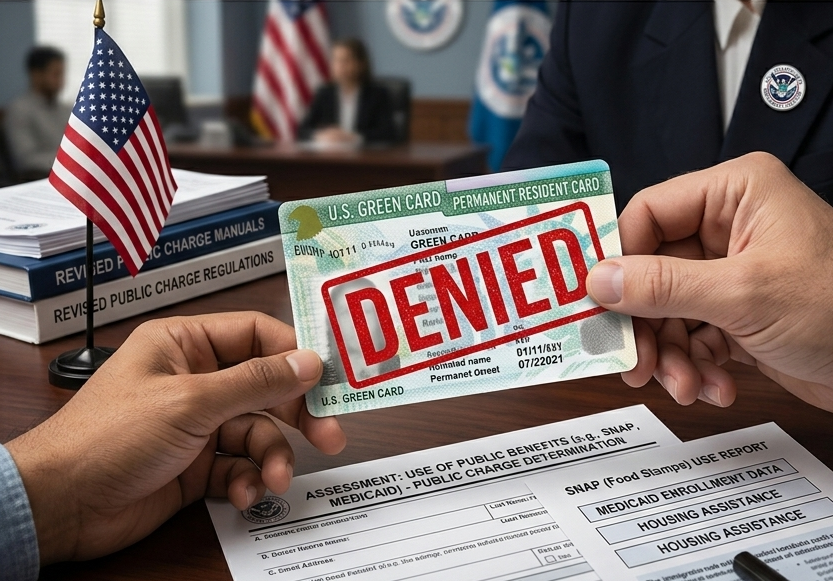
The Trump administration is bringing back a controversial policy that could deny permanent residency to immigrants who use public benefits including food stamps, Medicaid, and housing vouchers, with the rule set to take effect on September 18. The Department of Homeland Security announced the revival on Thursday, framing it as a restoration of “self reliance” and a protection of taxpayer resources. The policy, which appeared in the Federal Register and will be formally published on July 20, marks the return of a “public charge” test that was first implemented in 2020 during Trump’s first term, abandoned under the Biden administration in 2022, and now resurrected as part of a broader crackdown on both illegal and legal immigration.
The revived rule significantly expands the grounds for disqualification compared to the narrower standard that existed under President Joe Biden. While federal law has long required green card applicants to demonstrate they will not become a public charge, the Trump administration’s version broadens the definition to include anyone who received government benefits for more than 12 months in any three year period. Unlike the original 2019 rule, the new version does not specify particular programs by name, instead giving immigration officers wide discretion to make “individualized, fact specific” determinations based on the “totality of the alien’s circumstances.” The U.S. Citizenship and Immigration Services stated on X that the rule reaffirms the requirement that “aliens in the United States be self reliant and not dependent on taxpayer funded government benefits,” adding that “under President Trump, USCIS is restoring the basic principle that immigrants must be able to support themselves.”
Critics warn the policy will sow fear far beyond those it directly disqualifies. During its first iteration, the rule generated what public health experts call a “chilling effect,” causing millions of immigrants and their U.S. born family members to avoid benefits they were legally entitled to receive. Manatt Health estimated the 2019 version deterred as many as 26 million people from seeking healthcare, food, housing, or other aid, roughly half of them U.S. citizens, mostly children in mixed status families. The Migration Policy Institute found that while the number of immigrants who could actually be deemed ineligible based on benefit use was relatively small, fewer than 167,000 out of 22.1 million noncitizens, the fear it created was vast. Immigrant advocates argue the rule amounts to a “wealth test” that unfairly targets the poor. “This regulation is a direct assault on immigrant families, and a threat to our country’s health and economic security,” said Adriana Cadena of the Protecting Immigrant Families Coalition. Sarah Krieger of the National Immigration Law Center added that the rule would make immigrants afraid to go to the doctor, buy food, or file taxes, calling it “deeply harmful” and legally questionable.
The revival comes as the administration is simultaneously ramping up deportations, restricting legal immigration pathways, and targeting mixed status families where parents are foreign nationals and children are U.S. citizens. With healthcare and food costs already rising, the rule’s return threatens to deepen hardship for low income immigrant communities while creating new bureaucratic hurdles for those seeking to regularize their status. Legal challenges are almost certain, echoing the lawsuits that delayed the original rule’s implementation for months. For now, the administration has set a 60 day runway before the policy takes hold, leaving immigrant families, attorneys, and advocacy groups scrambling to understand how broad discretionary authority will be wielded when officers begin making “totality of circumstances” judgments at consulates and ports of entry across the country.