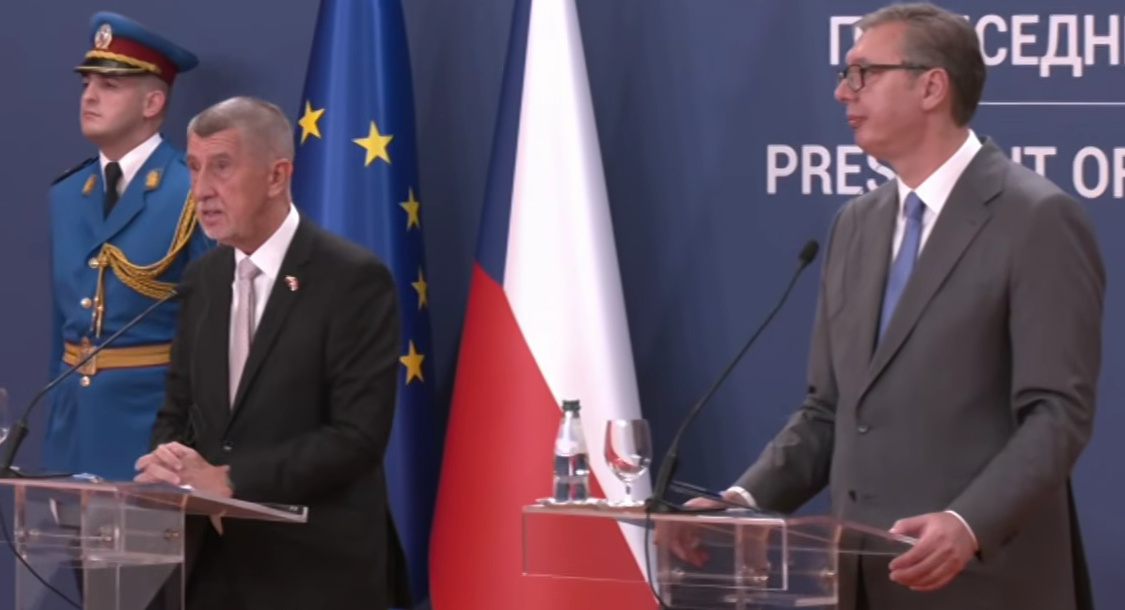
Serbian President Aleksandar Vučić has hosted Czech Prime Minister Andrej Babiš in Belgrade for a two day official visit focused on deepening economic cooperation, with both leaders emphasizing business networking, investment opportunities, and joint responses to regional challenges. The visit, which included a plenary meeting and a roundtable discussion titled “Serbia–Czechia: Business Dialogue and New Opportunities for Economic Cooperation,” underscores the strategic importance Prague places on its relationship with Belgrade at a time when both countries are navigating complex European dynamics.
The economic foundation is already substantial. Bilateral trade reached €2.4 billion in 2025, with Serbian exports accounting for €1.4 billion and imports at €1.0 billion, a rare trade surplus for Serbia within the region. Czech investment in Serbia has been significant and diverse, the PPF Group acquired Telenor’s Southeast European operations for €2.8 billion in 2018, Mattoni 1873 and PepsiCo purchased the iconic Knjaz Miloš mineral water company in 2019, and Czechoslovak Group invested €24 million in the 14. Oktobar defense factory in Kruševac. The Czech Republic is also a key player in Serbia’s EU accession process, consistently supporting Belgrade’s European path and visa liberalization efforts.
A central focus of the visit was EXPO 2027, the specialized world exposition scheduled to run from May 15 to August 15, 2027, in Belgrade under the theme “Play for Humanity: Sport and Music for All.” The Czech Republic officially confirmed its participation on June 12, 2026, signing a contract that makes it one of 140 confirmed countries. With an estimated cost of €1.29 billion and projected attendance of over 6 million visitors across 8,000 events, EXPO 2027 represents Serbia’s most ambitious international project to date. Vučić expressed gratitude for Czechia’s confirmation, stating his confidence that the exposition “will provide an opportunity to showcase innovation, link our economies, and open new doors for joint projects.”
The visit also carried political weight beyond economics. Vučić and Babiš discussed Serbia’s European path and the need for coordinated responses to illegal migration, issues that resonate with Babiš’s domestic agenda. The Czech prime minister, leading a coalition that includes the nationalist SPD party, has prioritized Central European solidarity, migration control, and pragmatic engagement with non EU partners. His choice of Serbia for a high-profile visit signals Prague’s interest in maintaining influence in the Western Balkans as the EU enlargement process accelerates for Montenegro but stalls for others. The Friends of the Western Balkans group, which includes the Czech Republic, Slovakia, Austria, Croatia, Greece, Italy, and Slovenia, recently reaffirmed support for the region’s EU integration while insisting on compliance with existing rules.
For Serbia, the Czech partnership offers multiple benefits, a reliable EU ally that supports its accession bid, a significant source of foreign direct investment, and a bridge to broader Central European markets. For Czechia, Serbia represents an attractive investment destination with competitive labor costs, strategic geographic positioning, and a government eager to attract capital. Whether the business forum produces concrete deals or merely reaffirms existing ties, the symbolism matters. In a region where political rhetoric often outpaces economic reality, Vučić and Babiš have chosen to put commerce at the center of their bilateral agenda, a pragmatic approach that may prove more durable than the diplomatic flourishes that typically define such visits.