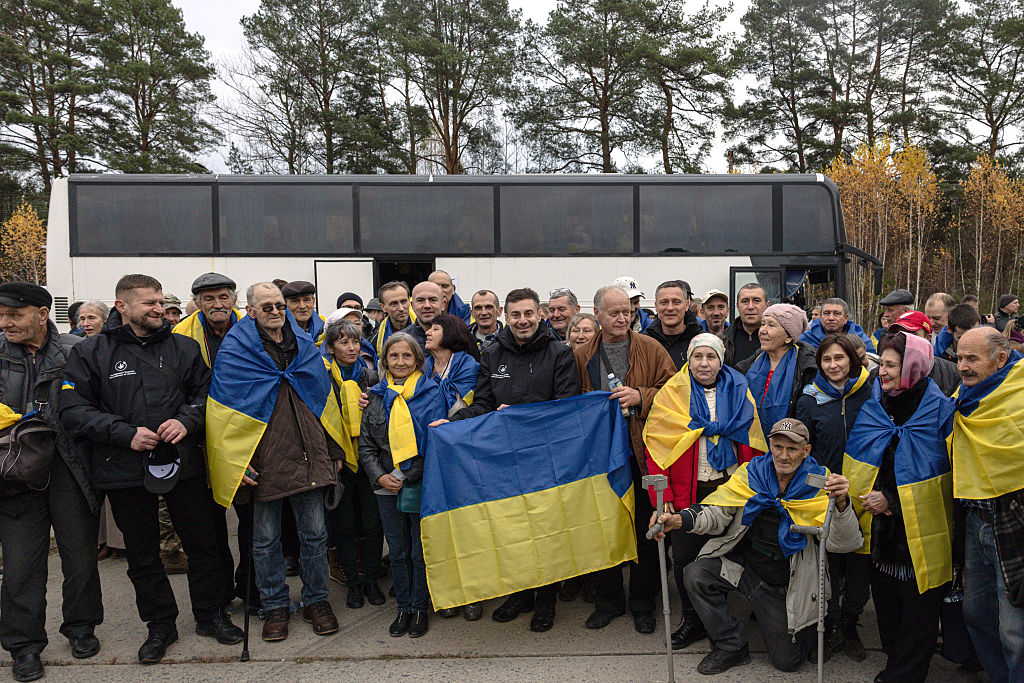
Elderly residents, a baby and hundreds of other civilians have been evacuated from the Russian-occupied town of Oleshky in a rare humanitarian operation. Some survivors say they were forced to eat grass and whatever they could find to stay alive.
Hundreds of exhausted and malnourished Ukrainians have returned to Ukrainian-controlled territory after escaping the Russian-occupied town of Oleshky, describing their ordeal as a journey out of “hell.”
The civilians crossed back into Ukraine under a rare, localized ceasefire designed to prevent a humanitarian catastrophe in the southern frontline community, where food supplies had virtually disappeared.
Among those returning was an elderly man in a wheelchair who said he had lost 20 kilograms over the past year and become so weak that he needed hospital treatment. Another evacuee, Svitlana Yermakova, described the desperate measures residents took to survive.
“We chopped grass and squash … just to hold on,” she said. She also recalled risking bicycle rides through minefields to reach a nearby village in search of food for herself and her dog, Manila.
The oldest person evacuated was 94, while the youngest was a baby just over one year old.
One elderly woman broke down in tears as she stepped off a bus carrying returning residents, telling reporters they had escaped from hell. She was greeted by another woman wrapped in Ukraine’s blue-and-yellow national flag, in one of several emotional reunions captured on camera.
A rescue operation across three countries
The arrivals followed a complicated, multi-stage rescue operation involving three countries. The humanitarian effort was facilitated with the involvement of US First Lady Melania Trump and came after appeals from Pope Leo XIV.
Because active military positions along the heavily fortified Dnipro River made a direct crossing impossible, the civilians had to take a lengthy route. They travelled by bus through Crimea to the Russian town of Anapa, then flew to Belarus before continuing toward Ukrainian-controlled territory.
A video released by Ukraine’s human rights ombudsman showed dozens of Oleshky residents slowly disembarking from an aircraft at an airfield in Belarus. Many were elderly, and some needed assistance walking. Others were transported on stretchers or in wheelchairs. Most carried only a small bag or two, while pets, including dogs in cages, were also brought along.
At a reception point in northern Ukraine, aid workers from the Red Cross, Doctors Without Borders and World Central Kitchen prepared heated tents, food stations and veterinary services for the returning residents.
Relatives gathered along the road, hoping to reunite with family members they had not seen in years.
Among them was 19-year-old Liza Paliy, who had been separated from her father for more than two and a half years. She and her mother and sister fled the occupied Kherson region early in the war, while her father remained behind to look after their home.
“We thought at that time that it would be a month, two maximum, and we would return, but unfortunately, two years have already passed,” Paliy said.
Nearby, Daria Pavlyn was waiting for news of her father, Mykhailo, with whom she had lost contact about a month earlier.
Her family had initially planned to escape together after an artillery strike killed two neighbours. But her father stayed behind to look after their property and animals. Eventually, he walked his family to the road.
“We realised that, well, there was no other way, and he walked us to the road and that was it — that was the last time,” Pavlyn said.
She added that her father had been afraid to make the journey alone because he did not have the documents required under Russian occupation.
It remained unclear whether either woman’s father was among those evacuated. Ukrainian authorities imposed strict reporting restrictions during the operation, refusing to disclose the exact number of people transported or the location of the border crossing.
Officials said the restrictions were necessary to protect residents who had chosen to remain in Oleshky and to preserve the security of possible future humanitarian corridors.
Melania Trump previously said on social media that the operation had been organized to safely evacuate more than 750 people. The precise number who have so far returned to Ukrainian-controlled territory has not been confirmed.
A town pushed to the brink
Oleshky lies on the Russian-occupied eastern bank of the Dnipro River, directly opposite the Ukrainian-controlled city of Kherson. The town has endured persistent shelling and intense drone surveillance.
Commercial supply routes collapsed entirely in May, leaving residents increasingly isolated and without reliable access to food and medicine.
Before Russia’s full-scale invasion, Oleshky had a population of approximately 24,000. Officials estimate that only between 1,700 and 2,000 people remained, most of them elderly or unable to leave without assistance.
The localized ceasefire took effect at 3 a.m. on Tuesday and was scheduled to remain in place until Sunday evening.
Residents were given three options: relocate to Russia, return to Ukrainian-controlled territory or remain in Oleshky with renewed deliveries of food and medical supplies.
Some chose to travel to Russia, while others decided to stay in the town despite the lack of gas, electricity and running water.
Ukraine’s human rights commissioner, Dmytro Lubinets, accompanied the evacuees during their journey. In a video recorded alongside passengers at the airport in Homel, Belarus, he said: “We will be home soon!”
Russian Human Rights Commissioner Yana Lantratova acknowledged that conditions in Oleshky remained difficult and said she would continue working with Lubinets to assist those who stayed.
“The mission has come to an end,” she wrote on Telegram. “We have agreed to carry out regular humanitarian missions, which is a very important step.”
For those who made it back, the operation meant more than simply crossing a border. It offered a chance to reunite with loved ones, receive medical care and begin rebuilding lives after months of isolation, hunger and fear.