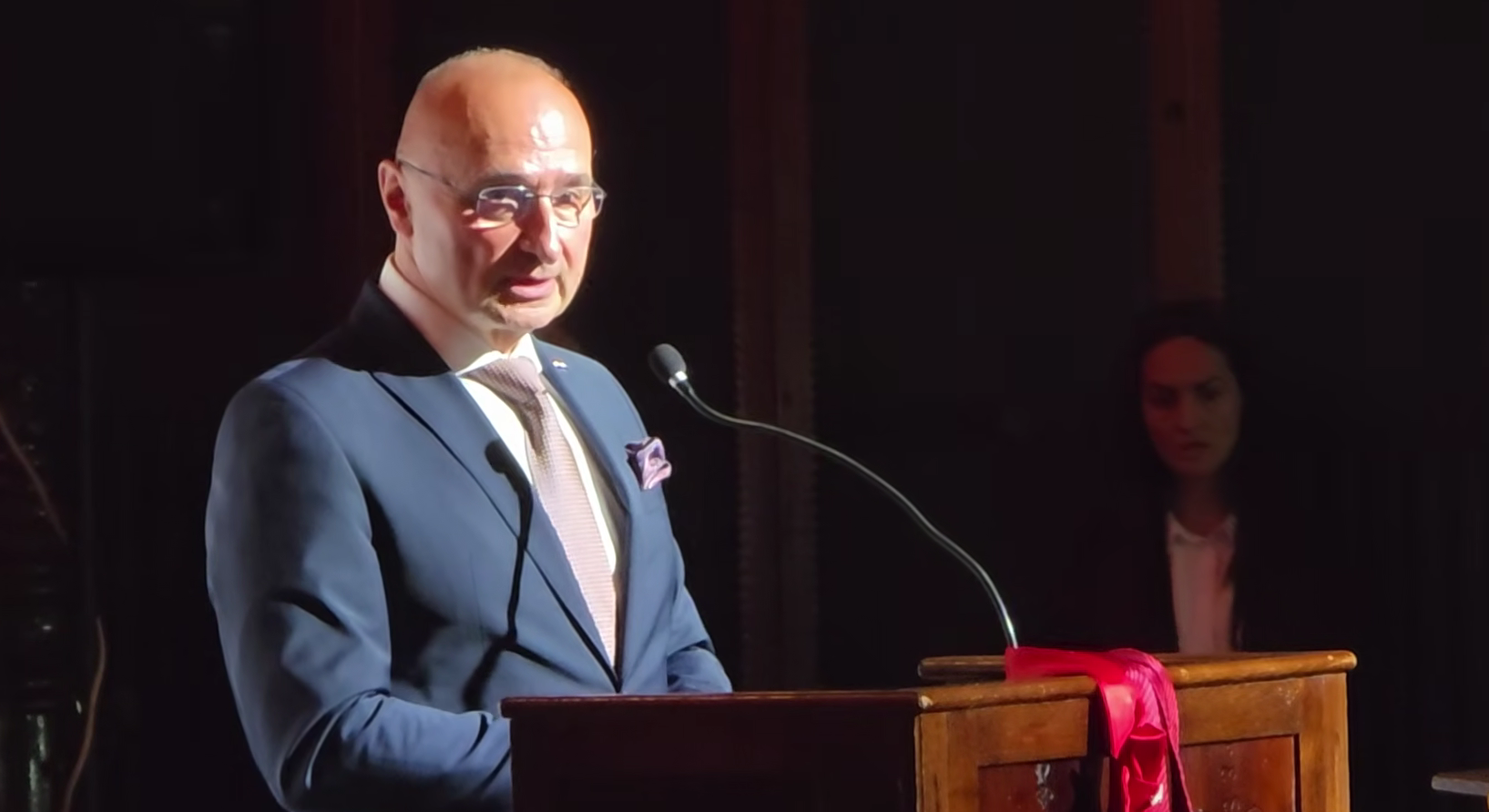
Croatian Foreign Minister Gordan Grlić Radman has reaffirmed Zagreb’s commitment to securing political equality for Croats in Bosnia and Herzegovina, saying his government will continue advocating for electoral reform and constitutional changes ahead of the October 2026 general elections. Speaking on the sidelines of a humanitarian event near Mostar, Grlić Radman criticized a recent conference organized by Bosnian Foreign Minister Elmedin Konaković in Sarajevo, arguing that it failed to address the central issue of electoral reform and did not represent a genuine international gathering because it was organized by Konaković’s party, Narod i pravda, without participation from representatives of the other constituent peoples.
The Sarajevo conference was held in response to a Croatian Parliament resolution adopted in July 2026 calling for greater political representation for Croats. At the meeting, Konaković argued that Bosniaks are underrepresented in state institutions while Croats hold more positions than their share of the population would warrant. Grlić Radman rejected that assessment and said it was regrettable that the conference did not focus on changes to the Election Law that could address what Zagreb considers discrimination in the electoral process.
The Croatian foreign minister also defended proposals for a separate electoral unit from which the Croat member of the Bosnia and Herzegovina Presidency would be elected. He argued that such a proposal should not be presented as an existential threat to the state, pointing to the Dayton Peace Agreement and its framework for political equality among the country’s three constituent peoples.
Electoral Reform Remains at the Center of Dispute
Grlić Radman also criticized the announced candidacy of Slaven Kovačević, a member of Željko Komšić’s Democratic Front, for the Croat seat on the Presidency. Kovačević, who has served as an adviser to Komšić, was endorsed by the DF after the European Court of Human Rights Grand Chamber dismissed his discrimination case in June 2025. Grlić Radman accused Kovačević of supporting unitarist objectives that would alter Bosnia and Herzegovina’s constitutional structure and weaken the principle of constituent peoples, warning that such changes could threaten political stability.
The issue is particularly contentious among Croat political parties because Komšić has won the Croat seat on the Presidency in four consecutive election cycles, largely with votes from predominantly Bosniak areas. His victories have fueled long-running demands among Croat parties for changes to the electoral system, while Bosniak political leaders and others have rejected proposals that they believe would create additional ethnic divisions within the state.
Grlić Radman’s comments come amid heightened diplomatic tensions following the Croatian Parliament’s July resolution, which passed with 83 votes and called on the government to support full political equality for Croats, including a separate electoral constituency. The resolution also condemned what Croatian lawmakers described as electoral engineering and the outvoting of Croat voters. Bosnian officials, including Presidency Chair Denis Bećirović, criticized the resolution as unacceptable interference, while Konaković announced plans for a separate meeting to examine the representation of the constituent peoples in state institutions.
Zagreb says it will continue its political, legal and diplomatic efforts to advance Croat equality while respecting Bosnia and Herzegovina’s sovereignty and territorial integrity. Grlić Radman also pledged to keep pressing international partners, particularly within the European Union and the United States, for limited constitutional changes and an overhaul of the Election Law. The dispute ensures that Croat equality in Bosnia and Herzegovina will remain one of the most sensitive political issues ahead of the 2026 elections.