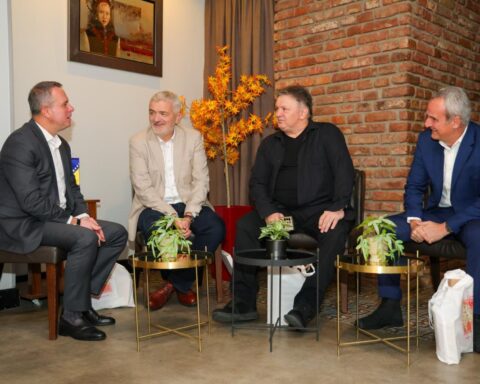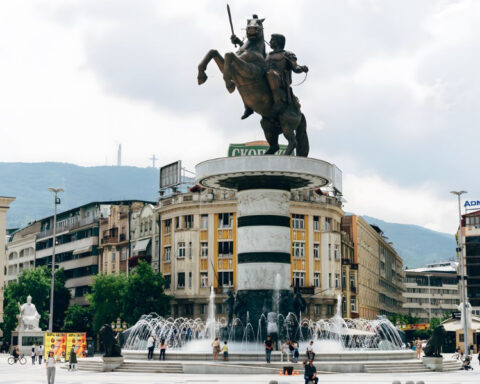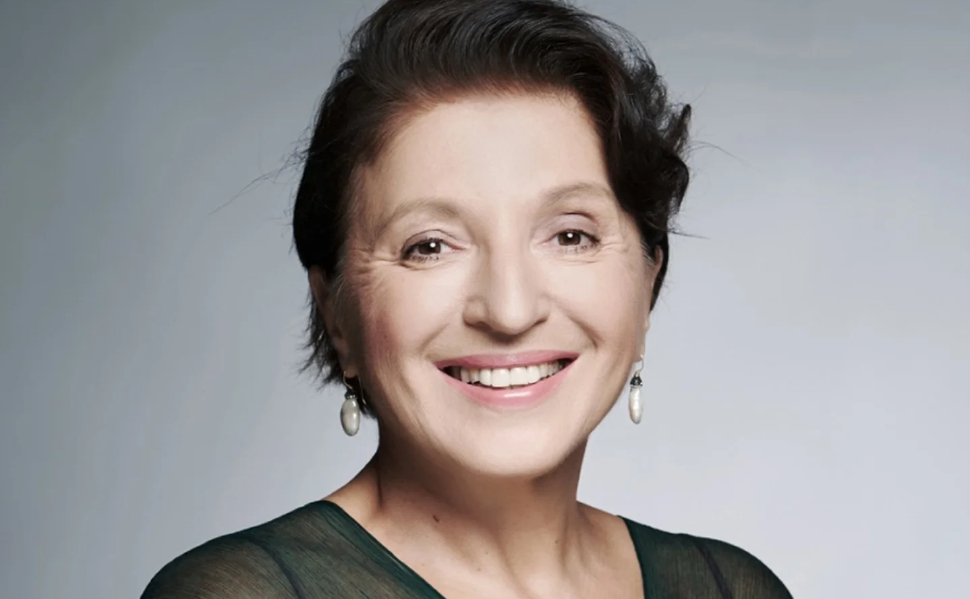
Serbian actor, producer and director Dragan Bjelogrlić delivered a powerful message to aspiring filmmakers during a masterclass at the Youth Cultural Center (MKC) in Skopje, held as part of this year’s Skopje Film Festival.
Bjelogrlić argued that every filmmaker must answer three fundamental questions: What is the film about? Who is it being made for? And how is the story being told?
He emphasized that filmmakers should not become so focused on international festivals and awards that they lose sight of the people they are ultimately trying to reach.
“When you make a film, you have to ask yourself what you are actually making it about, regardless of the subject you have chosen and why you chose it. The second question is: Who are you making the film for?” Bjelogrlić explained.
He said that while an artist may personally understand the motivation behind a project, a producer has a responsibility to ask who will actually watch it.
“When I make a film, I make it for my neighbors – electricians, plumbers, shop assistants. For those people. I often tell students that it is fine to present your film at Eurimages or at some festival, but tell the story to a plumber. Does that person find the story interesting? If you tell it to him and he doesn’t understand anything, then you have a problem,” he said.
According to Bjelogrlić, filmmakers should create stories that resonate with the people around them, their fellow citizens and the communities in which they live.
He acknowledged that making authentic films in smaller countries can be particularly challenging, as filmmakers often feel pressure to produce work that will appeal to international festivals.
“It is natural for people in small countries to make films for festivals, but that is already the first mistake. You cannot make a film simply so that it will be shown at a festival. What is that – a special genre? A festival film, like a horror film?” he said.
Bjelogrlić warned against trying to imagine what a Dutch, Swedish or German audience might want to see, arguing that the desire to please international audiences can undermine an artist’s authenticity.
For him, the three essential questions – what, for whom and how – should remain central throughout the entire filmmaking process.
‘Montevideo’ and the Art of Telling a Universal Story
Bjelogrlić also discussed his transition from acting and producing to directing, explaining how his approach to storytelling shaped some of his most successful projects.
He used his directorial debut, Montevideo, God Bless You!, as an example of how a film can reach audiences far beyond its apparent subject.
When he first developed the project, some people questioned whether a football film would attract only male viewers.
“They told me: ‘You’re making a film about football, so only men will watch it, not women.’ But it turned out that 70 percent of the audience were women,” he recalled.
He explained that the film was never simply about football.
“It is a melodrama, a romantic story, a fairy tale about times gone by and about making a dream come true,” Bjelogrlić said.
He believes that understanding the emotional core of a story is more important than trying to predict audience numbers or festival success.
‘Toma’ – A Story About a Singer, a Country and an Entire Era
Another major part of the masterclass focused on Toma, his acclaimed film about legendary Serbian singer Toma Zdravković.
Bjelogrlić admitted that he was not particularly interested in folk music before the project was brought to him. However, he quickly realized that the singer’s life could provide a way to tell a much bigger story.
“I am not someone who listens to folk music, but when they approached me with the idea for Toma, I realized that through the story of a singer I could tell the story of a time that no longer exists, of people who are no longer here, and of a country that no longer exists,” he explained.
He pointed out that Zdravković died in 1991, just as the wars that would lead to the breakup of Yugoslavia were beginning.
For Bjelogrlić, the singer’s death symbolically coincided with the end of an entire country, political system and way of life.
“Through Toma and his songs, I tried to tell that story. That was my main idea,” he said.
He described the film as an attempt to capture the atmosphere of former Yugoslavia and its socialist era – a period with many shortcomings, but also a certain carefree spirit, beauty and simplicity of everyday life.
From Actor to Director: A Journey Behind the Camera
Bjelogrlić also reflected on his early acting career and the moment he first considered becoming a director.
His first film role was as Sirogojno in Boško Buha. The film’s director, Branko Bauer, encouraged him to consider directing, telling him that one of his eyes always seemed to be behind the camera.
“That sentence stayed with me,” Bjelogrlić recalled.
Even after enrolling at the Faculty of Dramatic Arts, he was constantly developing story ideas and discussing the possibility of making films about his generation, rebellion and contemporary social issues.
One of those ideas eventually became The Black Bomber (Crni bombarder).
His interest in storytelling gradually led him into film production, although he initially lacked the confidence to consider directing himself.
In 1993, he traveled to the United States and spent two months in Los Angeles, exploring whether he could build a career there.
He eventually reached a different conclusion.
“I realized that if I wanted to work in acting, film and art in my own language, I had to work where I was born and tell stories from there – but try to tell stories that would be interesting to the entire world,” he said.
That philosophy later influenced projects such as Pretty Village, Pretty Flame (Lepa sela, lepo gore), a film set against the backdrop of the Bosnian War.
Bjelogrlić recalled that when the project was first developed, he assumed the war might be over by the time the screenplay was completed and financing secured.
He acknowledged that filming a story about an ongoing war, without the benefit of historical distance, involved enormous risks.
Looking back, he said he would not take the same risks today, with the experience and perspective he has gained over the years.
Nevertheless, he believes that taking creative risks can pay off when a project is executed with quality and conviction.
“Today, I Would Rather Direct Than Act”
Bjelogrlić revealed that directing has become a greater passion for him than acting, even though he still considers himself primarily an actor.
He has been directing for more than 15 years, and writing, developing stories and creating film projects have become his main professional passions.
“If you asked me today whether I would rather act or direct, I would immediately tell you that I would prefer to direct,” he said.
He also explained that he never formally attended film school to study directing. Instead, he learned through practical experience, working on films and observing every aspect of the filmmaking process.
With more than 100 film and television roles behind him, Bjelogrlić considers his acting career his education in directing.
His masterclass in Skopje offered aspiring filmmakers a perspective shaped by decades of experience: make films that are authentic, tell stories that matter to the people around you, and never lose sight of why you wanted to make a film in the first place.