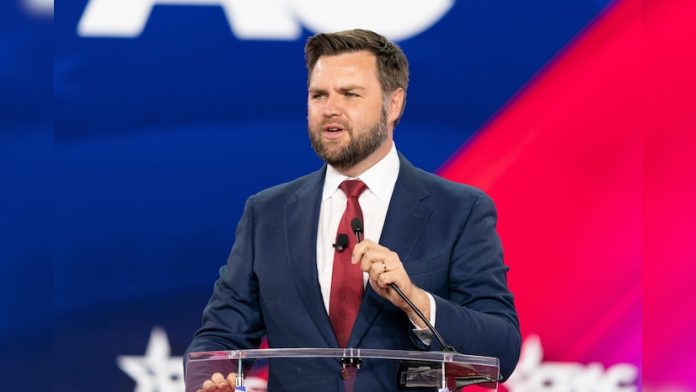
The upcoming midterm elections are shaping up to be more than just a battle for congressional control—they may also serve as a critical proving ground for Vice President JD Vance, who stands to gain significant political capital by campaigning aggressively for Republican candidates nationwide.
President Donald Trump has already made clear he intends to return to the campaign trail to defend the GOP’s narrow majorities in Congress, effectively treating the 2026 midterms as another referendum on his leadership after three consecutive presidential runs.
But while Trump brings star power, Vance brings money—and organization. As chairman of finance for the Republican National Committee, Vance plays a central role in fundraising during what is expected to be a fiercely competitive cycle. With history and current polling favoring Democrats, the GOP will rely heavily on its financial edge to stay competitive.
Republican operatives close to the White House told the Washington Examiner that Vance is expected to be in constant demand on the campaign trail, with one describing him as a “rock star” among donors and grassroots activists alike.
Vance has already been deployed as a key surrogate in the Trump administration’s affordability tour, an effort to counter Democratic messaging on inflation and the cost of living. He has also taken a prominent role defending the administration’s deportation policies, including after a fatal shooting in Minneapolis involving an immigration enforcement officer.
Still, the midterms present a daunting challenge. Democrats currently hold a 5.2-point advantage in polls measuring voter preference for control of Congress, according to the RealClearPolitics average. Trump’s job approval rating stands at 42.1% in the same polling aggregation, more than 13 points underwater.
History is also unkind to the party in power. Since 1938, the White House party has lost congressional seats in all but two midterm elections—once following the impeachment of President Bill Clinton and once after the September 11 terrorist attacks.
Republicans, however, believe they have reasons for optimism. The RNC entered the year with nearly $100 million more on hand than its Democratic counterparts, while Trump’s broader MAGA fundraising network is estimated to control a war chest of roughly $300 million. Party leaders are also banking on voter registration gains and what they describe as a Democratic shift further to the left.
For Vance, the stakes go beyond 2026. The relationships he builds—and the favors he earns—could prove invaluable if he decides to run for president in 2028. Potential Democratic contenders such as former Vice President Kamala Harris and California Governor Gavin Newsom are expected to pursue similar strategies this year with an eye on the next presidential cycle.
“The midterms are a chance for future presidential candidates to build relationships, test-drive messages, and sharpen their political teams,” said Republican strategist Alex Conant, a veteran of Marco Rubio’s 2016 campaign. “In this case, the means matter more than the ends. If Vance helps candidates this year, those relationships will pay off regardless of the final results.”
Vance has already headlined several major fundraisers and is expected to intensify his schedule in the coming weeks. His RNC role places him in direct contact with the party’s top donors, helping the Ohio populist build both a fundraising record and a powerful internal network.
“History shows the best approach is to visit as many congressional districts as possible and help colleagues win reelection,” said Republican strategist John Feehery. “By collecting chits, he builds alliances and support. Richard Nixon did it most famously, but every successful presidential candidate uses the midterms to expand their network.”
Nixon, who served as vice president under Dwight Eisenhower, later became the Republican nominee three times and won two terms in the White House—a path some see as instructive for Vance.
White House chief of staff Susie Wiles recently told the New York Post that Trump plans to campaign “like it’s 2024” and act as though he is personally on the ballot. Democrats are expected to do the same, ensuring the midterms double as a direct judgment on Trump’s presidency.
Vance, for his part, will not be a spectator. Within the administration, the approach to 2026 is clear: all hands on deck. Democrats are looking to build on last November’s victories and derail Trump’s legislative agenda, while Republicans see the midterms as both a defensive fight and an opportunity.
Once the ballots are counted, attention will quickly turn to 2028. GOP consultants say Vance could emerge from this cycle better positioned for both contests.
“He shouldn’t wait around for Trump’s endorsement,” Feehery told the Washington Examiner. “He should spend as much time as possible in early primary states. Don’t waste too much time in Washington.”