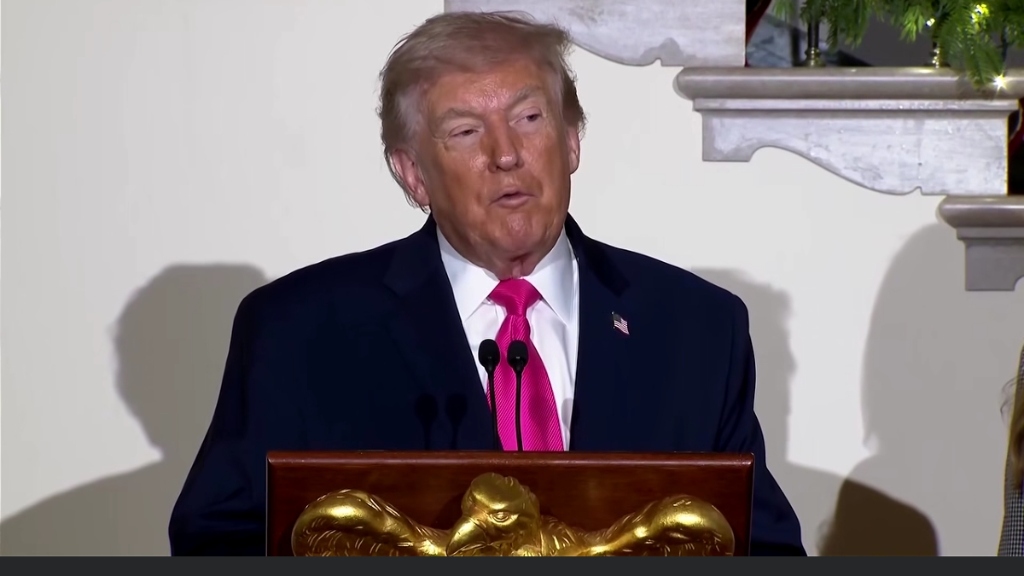
President Donald Trump delivered the longest State of the Union-style address in modern US history, using the speech to argue that the country is entering a “golden age” and that his economic agenda is working, while sharply attacking Democrats and highlighting immigration enforcement and national security. The address, reported as lasting roughly 1 hour 45–48 minutes (about 107 minutes), was marked by interruptions and visible partisan tension inside the chamber. Trump criticized a recent Supreme Court ruling that struck down key parts of his tariff policy and said he would pursue new tariffs under other legal authorities. He also issued stark warnings about Iran’s nuclear ambitions while mixing policy claims with highly symbolic moments, awards, and invited guests.
Record length, campaign-style tone, and disruptions in the chamber
Trump’s address was described as more like a campaign rally than a detailed policy presentation, with repeated political attacks and an atmosphere of open conflict. A Democratic lawmaker, Al Green, was removed after interrupting the speech, underscoring how combustible the event became. Inside the hall, Republicans repeatedly stood and applauded while Democrats largely remained seated, at times shouting back and interrupting.
Tariffs after the Supreme Court ruling: “Congress should do nothing.”
A central theme was Trump’s insistence that tariffs remain key to his economic program even after the Supreme Court overturned his “reciprocal” tariffs. He called the decision “unfortunate” and “disappointing” and said he would keep tariffs in place via alternative legal mechanisms—acknowledging a new approach might be more complicated but arguing it would be sustainable. In one of the most striking lines, he suggested tariffs “paid by foreign countries” could replace the income tax system, telling lawmakers they did not need to take action because “everything is already checked and approved.”
Economy, taxes, and consumer costs: competing claims
Trump claimed strong economic performance, citing lower inflation, cheaper fuel and record stock market levels, while also referencing his tax law and special accounts for newborns. At the same time, the coverage noted polling showing public skepticism about tariff management and continued concern over living costs, including estimates that tariffs add high yearly costs for households. The speech also previewed additional economic steps mentioned in reporting, including tax relief tied to tips and overtime pay and proposals related to children’s accounts and drug prices.
Immigration and a sharper confrontation with Democrats
Immigration repeatedly surfaced as a flashpoint. Trump challenged Democrats to support his framing that the government’s first duty is protecting US citizens rather than “illegal immigrants,” a moment that intensified partisan division in the chamber. Democratic lawmakers Ilhan Omar and Rashida Tlaib were reported shouting objections during the speech as Trump criticized immigrants, and the confrontation escalated after Trump told Democrats they “should be ashamed.” Trump also pushed election-related measures, calling for stricter voter identification through the “SAVE America Act” and arguing against mail voting without special reasons.
Iran’s warnings and claims about military actions
On foreign policy, Trump delivered one of his toughest messages on Iran, saying he would never allow Tehran to obtain nuclear weapons and suggesting the possibility of future strikes if no agreement is reached—while also saying he preferred a deal. Reporting also noted his references to US military actions and broader security claims, including operations in Iran and Venezuela, alongside assertions about border closure efforts and drug smuggling enforcement.
Health insurance, drug discounts, and a patriotic frame
Trump outlined a health insurance concept without detailed mechanics, saying he wanted to stop payments to large insurers and direct that money to people to buy “better and significantly cheaper” coverage, and he highlighted “TrumpRx,” described as a state platform for drug discounts for uninsured people. The speech also leaned heavily into symbolism tied to the upcoming 250th anniversary of US independence, featuring honors and medals for individuals including a 99-year-old World War II veteran and Coast Guard member Scott Ruskan, as well as a Medal of Honor moment for officer Erik Slover; the program included invited guests such as Olympic hockey gold medalists and multiple recognitions of veterans and active-duty service members.