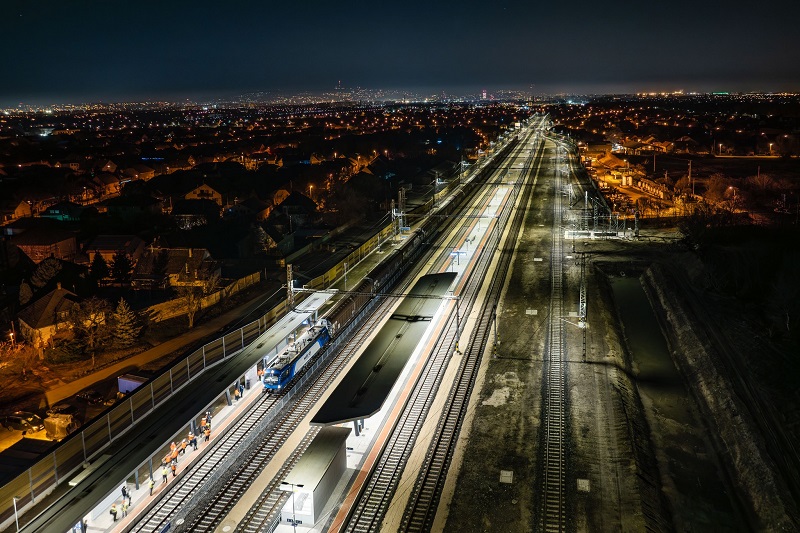
The upgraded Belgrade–Budapest railway connection has been officially put into operation, marked by the departure of the first freight train shortly after midnight and the start of regular traffic on the route. The initial service was operated by MAV Railtours, with reports noting a Siemens Vectron locomotive on the train, and officials said the freight runs will also serve as a real-world test phase ahead of the full resumption of passenger services.
Statements carried in regional coverage said the renewed Hungarian rail line—identified as Line 150—will be tested under daily freight operations before passenger trains are reintroduced, even though measurements and trials have already indicated the infrastructure meets safety and operational requirements for freight traffic. Zsolt Hegyi, head of Hungary’s rail operator MAV Group, described the reconstruction as one of the country’s largest rail investments in recent years, emphasizing that the project replaced an old, single-track line in poor condition with a modern double-track railway designed for speeds up to 160 km/h and equipped with contemporary passenger-oriented features.
Reports also linked the opening to broader regional infrastructure modernization. Coverage in Bosnia and North Macedonia described the Belgrade–Budapest connection as a significant upgrade for Central and Eastern Europe, while a separate international report noted that freight services on the Hungarian section resumed just after midnight, with the first train departing from Budapest’s Ferencváros station. The same report said that once the entire route is fully in service, travel time between the two capitals is expected to fall from roughly eight hours to about three and a half hours, underscoring the scale of the change compared with previous travel times.
In parallel, local reports in the region highlighted the expected passenger impact once full service begins. Several outlets reported that travel between Belgrade and Budapest is expected to take about 2 hours and 40 minutes when passenger operations resume. However, they differed on the exact ticket price: one report cited €25, while another cited €32. Both figures were presented as reported prices for a passenger ticket on the route once passenger trains start running, with passenger service described as following completion of testing under real operating conditions.
The same reporting framed the project as more than a single transport upgrade, describing it as a major cross-border rail investment and a key part of Serbia–Hungary connectivity. One account described it as a significant infrastructure investment in Central and Eastern Europe and linked it to broader cooperation among China, Serbia and Hungary under the Belt and Road Initiative, while also providing technical details on the Serbian section—reported as 183.1 km long, double-tracked, electrified, and designed for mixed traffic with a maximum speed up to 200 km/h.